




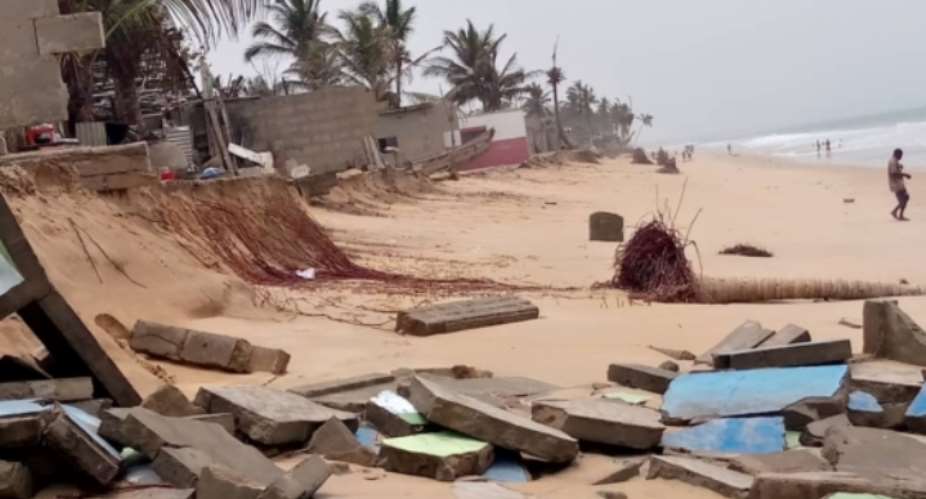
The coastal town of Keta, located in the Volta Region of Ghana, has a rich history marked by its strategic importance as a trading post and its ongoing battle against the relentless forces of nature. Over the centuries, Keta has faced significant challenges due to sea erosion and tidal waves, which have reshaped its landscape and impacted its communities.
HISTORICAL EVOLUTION OF KETA
Keta was originally settled by the Anlo Ewe people in the 17th century, who migrated from Ketu in Benin. The town became an important trading post between the 14th and late 20th centuries. Keta used to be the regional capital of the Volta Region. In the 18th century, Keta attracted the interest of European powers, including the Danes, who established Fort Prinzenstein in 1784. The fort played a significant role in the transatlantic slave trade.
Since the early 20th century, Keta has been subjected to severe sea erosion, which has led to the destruction of homes, infrastructure, and historical sites. The erosion has advanced significantly, threatening the town's existence. In recent years, tidal waves and sea erosion have continued to pose a threat to Keta, leading to widespread devastation and displacement of residents.
THE PERIL OF ANGRY SEAWAVES
Rogue waves, also known as freak waves, are large and unpredictable waves that can appear suddenly and with devastating force. They have been responsible for numerous maritime disasters and pose a significant threat to coastal communities. The recent tidal waves in Keta have caused extensive damage, destroying homes, submerging cemeteries, and endangering critical infrastructure. The disruption of fishing and economic activities has further exacerbated the situation.
The recent visit of Hon. James Gunu, the Volta Region Minister, to assess the impact of tidal waves in Agavedzi, Sallah Korfe, and Amutinu in the Ketu South District revealed widespread devastation. Approximately 232 houses have been destroyed, centuries-old cemeteries are submerged, and critical infrastructure such as pipelines, high tension poles, and roads are perilously close to the sea. The situation is further exacerbated by the disruption of fishing and economic activities, as well as the impact on schools in Afiadenyigba.
Hon. Eben Assah, Assembly Member for Agavedzi, underscored the urgent need for dredging and the continuation of the sea defence project, given the ineffectiveness of previous constructions. In response to the crisis, the Environmental Protection Agency (EPA) provided relief items, including food supplies, to support affected residents. CEO Prof. Naana Ama Browne Klutse assured that immediate measures, such as dredging and reinforcement of the sea defence, will be recommended to the Government. Minister Gunu reaffirmed his commitment to working with stakeholders to complete the sea defence project, restore clinic and hospital supplies, and provide temporary structures for displaced families. He emphasized that coastal protection is a priority, requiring swift action to prevent further destruction.
URGENT CALL TO ACTION: The Keta Port Project and Land Reclamation
The Keta Port Project aims to establish a modern port facility in Keta to enhance maritime trade, create jobs, and stimulate regional development. The project includes essential components such as dredging, land reclamation, and the construction of port infrastructure. The dredging of the Keta Lagoon for aquaculture is also a crucial part of this initiative. Estimated at $1 billion, the project involves multiple phases, with a targeted completion timeline of five years.
1. Phase 1 (Year 1-2): Feasibility studies, environmental assessments, and initial dredging activities.
2. Phase 2 (Year 3): Construction of basic port infrastructure, including quays, cargo handling facilities, and access roads.
3. Phase 3 (Year 4-5): Finalization of port infrastructure, operational testing, and commencement of port activities.
The land reclamation projects aim to restore degraded land, prevent soil erosion, and increase arable land for agriculture. These projects are crucial for promoting sustainable land use and improving the livelihoods of local communities. The estimated cost for land reclamation efforts is approximately $500 million, with a projected timeline of three years.
1. Phase 1 (Year 1): Identification of degraded land areas, environmental impact assessments, and initial reclamation activities.
2. Phase 2 (Year 2): Expansion of reclamation efforts, soil stabilization, and implementation of erosion control measures.
3. Phase 3 (Year 3): Completion of reclamation projects, restoration of vegetation, and monitoring of reclaimed land.
RECOMMENDATIONS AND SUGGESTIONS
1. Stakeholder Collaboration: Engage local communities, government agencies, and international partners to ensure inclusive and participatory project planning and implementation.
2. Financing Options: Explore diverse financing options, including government funding, public-private partnerships, international loans, and grants.
3. Regulatory Framework: Establish a robust regulatory framework to ensure compliance with international standards and environmental regulations. Implement policies to promote transparency and accountability in project management.
4. Technical Expertise: Collaborate with international experts and maritime engineers to ensure the successful execution of the Keta Port Project and land reclamation efforts.
CALL TO PRESIDENT MAHAMA AND SECTOR MINISTERS
President John Dramani Mahama, your administration has the opportunity to make a transformative impact on Ghana's coastal communities. The devastation caused by recent tidal waves demands swift and decisive action. I urge you and your sector ministers responsible for transport, environment, and infrastructure to prioritize the Keta Port Project and land reclamation efforts. These initiatives will not only protect vulnerable communities but also drive economic growth and sustainability.
CONCLUSION
To achieve these ambitious goals, it is essential for Ghanaian companies to form a conglomerate and secure funding for these critical projects. The Minister of Transport is encouraged to contact +233264140626 for free consultation on funding sources and navigating the complexities of project financing and implementation. As Chinua Achebe once wisely remarked, "One of the truest tests of integrity is its blunt refusal to be compromised." Fusaini Isah's Dogomba Wise Proverb reminds us, "A man does not abandon his old firewood until he has gathered new firewood." The Bible teaches us in Proverbs 12:1, "Whoever loves discipline loves knowledge, but whoever hates correction is stupid." Finally, as John F. Kennedy once said, "The best way to predict your future is to create it."
By committing to these projects, you can create a legacy of resilience and progress for Ghana. Together, we can build a more prosperous and well-protected nation.
Retired Senior Citizen
Teshie-Nungua
For the attention of:
Hon. James Gunu, the Volta Region Minister
Hon. Eben Assah, Assembly Member for Agavedzi


 Ms. Emelia Affi Agbenyo must honourably resign as new EC Deputy Chairperson to p...
 Why have US-Ukraine relations soured ahead of the midterms?
 Govt to meet Free Zones Authority, Trade Ministry over Customs Act concerns
 Kojo Bamba was never my driver or bodyguard — Nana B
 Ekow Assafuah petitions OSP to probe alleged World Cup visa facilitation irregul...
 Africa attracting wrong waste management solutions – GAIA report
 Summon Kofi Adams, GTA boss over 2026 World Cup visa scandal — NPP tells Parliam...
 Obuasi SHS headmaster accused of sexual abuse is NDC constituency secretary – Ma...
 Family demands answers over death of 14-year-old student at Abomosu STEM SHS
 Osahen Afenyo-Markin reflects on loneliness of public service, says survival is ...


