




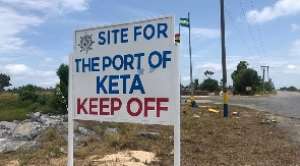
NAVIGATING CONTROVERSY: The Mismanagement of the Keta Port Project
INTRODUCTION:
The recent firing of the director of the Keta Port by President John Mahama has raised eyebrows and sparked discussions about the legality and ethics of such a decision. The public outcry stems from the fact that the Keta Port, which was supposed to be a significant infrastructure project, never materialized. This article aims to explore the legal implications of this decision, the international business practices regarding the appointment of port managers, and the broader context of financial mismanagement under the Akufo-Addo-Bawumia administration.
Legal Implications:
Legally, the question arises whether the director can be held accountable and required to refund his salary for a project that never came to fruition. While there is no international precedent for such a specific case, general principles of employment law and accountability would suggest that if the director was found to have been grossly negligent or engaged in misconduct, there could be grounds for legal action. However, the mere fact that the project did not materialize does not automatically imply wrongdoing on the part of the director.
International Business Practices:
Internationally, it is not a common practice to appoint a port manager when there is no port to manage. Effective port management involves strategic planning, infrastructure investment, and operational efficiency. Appointing a manager for a non-existent port goes against these principles and can be seen as a misallocation of resources. Best practices in port management emphasize the importance of having a clear, long-term vision and aligning port operations with regional economic goals.
Wrongdoing Under the Akufo-Addo-Bawumia Administration:
The Akufo-Addo-Bawumia administration has faced criticism for various instances of financial mismanagement, including the controversial Keta Port project. The decision to appoint a port manager for a non-existent port is seen as emblematic of broader issues within the administration, such as lack of transparency, poor planning, and potential political interference in financial decisions. These practices undermine public trust and hinder economic development.
Conclusion:
The firing of the Keta Port director highlights the need for good business practices and accountability in public projects. While the legal implications of requiring a refund for no work done are complex, the broader issue of financial mismanagement under the Akufo-Addo-Bawumia administration cannot be ignored. Moving forward, it is essential to adhere to international business practices and ensure transparency and accountability in all public projects.
Retired Senior Citizen
Teshie-Nungua


 Ms. Emelia Affi Agbenyo must honourably resign as new EC Deputy Chairperson to p...
 Why have US-Ukraine relations soured ahead of the midterms?
 Govt to meet Free Zones Authority, Trade Ministry over Customs Act concerns
 Kojo Bamba was never my driver or bodyguard — Nana B
 Ekow Assafuah petitions OSP to probe alleged World Cup visa facilitation irregul...
 Africa attracting wrong waste management solutions – GAIA report
 Summon Kofi Adams, GTA boss over 2026 World Cup visa scandal — NPP tells Parliam...
 Obuasi SHS headmaster accused of sexual abuse is NDC constituency secretary – Ma...
 Family demands answers over death of 14-year-old student at Abomosu STEM SHS
 Osahen Afenyo-Markin reflects on loneliness of public service, says survival is ...


