




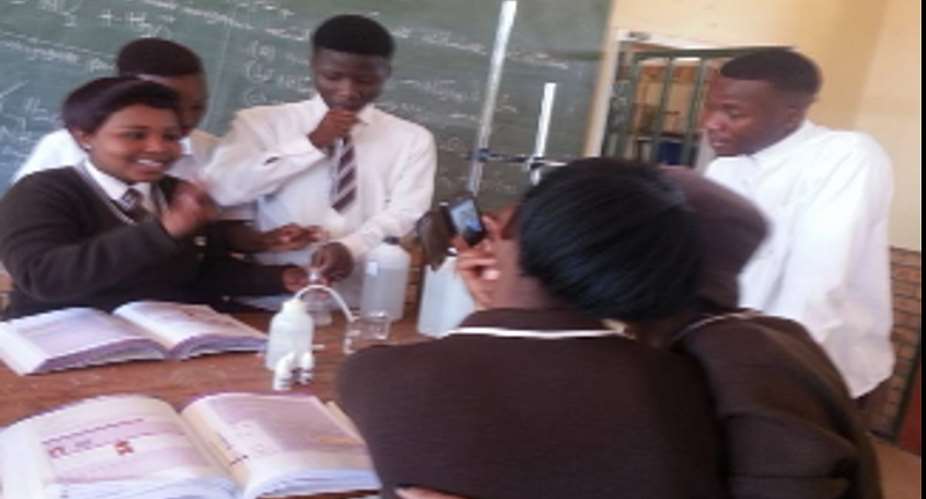
To ensure the preparation and production of qualified science teachers in Ghana, there must be a significant focus on science education in higher education. Given that STEM education plays a pivotal role in the advancement of countries during the fourth industrial revolution, it is imperative for Ghana's educational system to produce competent science teachers who can actively contribute to STEM education. This will also enable the creation of skilled science professionals who can help Ghana maintain its competitive edge.
Ghana has recently been the breeding ground for some of the world's most exceptional scientists, whose groundbreaking contributions have had a profound impact on society. Among these remarkable individuals is Dr. Thomas O. Mensah, a distinguished chemical engineer and inventor who played a pivotal role in advancing fiber optic manufacturing and nanotechnology and has 14 patents under his name. Additionally, we have Prof. Francis Allotey, whose development of the Allotey Formalism revolutionized our understanding of matter in space. Among others, we cannot overlook the significant contributions of Prof. Ewurama Addy, Ghana's first female natural science scientist, who has played a vital role in popularizing herbal medicine. These luminaries are just a few examples of the extraordinary science talent that Ghana has nurtured.
In Ghanaian high schools, a significant number of students are currently facing difficulties with science and mathematics subjects. Despite the recent increase in science and mathematics scores on the West African Examination Council (WAEC) exam, many students continue to struggle with these subjects. Several factors, including instructional methods employed by teachers, limited opportunities for experiments or practical work, and teachers' expertise in the subject matter, are all contributing to the decline in science performance and student enrollment in science and mathematics.
Lesson study is one of the best approaches for teaching science and mathematics that are now accessible. Since its introduction by Japan in the 1870s, lesson study has been utilized in numerous countries to improve the teaching and learning process. Lesson study is a type of classroom inquiry in which a group of teachers comes together to design, teach, observe, revise, and communicate the results of their lessons. Science and mathematics are taught in schools mostly through lesson study in developed countries like the United States, Canada, China, Japan, and the United Kingdom, where STEM education is widely accepted.
Since lesson study is a tool for teacher professional development, Ghana Education Service can conduct research and perform lesson study in schools in districts, municipalities, and metro areas that are classified as circuit, cluster, or zonal since it is a tool for teacher professional development. It can be relied upon by mathematics and science teachers to identify the appropriate Pedagogical Content Knowledge (PCK) to teach challenging topics in the science and mathematics classrooms.

 We provided assistance to US authorities in Asante Berko's conviction - OSP
 'Murdered car dealer called me lazy and useless’ — Two brothers arrested, confes...
 C/R: “It is an open secret" — Lawyer Obeng Nkum bemoans abysmal performance of R...
 University Administrators reactivate nationwide strike over pay disparities in p...
 August 10: Cedi sells at GHS12.45 on forex market, GHS11.77 on BoG interbank
 Hopeson Adorye given 48 hours to retract claim linking Ekow Ekow Assafuah to Gha...
 Criminal networks using advanced technology to facilitate operations - GIS boss

