




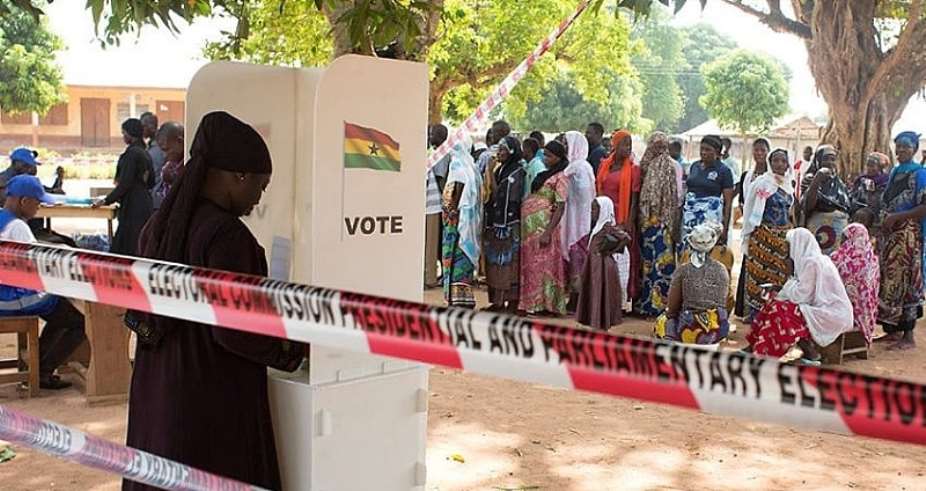
By now, this first week of December, with Ghana’s Election 2024 scheduled to take place on Saturday, December 7, doubtless everybody knows who they will vote for – or, even easier, who they will NOT vote for!
But does every would-be voter know how to vote, how to go through the correct process of what should be a simple of thumb printing in the allotted space on a ballot paper?
Unfortunately, from previous elections, the answer to the question is an emphatic ‘NO!’ The number of spoilt votes and rejected ballots, meaning votes that ended up in the statistics of votes that could not be counted, has consistently and shockingly made ‘Breaking News’ headlines.
This is why to my mind, this ‘finish hard’ week should be devoted mainly to teaching prospective voters HOW TO VOTE, HOW TO PLACE THEIR THUMB CORRECTLY ON THE BALLOT PAPER! The public education has to be a concerted affair, with practical demonstrations, especially in rural areas, of how the thumb mark is to be made on a ballot paper.
Interestingly, to their credit, it seems there is no hamlet or corner in Ghana that has not been visited by the candidates, including door-to-doors and visits to palaces, churches and mosques. Schools and markets have not been left out, either.
Also, the aspirants, both presidential and parliamentary, party members and independents, have all made known their policies. Additionally, the major pre-election activities, including the signing of a Peace Pact by the Presidential aspirants, have taken place or will do so in a day or two – final rallies, for example.
Nevertheless, in my view, something else remains to be done, the critical factor of ensuring that the voting, the actual placement of the voter’s thumb on the ballot paper will be done accurately.
Voters need to be taught, or reminded, of how to use their precious thumb print so that it adds to the total of votes for their preferred party or candidate, to avoid their votes ending up in the ‘Rejected’ statistics.
What is a Rejected Ballot? The Electoral Commission of Ghana (EC) explains:
“SPOILT/REJECTED BALLOT
“Those two cases arise under different circumstances. They mean different things so they cannot be used interchangeably.
“SPOILT BALLOT
A spoilt ballot refers to a ballot paper that has been handled in such a way that it is no longer suitable to be used for voting. A spoilt ballot does not go into the ballot box. …
REJECTED BALLOT
“Unlike the spoilt ballot, the rejected ballot is always found in the ballot box.
“It is a ballot paper which is handled by the voter in such a way that the choice of candidate or the voter’s intention cannot be ascertained such as:
- Failing to make a mark.
- The mark lies in two candidates’ boxes.
- The voter marked for more than one candidate …
- Voter tears ballot paper across.
- Voter writes his/her name on the ballot paper.”
Analysing the gravity of the subject, earlier this year, in a July 20 article, “Rejected Ballot: A misplaced power of the thumb”, Maxwell Awumah of the Ghana News Agency wrote:
“EC’s data has put rejected ballots since 1992 as follows: 1992 – 64,354 rejected ballots (3.02%); 1996 – 111,108 rejected ballots (1.53%); 2000 first run, 119,362 rejected ballots (1.8%) and the run-off – 104,214 rejected ballots (1.53%).
“Again, in 2004 – 188,123 rejected ballots (2.13%) were recorded; 2008 – 205,438 rejected ballots (2.4%) in the first round, 92,886 rejected ballots (1.02%); in the run-off, 2012 – 251,720 rejected ballots (2.3%); 2016 – 168,882 rejected ballots (1.54%); and 2020 – 313,397 rejected ballots (2.33%) of total votes cast.”
These figures appear to indicate that, unfortunately, candidates and parties don’t pay enough attention to ensuring that their supporters apply their thumb power correctly; inadequate voter education.
Naturally, the EC itself is concerned about the situation, hence it features on the Commission’s list of ‘ELECTORAL REFORM ITEMS’: “EC should take steps to reduce rejected ballots.”
Ghana’s literacy rate is supposed to be above 60 per cent, but sometimes one wonders! Evidently, from the statistics, despite contributors’ vocal and confident expression of political opinions on platforms, radio and TV, there is no room for complacency, no assumption that everyone who enters a voting booth will do the right thing.
Conceivably, as many observers have pointed out, some candidates could have done significantly better if some rejected ballots had been correct and added to their total.
It’s a subject that has often engaged the attention of many writers. The following is the introduction of an article I wrote in 2020:
“As Ghana enters the final phase of Election 2020, one nagging issue which should be engaging the serious attention of all the major players is the high incidence of rejected ballots recorded with each general election.” (published in the Mirror weekly, on November 21, 2020 under the headline, “No room for complacency: Teach people how to vote!”)
For the record, I have seen well crafted ‘how to vote’ videos for Election 2024, mainly by the EC and the National Commission for Civic Education (NCCE). The NCCE’s is titled, “DON’T LET YOUR VOTE BE REJECTED”; and the EC has “MAKE YOUR VOTE COUNT”, including ‘VOTE CORRECTLY’ in print media.
There are also some by both the ruling New Patriotic Party and the main opposition party, the National Democratic Congress. The Ghana Police TV’s ‘Police Election Security Watch’ too, includes ‘how to vote’, as well as election do’s and don’ts in English and some Ghanaian languages.
However, it seems there is need for a massive offensive this eve of Election 2024, viewed as a ‘do or die’ poll. Thus much more needs to be done about publicising the videos, and adding more print media ones, as those appear to be few.
Moreover, emphasis needs to be put on the importance of voters checking that the ballot paper they are given has the EC’s stamp at the back. Some of the demonstrations neglect this mandatory requirement.
Furthermore, I think that although voter education is shared by the NCCE and the EC, surely the political parties and the candidates have more to gain if rejected ballots reduce substantially or, wishful thinking, are eliminated altogether, they being the beneficiaries of the added votes.
Fortunately, Ghana has the reputation of being one of the continental leaders in mobile phone and social media usage. So it should be cost effective for parties and candidates to invest in sustained ‘how to vote’ messages this week, on more social media platforms, from dawn to dusk, before the ‘D-Day’.
My abiding question for the political parties and the aspirants is: of what use is all your effort and expense if a voter ends up with a rejected ballot meant for you?
Thus to me, these last few days should see intensified coaching by all the parties and the candidates, either through first time demonstrations or refresher lessons, simply on HOW TO VOTE.
Everything needs to be done to prevent in 2024 yet another flood of ‘Rejected Ballots Breaking News’.
XXXXX

 FDA seizes over 2,100 banned alcoholic energy drinks in Western North Region
 You have shown the world how to blend traditional leadership and modern statecra...
 Mahama tells Asantehene he has made Ghana peaceful and stronger
 Retired military officers urge Mahama to appoint army general with martial law p...
 VIP Jeoun petitions police, NRSA to sanction drivers of broken-down vehicles lin...
 Verify residence permits before renting to foreigners — GIS warns landlords
 Nigerian airlines avert shutdown as Mideast war hikes fuel prices
 Cedi ends April 2026 selling at GHS12.15 on forex market, GHS11.20 on BoG interb...
 Gov’t behind Angel Maxine’s attack on me due to my anti-gay bill comments — Ntim...
 Government has deceived law students with u-turn on entrance exams — Ekow Assafu...


