




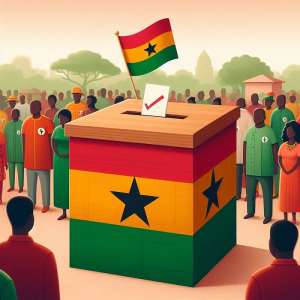
Ghana, often hailed as a beacon of democracy in West Africa, has a rich and complex electoral history. Since gaining independence in 1957, the nation has experienced a series of democratic transitions, military coups, and significant political reforms. This article provides a detailed account of every election ever held in Ghana, highlighting the key events and milestones shaping the country's political landscape.
Colonial Era and Early Elections
During the colonial era, the right to vote was highly restricted. The first legislative council election took place in 1925, but only a privileged few had the right to vote. These early elections were characterized by limited voting, with only property owners and urban residents participating. The 1951 Gold Coast general election was a significant turning point, as it was the first in Africa to be held under universal suffrage. Kwame Nkrumah's Convention People's Party (CPP) won a majority of the seats, paving the way for Ghana's independence.
Post-Independence Elections
After gaining independence in 1957, Ghana held its first parliamentary elections in 1956, which were crucial in establishing the new nation's political framework. The CPP, led by Nkrumah, won a decisive victory, and Nkrumah became the first Prime Minister of Ghana. However, the subsequent years were marked by political instability, with several military coups disrupting the democratic process. These were the 1st, 2nd and 3rd Republic eras.
The Fourth Republic and Democratic Consolidation
The return to democratic rule began in the early 1990s, culminating in the 1992 elections. These elections marked a significant turning point, as they reinstated civilian rule and set a precedent for the peaceful transfer of power. The 2000 elections were particularly noteworthy, as they saw the first peaceful transfer of power between rival parties, further solidifying Ghana's commitment to democracy. The New Patriotic Party presidential candidate, John Kofi Agyekum Kufuor (born 8 December 1938), took over from Jerry John Rawlings (22 June 1947 – 12 November 2020) of the National Democratic Congress. After eight years, the NDC’s flagbearer, John Evans Fiifi Atta Mills (21 July 1944 – 24 July 2012), won the elections and became the third president of the Fourth Republic in January 2009. However, Mills could not complete the first four years of his tenure - he died on 24 July 2012 at the 37 Military Hospital in Accra, three days after his 68th birthday. Vice President, John Dramani Mahama (born 29 November 1958), was sworn in to complete his boss’ four-year rule. John Mahama won the presidential elections held on 7th December 2012 and became Ghana’s 4th president of the 4th Republic until 2016.
Recent Elections and Current Political Landscape
In recent years, Ghana has continued to hold regular elections, with the 2016 and 2020 elections being pivotal moments. These elections revealed a populace increasingly vocal about their dissatisfaction with the political elite, demanding greater accountability from their leaders. The NPP recaptured political power through the ballot box, with Nana Addo Dankwa Akufo-Addo (born 29 March 1944) becoming Ghana’s fifth president of the Fourth Republic. He will step down on 7th December 2024 having ruled for eight uninterrupted years.
As Ghana approaches the December 7 2024 elections, the historical context underscores the electorate's unwavering resolve to shape its future. Former President John Dramani Mahama of the National Democratic Congress will be battling it out with the incumbent Vice President, Mahamudu Bawumia (born 7 October 1963), representing the New Patriotic Party. The Electoral Commission Ghana will conduct a special voting exercise in 14 of 16 regions on Monday, December 2. The Electoral body rescheduled the exercise in Eastern and Western regions for Thursday, 5th December 2024, following a security breach leading to the tempering of ballot papers after reprinting new ones. Whoever wins the 2024 elections, except John Dramani Mahama, will stand the chance to be reelected. Security officials, media personnel and other stakeholders with special duties will participate in the special voting exercise.
Chapter 8, Article 62 of Ghana’s 1992 constitution stipulates that the president serves only two terms, each lasting four years, whether successive or separated.
Past and Present Ghana Electoral Commission Chairpersons
Chairman - Jean Adukwei Mensa - August 2018 – present
Chairman - Charlotte Osei: June 2015 – June 2018
Chairman - Kwadwo Afari-Gyan: 1993 – June 2015
Chairman - Josiah Ofori Boateng: 1992 - 1993
Chairman - Joseph Kingsley-Nyinah: 1978 - 1981
Chairman - Isaac Abban: 1978
Chairman - G. A. K. Bonsu: 1971 - 1972
Chairman - V. C. R. A. C. Crabbe: 1968 - 1971
Conclusion
Ghana's electoral history is a testament to the nation's resilience and commitment to democracy. From the early days of restricted suffrage to the present era of regular, peaceful elections, Ghana has made significant strides in its political journey. As the country prepares for the 2024 elections, the lessons of the past will undoubtedly continue to shape its democratic future.
With additional information from CV News, GhanaWeb, Wikipedia, Edinah Nyakey, Dominic Prince Amenyenu, Hilarious Godsway Adifli, Samuel Goka, Eric Boadu, Emmanuel A. K. Gbadey, Emmanuella Sunu, Dr. Albert Hagan, and Dr. Amos Oppong.


 SkyTrain trial: High Court adjourns case management conference to October 19
 Edudzi Tameklo recalls how Duffuor was slapped with GH¢100 million bail in 2020,...
 About 800 Director I and II applicants unreachable due to invalid contact number...
 'Boakye Agyarko was seen as anti-Bawumia' – Lecturer on John Boadu’s victory
 'NPP delegates made wrong choice electing John Boadu as chairman' — Political Sc...
 MTN Ghana secures new 5G spectrum in 700 MHz and 3 GHz bands
 Bawumia explains NPP hunt for winnable parliamentary candidates, not deep-pocket...
 Ghana to tap Egypt’s expertise for new capital city, housing projects – Mahama
 Ghana, Egypt deepen cooperation in health, defence and housing
 NDC Women’s Organiser Abigail Mensah condemns alleged pepper spray plot by Hawa ...


