




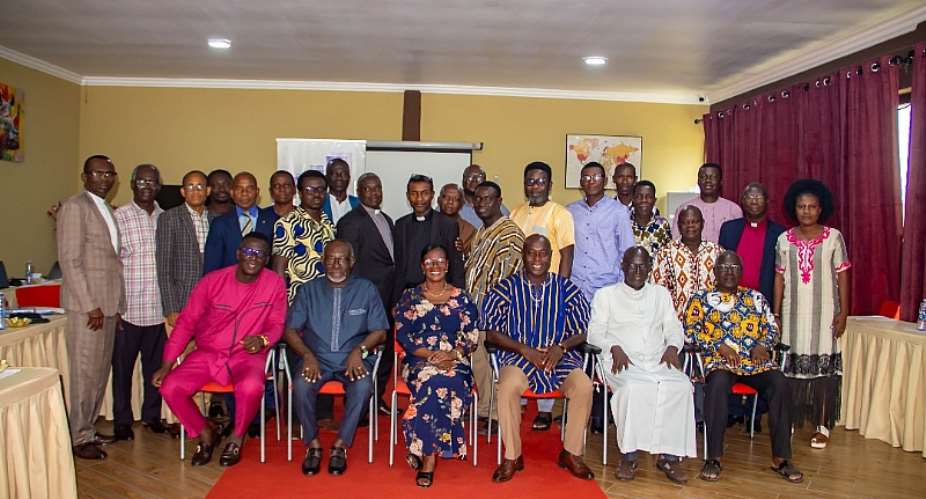
Some religious and faith-based leaders in the Western Region have expressed their utter shock and dismay about the contents of the Human Sexual Rights and Family Values Bill, otherwise known as the anti-gay bill.
Even though they had taken a stance on the Bill, they had not seen or read it and were therefore surprised about the contents of the Bill when they were taken through it – clause by clause – for the first time.
“I am completely saddened to realise that this is what is contained in the Human Sexual Rights and Family Values Bill, no wonder it is shrouded with so many controversies and legal battles,” said a Reverend Minister on conditions of anonymity during an interview in Takoradi.
According to him, he cannot comprehend how the country’s legislators would approve such a Bill and expect it to be binding on everyone in the country without considering its implications on some other minority groups in society.
He was speaking on the sidelines of a two-day social dialogue with religious and faith-based leaders on human rights and rights-based approaches to protecting and respecting the rights of sexual minorities in Ghana.
It was organised by the Ghana Center for Democratic Development (CDD-Ghana), an independent, not-for-profit research and advocacy think tank, working to advance democracy, good governance, and inclusive economic growth.
The religious and faith-based leaders, who had access to the contents of the Bill for the first time during the session, contended that the Bill, as it stands now, appears to be politically motivated and that the personal interests of those behind it have overshadowed the national interest, further discussions on the various clauses on the Bill before a final determination on the issue is made.
In separate interviews on the sidelines of the programme, most of the participants added their voices to the call for further conversations around the Human Sexual Rights and Family Values Bill, also called the anti-gay Bill, to ensure that the fundamental human rights of people are not violated on the altar of a new legislation.
They believe that the Bill must be thoroughly looked at again to ensure that people’s basic rights are not infringed upon flagrantly, adding that some portions of the bill appear to be sentimental and do not seem to be accommodating the fundamental human rights of a section of the populace.
“There are things we think that we know but we do not know. This programme has really enlightened me about the freedoms and rights of people. Sometimes, you may be pursuing a certain agenda, but you may overlook the rights that some people have. But if we have a clear understanding of other people's rights, then we will do well to protect them even though we have an agenda to pursue,” Rev Dr. Joseph Appiah Asamoah, the Chairperson of the Western Presbytery of the Presbyterian Church of Ghana said.
For his part, Bishop Daniel Bright Karikari of the Porters Victory Chapel noted that the social dialogue was very useful as it has broadened their horizon on the fundamental human rights of all, irrespective of one’s religion, tribe, or background.
Addressing the participants during the session, Dr. Michael Augustus Akagbor, Senior Programmes Officer of CDD Ghana, took the participants through basic understanding of human rights and the need to respect the rights of the minority in society.
He explained that fundamental human rights cannot be contingent on people’s sexuality and should never be at the discretion of any legislation and added that every effort must be made to always protect the rights of the minority.
Mr. William Nyarko, the Executive Director of the Africa Center for International Law and accountability (ACILA) explained the various clauses of the Human Sexual Rights and Family Values Bill, which has been passed by Parliament but yet to be assented to by the President.
According to him, Ghana’s 1992 Constitution guarantees the rights of all citizens, irrespective of their sexual orientation, religion, ethnic background or socioeconomic status and that Ghana has ratified several conventions on fundamental human rights, making it unacceptable for any legislation that violates the rights of any group of people to be introduced in the country.

 Court of Appeal indefinitely adjourns Hanan Abdul-Wahab’s appeal over NAFCO char...
 “Even though macro indicators are well, see my pocket; there's no money” – Steph...
 33 manufacturing firms, 12 oil marketers join Ghana’s 24-hour Economy programme ...
 ACP Odonkor cautions police against hiding behind containers to intercept motorb...
 University of Ghana Enterprises cites GH¢70million debt as reason GH¢8,000 Legon...
 Parliament committee demands independent probe into deadly Manso Keniago clash
 Why Ukraine keeps trying to bring down Russia's bridge to Crimea
 Bank of Ghana cuts policy rate to 11% as economic conditions improve
 $60m presidential jet could save Ghana up to $2m annually in charter costs – Nkr...
 August 6 helicopter crash should end politicisation of presidential jet purchase...


