




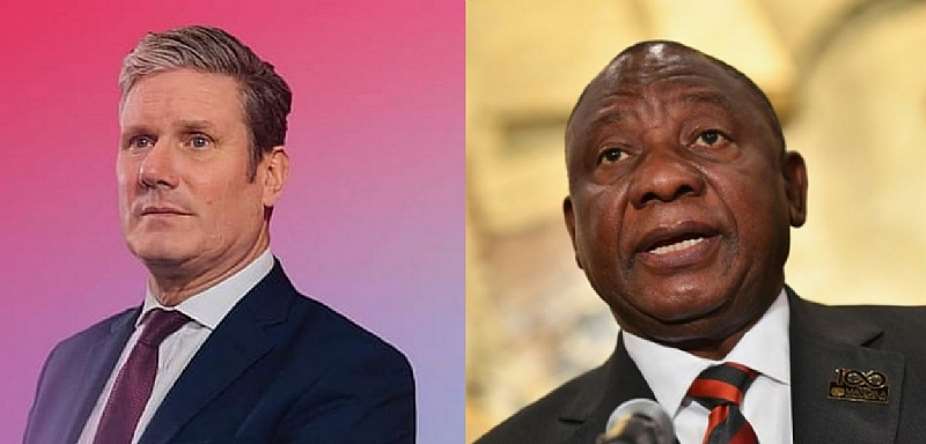
British Prime Minister Sir Keir Starmer would have only just settled in his new chair at 10 Downing Street when, on Sunday, 7 July, he placed a call to Pretoria. It marked the first official communication between Starmer and President Cyril Ramaphosa since the South African leader's visit to the UK-SA Business Forum at Lancaster House in 2022 – a meeting that celebrated the transformative potential of trade, investment, and innovation between the two nations.
During that call, both leaders underscored their shared commitment to deepening bilateral cooperation in pursuit of shared economic prosperity and addressing global challenges through robust multilateral engagement.
This is significant, as Starmer’s Labour Party has previously acknowledged the rising political and economic significance of African nations, pledging in its manifesto to adopt a renewed strategy towards the continent that cultivates opportunities for mutual long-term benefit.
But this is no easy task.
Britain’s recent preoccupation with Europe and the Indo-Pacific has pushed Africa to the margins of its foreign policy agenda: the perceived absence of substantial support during the Covid-19 pandemic, repeated shortfalls in climate finance commitments, and reductions in bilateral development funding have fostered a sense of disengagement, compounded by the fact that no UK cabinet minister has set foot in South Africa – its largest trading partner on the continent, accounting for almost a third of all its trade with Africa – since 2018.
Meanwhile, African countries are realigning their geopolitical and economic priorities, seeking partnerships that resonate with their developmental agendas and the broader aspirations of the Global South. South Africa, for example, continues to play an active role in various global bodies, to enable and influence economic activity.
For Britain to remain relevant in Africa’s economic future, there is an opportunity to recognise South Africa not just as a trading partner, but as a gateway to a more interconnected and influential network of emerging economies.
The foundation of such a relationship is already intact.
In the four quarters leading up to the end of Q1 2024, total trade in goods and services between the two nations reached a notable £10.3 billion: with UK exports to South Africa amounting to £4.5 billion and imports from South Africa surpassing this at £5.8 billion. By 2023, nearly 11,000 UK businesses were actively trading with South Africa.
Additionally, the economic corridor between the two nations saw £21.5 billion in foreign direct investment flow from Britain to South Africa in 2021.
Development Finance Institutions (DFIs) have also been pivotal in fostering economic partnerships and driving sustainable growth initiatives between the two countries. Since 1995, British International Investment (BII) has invested over $2 billion in at least 150 South African businesses, supporting more than 54,500 jobs annually since 2014, with its portfolio value in the country reaching approximately $285 million by the end of 2022.
To translate this robust foundation into a truly strategic partnership, the UK can embrace a proactive, long-term approach. This means prioritising joint ventures in future-fit sectors pivotal to South Africa’s development, such as renewable energy, health, infrastructure, and digital technology.
The blueprint for this already exists in the UK’s Strategy for International Development (IDS), reiterated in the Integrated Review Refresh (IR23) published last year – and it mirrors South Africa’s National Development Plan (NDP) more closely than one might expect. The NDP envisions a just transition to a low-carbon, climate-resilient economy, fostering inclusive and sustainable economic growth, strengthening health systems, and promoting gender equality and women’s rights. Similarly, the IDS commits to delivering honest and reliable investment to support sustainable economic growth, empowering women and girls, and addressing global challenges like climate change, nature conservation, and global health.
With both countries charting similar paths, there is a clear mandate for the UK to move from rhetoric to implementation. Financial institutions, particularly banks with established operations in both regions, are uniquely positioned to serve as catalysts in this process.
Their expertise in navigating complex regulatory frameworks and local market dynamics enables them to craft tailored financial solutions that address the intricacies of cross-border trade, while their access to diverse capital sources supports advanced investment strategies and specialised vehicles that de-risk high-growth sectors, directing capital into areas essential for sustainable development. Crucially, for small and medium-sized enterprises – the lifeblood of African economies – these banks offer tailored financial products and digital platforms that streamline payments, enhance liquidity, and improve risk assessments through instruments specifically designed for the unique needs of various industries and regions.
Many of these capabilities and the potential of such partnerships came under the spotlight at the South African Business Showcase in London recently, where a high-level delegation, including senior South African government officials, actively engaged in discussions to strengthen economic ties and explore new avenues for collaboration.
It marked the first occasion that senior cabinet representatives from the country’s newly established Government of National Unity engaged with UK counterparts on British soil. This convergence of new political leadership on both parts presents a rare opportunity to reset the bilateral agenda.
To seize it, the UK can enhance its prioritisation of Africa in its foreign policy, and South Africa should leverage this renewed focus to drive tangible economic and strategic outcomes. Only through concrete commitments and targeted investments can both nations forge a partnership that delivers real impact. This means creating clear policy roadmaps that prioritise innovation, infrastructure, and skills development, while ensuring that trade and investment flows are mutually beneficial and geared towards long-term economic resilience and growth.
Charles Russon, Interim Chief Executive Officer at Absa Group

 One dead, 14 seriously injured in Akuse-Akosombo Highway crash
 Dr. Bawumia meets TUC leadership to discuss living wage, jobs and pensions
 Bagbin calls for private member's bill for professional certification, charterin...
 Lands Commission to invest GHS1.8 billion in land administration reforms
 Israel election: Record turnout as Netanyahu and Eisenkot remain deadlocked
 'Ghana Airways will be back in the air before I leave office' — Ghana's Presiden...
 'You can’t make money in journalism' — Speaker Bagbin
 GES sets November 16 date for payment of 2025 promotion arrears
 Wontumi’s lawyers seek recall of prosecution witness in illegal mining case
 Minority urges independent audit of GHS49.7m South Africa evacuation


