




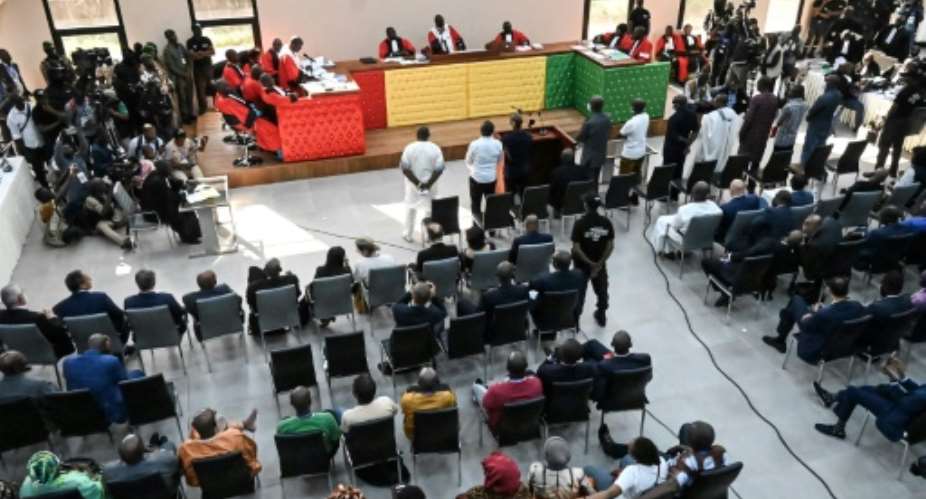
The trial of Guinea's former dictator Moussa Dadis Camara and 10 other ex-officials over a 2009 massacre was suspended Monday after lawyers launched a boycott demanding to be paid, an AFP reporter said.
The court adjourned the hearing until next week, according to the reporter, who was himself due to give testimony in the eight-month-old trial.
A lawyers' collective that includes those representing Camara had given authorities until Monday to meet their demands.
They want aid for their clients to pay for their defence, the creation of a fund to cover lawyers' fees and improved working conditions in the courtroom.
In a letter to the justice ministry on May 17 outlining their ultimatum, the lawyers said their clients were "without income" and unable to meet their obligations towards their lawyers.
Their law firms are "in decline, which could lead to their closure," they said.
A new letter addressed to the judge on Monday said the collective's demands had not been met and announced "the suspension of (its) participation" in the trial.
Camara and 10 other former military and government officials stand accused over the killing of 156 people and the rape of at least 109 women by pro-junta forces at an opposition rally in a Conakry stadium in September 2009.
They face charges ranging from murder to sexual violence, kidnappings, arson and looting.
Alseny Sall, spokesman for the Guinean Organisation for the Defence of Human Rights, called the trial's suspension "very concerning."
"It would be a great pity if this trial, which has raised so much hope that goes beyond the victims and Guinea itself, to stop now for funding reasons," he said.
At the time an unknown army captain, Camara seized power in December 2008 shortly after the death of Guinea's second post-independence president, General Lansana Conte, who had ruled for 24 years.
In December 2009, Camara was shot in the head by his own aide, Sidiki Diakite, amid disputes over who was to blame for the massacre. He headed to Morocco for medical treatment.
Camara fled into exile in Burkina Faso, where he was indicted in July 2015 by Guinean magistrates for his alleged role in the stadium massacre.
He has denied ordering the slaughter.
He was detained on September 27, a day before the trial began in a purpose-built court in Conakry.


 How IGP Yohuno led Police team to rescue victim, arrest four kidnappers in Assin...
 Akufo-Addo would have used Accra-Kumasi expressway for galamsey – Mahdi Gibrill
 Nigeria's Dangote refinery launches continent's biggest IPO
 Accra-Kumasi Expressway to cut travel time to 2hours, drive 120km per hour — Mah...
 'Our own money $2billion ready, we have not gone to borrow money from anywhere' ...
 Founder’s Day September 21 declared public holiday
 Council of State was not qualified to determine prima facie case against Torkorn...
 'Grounds for removal of Chief Justice and justice of superior court shallow, eph...
 Don't be a Bar that flips on principles but a Bar that is consistent — AG tells ...
 Prostate cancer may show no symptoms until advanced stage – Urologist warns


