




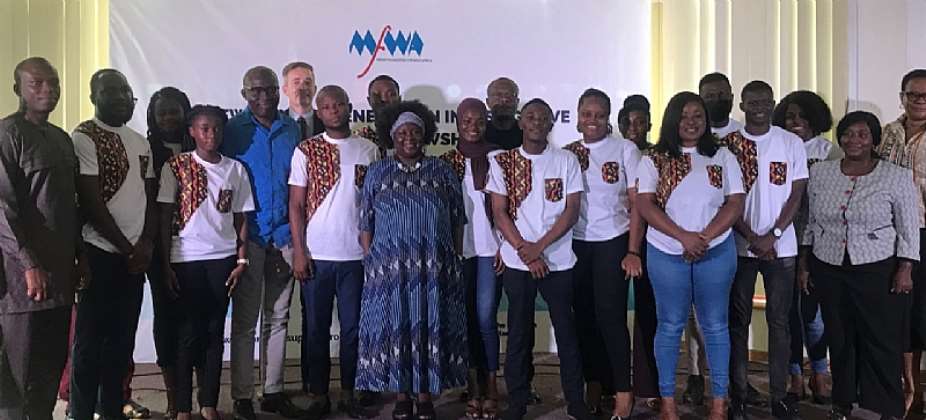
The Media Foundation for West Africa (MFWA) has given certification to 13 journalists from Ghana, Liberia, and Sierra Leone after completing the second edition of its Next Generation Investigative Journalism Fellowship (NGIJ 2022).
The cohort had 13 young journalists being selected from close to 200 applicants from Ghana, Liberia, and Sierra Leone.
The first edition of the Fellowship was rolled out in October 2021 with 10 Fellows who successfully completed the Fellowship in March 2022. The 10 Fellows who made it to the first cohort were all from Ghana.
The second edition of the Fellowship started in August and has come to an end this month.
Through the hard work of the young journalists in the five-month training and mentorship, they have all been certified today by the Media Foundation for West Africa at the closing ceremony.
At a closing ceremony held at the Kofi Annan ICT Centre for Excellence on Tuesday, December 20, all 13 participants were presented with Certificates of Honour plus other souvenirs for successfully going through the five months of training.
Speaking at the event, the Chairman of the occasion Prof. Audrey Gadzekpo commended MFWA for taking up the mantra to give training to young journalists to equip them with skills to practice quality journalism that impacts society.
She said Ghana, Africa, and the rest of the world continue to face crises and need good practitioners to make a change.
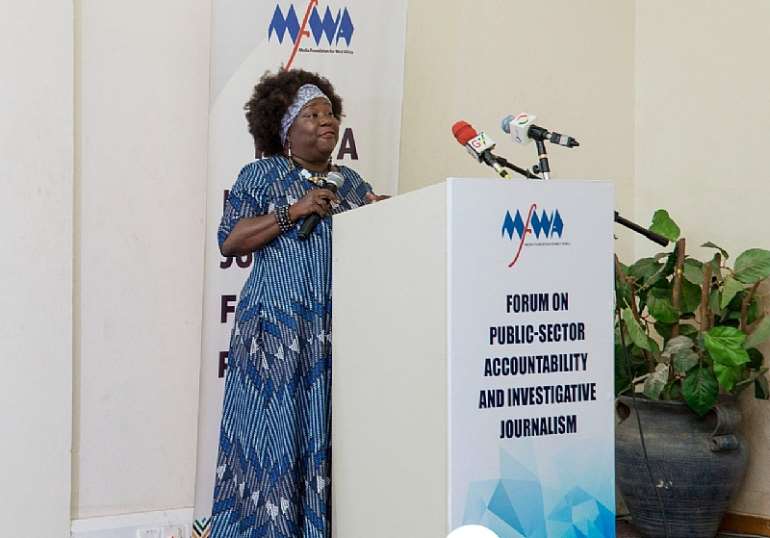 Prof. Audrey Gadzekpo
According to the media Scholar, the multiple national and international crises demand the skills of investigative journalism to hold those in authority to account for their actions and inactions.
“Those of you who have taken part in this training are aware of how investigative journalism exposes corruption.
“It’s a rough road, it’s risky, it’s dangerous, it’s lonely but it’s worthwhile. That is why all the investigative journalists in Africa continue to do it.
“Investigative journalist on the continent faces major challenges. Very few journalists are into investigative journalism…That’s why I think this fellowship is so critical. Because we need more investigative journalists to look after the public purse. We need investigative journalists and we need quality journalists,” Prof. Audrey Gadzekpo stressed.
She concluded, “I congratulate MFWA and the 13 fellows who have completed this course.”
Delivering his address at the event, MFWA Executive Director Sulemana Braimah bemoaned how democracy in the West Africa region is relapsing at an alarmingly fast pace.
He said to make matters worse, misinformation and disinformation have also taken centre stage with mounting insecurity in the region while deep-seated corruption is also at its all-time high.
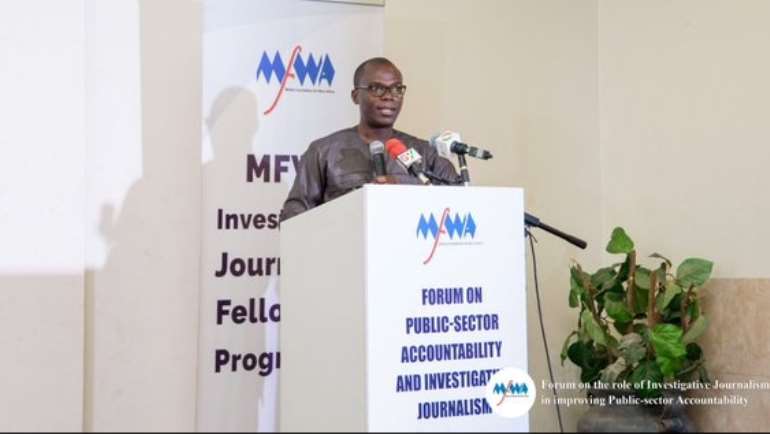 Sulemana Braimah
Recognising that the media, unfortunately, faces challenges including lack of capacity, financial issues, corruption, partisanship, as well as repression and abuse by state and non-state actors, Sulemana Braimah explained that it is why his outfit has taken it upon itself to train the next Generation of Investigative Journalists.
“We certainly cannot afford the consequences of not doing anything to respond to the crisis facing journalism in a swift and robust manner.
“This is because a crisis in journalism will not only impact journalists and journalism but the impact can be dire for the well-being of countries, for lives, for livelihoods, and the survival of democracies.
“This is why MFWA is training the fellows,” Sulemana Braimah emphasised.
While stressing that this is the beginning of the actual journey into quality journalism for the newly certified fellows, he urged all 13 young journalists to put the knowledge and skills acquired in the last five months to good use to benefit their communities, countries, and the continent.
Speaking at the event, the press attaché of the US Embassy, Kevin Brosnahan was full of praise for the Media Foundation of West Africa, adding that his outfit is happy it provided sponsorship for the second cohort of the Next Generation Investigative Journalism Fellowship.
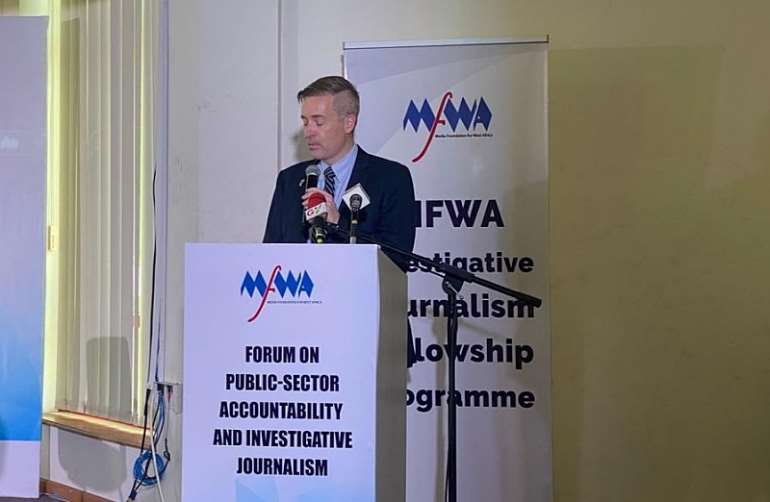 Kevin Brosnahan
In congratulating the certified fellows, he admonished them to go and ensure they use the knowledge, tools, and skills acquired to good use for the benefit of society and their respective countries.
Remarks from fellows:
Victor Jones, a beneficiary from Sierra Leone said, “I believe my fact-checking will be key in our election next year to deal with misinformation. I will be the torchbearer of investigative journalism in my country. I have been fortified and will put my skills to good use.”
Sharing her remarks, Vitoria Adonu from Ghana also noted, “I want to say thank the MFWA for the opportunity and I want to give the assurance that the works I will be coming up with will be very good stories.”
From Liberia, Forgbe Emma Kloh also said, “I’m grateful to the MFWA for affording me this opportunity. Journalism in Liberia is lacking behind. Through this training, my skills as a journalist have improved a lot.
“Thank you to MFWA, thank you to the funders for this life-changing opportunity.”
Special Awards:
- Best Fact Checker – Thelma Dede Amedeku
Received citation plus a Cash prize
- Best Story Writer – Victor Jones
Received citation plus Cash Prize
- Best User of the RTI – Edmund Boateng
Received citation plus a Cash prize
- Most promising young investigative journalist – Philip Teye Agbove
Received citation plus a Cash prize
About the NGIJ Fellowship
“The Next Generation Investigative Journalism Fellowship project is an initiative of the MFWA, and the first of its kind by a media rights organization in West Africa. It is aimed at boosting journalistic reporting that holds public officers accountable to the people of the three countries and beyond, while serving as a training ground for young aspiring investigative journalists.
It involves five months of intensive practical training in investigative reporting, data journalism and visualisation, fact-checking, basic multimedia, and mobile journalism; as well as mentorship under The Fourth Estate and Factcheck Ghana.
The first edition of the Fellowship was rolled out in October 2021 with 10 Fellows who successfully completed the Fellowship in March 2022. The 10 Fellows who made it to the first cohort were all from Ghana.
The second cohort is made up 13 early-career and student journalists from leading journalism/ communication training institutions in Ghana, Liberia, and Sierra Leone.
The 13 Fellows, made up of seven females and six males, have been taken through rigorous training in investigative reporting, data journalism and visualisation, fact-checking, basic multi-media, and mobile journalism.
The second edition of the Fellowship is being supported by the US Embassy, Ghana, and the Dutch Foreign Ministry (through the Embassy of the Kingdom of Netherlands).

 GJA Applauds Ghana’s Sharp Rise in Global Press Freedom Rankings
 US Embassy Cautions Against Censorship in Fight Against Misinformation
 Interior Minister Blames Weak Enforcement by Assemblies After Avenor Building Co...
 Gov’t Warns Against Rising Misinformation, Calls for Stronger Journalistic Stand...
 Ramaphosa Warns Against Vigilante Crackdowns on Foreign Nationals
 Global InfoAnalytics Boss Rejects Claims Polls Are Destabilising NDC
 Bawumia to Propose Policy Alternative as Cocoa Sector Tensions Deepen
 ECG Announces Scheduled Outages and Technical Fault Affecting Multiple Regions o...
 Investigation committee uncover GH¢19.5m loss at Bolgatanga Technical University...
 Afenyo-Markin calls for protection of journalists, warns against suppression of ...


