




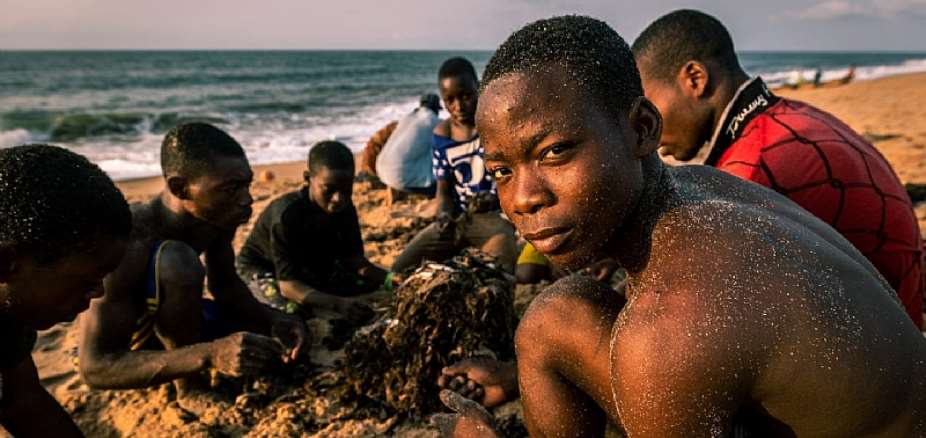
The ancient port town of Elmina in Ghana’s Central Region is dominated by a Portuguese-built 15th century castle. Black kites hang in the thermals above the fish market, which is confined on its northern edge by a deep channel that cuts up to a brackish lagoon fed by the Benya lagoon. Doing my best to look like a tourist, I move awkwardly through the market, shooting short clips and snapping pictures with a DSLR. A hidden camera captures the scene from a button on my shirt. Fishmongers weave through the crowds with large aluminium bowls packed with fish balanced on their heads, shushing me aside as I make my way to the quayside. There, fish are passed along chains of workers from the holds of the canoes that pack the channel. Steam rises from the bellies of the wide ocean-going canoes, where thousands of blocks of frozen fish are beginning to thaw in the morning light.
These canoes do not have the equipment on board to freeze fish at sea; only industrial vessels have that capacity. They do not even have fishing nets on board. As I lift my camera to capture the scene, a man quickly bats it down. He asks who I am and what I am doing there. ‘Delete all the pictures’, he instructs.
What’s happening in Elmina – and in port towns up and down the Ghanaian coast – is known as ‘saiko’. It began as an informal system of trading between the industrial trawlers that are licensed to fish in Ghana’s waters, and the local canoes that target small open water fish, such as anchovies and sardinella. The trawlers would sometimes catch these smaller species unintentionally while targeting the high-value, export-oriented seafood they were licensed to fish. So they would freeze this ‘by-catch’ and trade it with local canoe fishers for supplies: fresh water, fruit, even livestock.
As the commercial species dwindled from overfishing, trawlers began to intentionally target the smaller fish on which local canoe fishers had traditionally depended and sell it back to fishing communities for profit. Eventually, as small fish populations were decimated, some of the local fishers stopped bringing nets to sea at all, and would simply meet with the trawlers, fill their canoes with frozen fish, and return to port. In time, unscrupulous businessmen began to muscle in, investing in specially-adapted canoes capable of carrying tens of thousands of kilos of fish per trip. The illegal trade boomed. Saiko is the word used by fishers to describe this illegal transfer of fish between boats (known as trans-shipment at sea). It’s an industry that’s worth over US$50 million annually, and it’s pushing Ghana’s marine ecosystems to the brink of total collapse. According to recent assessments, Ghana’s small pelagic fishery could collapse within five ye ars unless urgent and drastic interventions are made. As it stands, the country is now forced to import well over half of the fish consumed.
The Environmental Justice Foundation (EJF) works across West Africa and around the world, to document illegal fishing and empower fishing communities to protect the resources that they depend upon for food and income. To date, the information gathered by EJF teams and the local communities we work with, has led to scores of official investigations , the delisting of illegal vessels, criminal charges being brought against operators, and millions of dollars of fines levied against ship owners. In Ghana, EJF’s local staff and extensive network of community mobilisers, work to strengthen fisheries monitoring at a grassroots and political level.
Speaking to Ekuwa, a fishmonger in the town of Ankaful to the north of Elmina, it’s clear what a catastrophe saiko has been. “There was a lot of fish when I became a fishmonger. Then saiko came and the canoes stopped catching all kinds of fish. Saiko has destroyed our ocean. The trawlers catch all the fish meant for our husbands and use it for saiko.” Ekuwa’s husband Kweku, a fisherman himself, is just as concerned. “I am worried about my children. There won’t be any fish left in the sea during their lifetime.”
For Ekuwa and the many thousands of women like her along Ghana’s 540km coastline, fish is their livelihood. And for the many millions more who buy fresh and processed fish in Ghana, it’s a key source of animal protein vital for health and food security.
For the industrial fleet, it’s a race to the bottom. Illegal fishing is systemic, and sanctions are rare, in spite of a recently improved and fairly rigid legal framework. There is an open secret in Ghana’s industrial fishing industry that undermines any kind of regulatory deterrent; around 90% of trawlers are operated by Chinese companies, despite foreign ownership of vessels being banned. Most are ‘owned’ by Ghanaian front companies, but the profits from their illegal fishing activities flow out of the country. This system of hidden beneficial ownership makes it almost impossible to sanction the true beneficiaries of illegal fishing.
There are systems in place to try and deter illegal fishing but speaking to those on the front line of the fight to regulate the trawlers reveals deep flaws. In late January 2020 the EJF team rented a small apartment near Tema, the deep-water port where the industrial fleet is based. From here, we interviewed six fisheries observers who worked aboard Chinese-owned vessels. Kwesi was one such observer. It had taken many weeks of back and forth on WhatsApp for him to trust us enough to meet in person, and even when we met he was visibly wary. The observer program was established in 2015 to monitor the industrial fleet and was initially funded by the World Bank. Every trawler licensed to fish in Ghana was mandated to have an observer like Kwesi on board to document illegal activities. “The captain sees you as a bad person... When you see certain things and you try to take pictures or video, it becomes a problem. Sometimes the captain will even try to fight you on board. The captain will say to you, ‘I don't need you on the bridge again, walk out, out of my bridge’. If you refuse, he will start pushing you.”
The fear among the observers we met was palpable. In July 2019, one of their colleagues, Emmanuel Essien, went missing from the trawler Meng Xin 15. Many we spoke to suspect foul play. Observers are isolated and alone when they’re on the trawlers, where the captains and senior crew are openly hostile. They are wary of reporting any illegalities they witness. “Before that time [Essien’s disappearance], if I was on board the vessel, I did challenge the captains, but from that time until now I don't challenge them. Because I don't know what will happen. If I'm taking a video or a picture, I'm also trying to protect myself so that nobody can see what is going on, especially the captain, I don't want him to see. If he sees something like that happening, I become disturbed. I started thinking that something can happen to me.”
Since World Bank funding dried up in 2018, the Ghana Industrial Trawlers Association (GITA) was tasked with paying observer salaries. GITA is the industry body that represents the very vessels that the observers are placed on. Kwesi told us: “Now observers are paid by the Chinese; by the captains. The captains can tell you, 'you are no good, I will not pick you for my vessel anymore', and that ends it. 'I want this observer on board, I don't want this observer'. When it comes to the reporting, if they realise that you have taken pictures or video, they will call the managers at the shore... They will then call you and say, 'ok this is what we have for you' [a bribe]. You have to say yes. If you say no…” Kwesi paused, looking pained. “You are still at sea; you have no option. So, if you don't agree with them and they decide to do something to you at the sea, what are you going to do? They say, 'if you don't take the bribe here, your bosses will take it'.” The observer program was promoted as a shining example of progressive and effective fisheries management in a region plagued by illegal fishing. This clear conflict of interest has now rendered it completely ineffective.
Having documented the unloading of the frozen trawler-caught fish in Elmina, the next step was to film the trans-shipment itself. Fishing vessels of a certain size are fitted with Automatic Identification Systems (AIS) which allow for marine traffic monitoring and help prevent collisions. Months of daily satellite monitoring data gave us a good idea of where we might be able to document a saiko trans-shipment. EJF’s Ocean Campaigns teams in Ghana and the UK were tracking a number of vessels that regularly moved from the deeper fishing grounds along the edge of the continental shelf to the edge of the zone reserved for small-scale fishers, around 12 nautical miles off Elmina, in the early hours of the day. They would spend a few hours within this trans-shipment zone, before heading back out to sea before dawn. Presumably, the saiko trans-shipments were taking place in this window.
The team had arranged the charter of a 15m semi-industrial fishing trawler from Takoradi, a port town to the west of Elmina. After explaining our objectives to the largely disinterested captain, we loaded the camera gear onto the vessel disguised in non-descript plastic bags and waited as the crew made ready and fetched fuel. The ancient diesel truck engine below whined and turned over as a cloud of acrid smoke billowed from the exhaust above the wheelhouse, before it died completely. After an increasingly tense 30 minutes, the engineer appeared from below and declared that a spare part was needed. It would have to come from Cape Coast, 100km up the coast. We waited on board as the sun sank below the horizon of gently creaking trawlers. At around 6:30pm, the part appeared and was taken below. Just 10 minutes later, we were emerging from the flat-calm harbour mouth as the last light faded over the Gulf of Guinea.
Back in Elmina, the rest of the team watched the canoe port from the hotel window at the mouth of the channel to the fish landing site. The saiko crews were busy lining canoes with thick blankets to keep the fish frozen for as long as possible on the return journey. Outboard engines with colourful handmade covers were brought out and carefully clamped to the sterns of the lumbering canoes as the crew boarded. As they set out, I got the call from the team at the hotel; we knew that saiko trans-shipments would be going ahead tonight.
The sea was rough and our trawler, light without gears or catch, rose and fell heavily with the waves. The moon was full and bright, and lit the deck in front of us as a shooting star streaked slowly across the sky over the Atlantic. Gas platforms flared on the horizon. The small trawler was infested with cockroaches which scuttled into the folds of our clothing and deep into the camera bags, where I continued to find them for days afterwards. At around midnight, we began to see the lights from the trawlers in the distance. Via satellite phone, the AIS monitoring team told us they could see multiple trawlers moving towards the trans-shipment zone.
At around 3am, we were approaching the closest vessel. It appeared stationary as we circled from a distance. We advanced slowly with the navigation lights off. At a hundred metres, we could discern the dark shape of a canoe tied alongside the trawler; we had arrived in the middle of the trans-shipment. We could see the chain of workers moving the blocks of fish from the hold of the trawler and into the blanket lined canoe. The rough sea made it hard to get stable shots and I braced myself in the doorway of the wheelhouse, shooting photos at the apex of the vessel’s swing when it was momentarily stationary. But I could not make out the vessel ID or name. I asked the captain to make one close pass to get shots of the markings and we edged closer until we could see the faces of the crew and hear them working. Now we could clearly make out the vessel’s IMO number (which would later give us its name: the Meng Xin 10) and see the Chinese captain under the work-light keeping count of the blocks coming up from the hold. This trans-shipment was one of hundreds that EJF estimates take place every month. During a one-month period of data collection in mid-2017, the team found that an average saiko canoe in Elmina landed around 2,400 slabs of fish (around 26.4 tonnes) per trip. In a single day, 73,000 slabs (803 tonnes) of saiko fish can be landed by over 30 canoes in Elmina alone. At least 100,000 metric tonnes of fish were landed through saiko in 2017 – that’s 60% of the officially recorded catch, with a value in port of over $50 million.
In the past three years, EJF has submitted 35 illegal fishing or suspicious activity alerts to the Ghanaian Ministry of Fisheries and Aquaculture Development (MoFAD). Some are based on satellite monitoring and are harder to verify. Some are accompanied by geotagged photographs of illegal activities taking place. Government investigations are rare, prosecutions even more so. The Meng Xin 10 has not faced sanctions, despite having been documented trans-shipping illegally in Ghanaian waters.
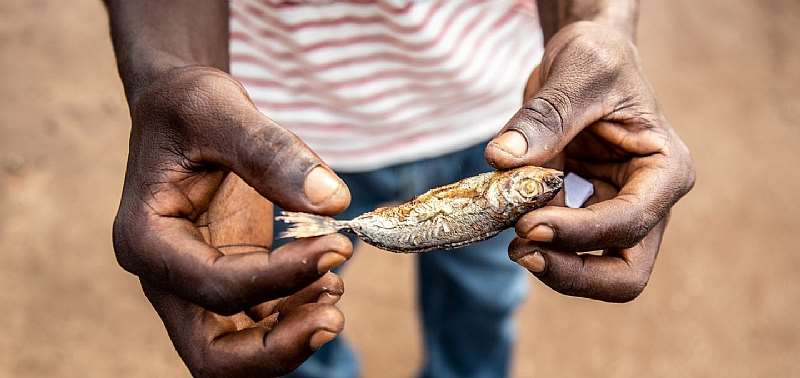
In the six years I have been travelling to Ghana to meet with fishing communities and hear from those on the front lines of this environmental catastrophe, the situation has deteriorated drastically. Fishmongers no longer see the range of species they used to. The fish they are able to get is smaller and, in the case of saiko fish, lower quality. It’s never been harder to make a living as a fisher in Ghana and the future does not look promising. Unless urgent interventions are made, the ecological crisis that illegal saiko fishing is driving will have a dire human cost, as many millions of people will be at risk of losing their livelihoods and a vital source of nutrition.
Writer: Tim Young, Investigative Filmmaker EJF
Originally published in Issue 14 of Oceanographic .

 Israel votes in first election since October 7 attack as Netanyahu faces crucial...
 US-EU trade truce at risk over $3.4 billion Airbus loan, Trump official warns
 Flavio Bolsonaro vows to lead opposition after Brazil court imposes travel ban
 Mecca pact nations hold talks with Iran to prevent renewed Middle East war
 New DStv sports package will save subscribers over Ghc500 monthly – Sam George
 Your past prescriptions never helped developing countries - TOR MD tells IMF
 Crude Distillation Unit turnaround was funded from TOR's internally generated fu...
 Trump offers $1 million for tipoffs leading to vote fraud conviction as midterms...
 UN cites 'ethnic cleansing' concerns around Israel's Palestinian displacement op...
 'Irresponsible media coverage is hurting Obuasi SHTS abuse probe' – Gender Minis...


