




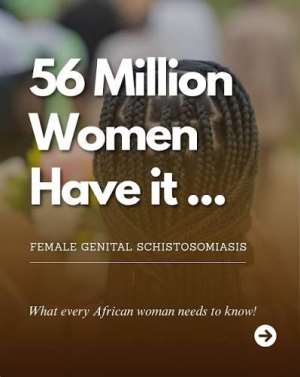
Female Genital Schistosomiasis (FGS) is an often-overlooked reproductive health condition caused predominantly by Schistosoma haematobium. Although schistosomiasis is widely recognized as a neglected tropical disease, its genital manifestations remain poorly diagnosed, particularly among women living in endemic communities. In Ghana, where freshwater exposure contributes to ongoing transmission, FGS may represent a hidden threat to women’s reproductive health. The condition is particularly concerning because its symptoms can be nonspecific, while the resulting tissue damage may persist long after infection. Strengthening the detection of FGS is therefore essential for reducing its reproductive consequences and improving women’s health outcomes.
FGS develops when S. haematobium eggs become trapped in genital tissues, where they induce chronic inflammation and granulomatous reactions. Persistent inflammation can result in mucosal lesions, fibrosis, abnormal bleeding, pelvic discomfort, and damage to reproductive tissues. More severe or prolonged disease may contribute to infertility and other reproductive complications. FGS has also been associated with an increased susceptibility to HIV infection, making it an important condition beyond the immediate effects of schistosomiasis. Despite these consequences, FGS is frequently underrecognized because its manifestations can resemble other common reproductive tract conditions.
A major challenge is the limitation of conventional diagnostic methods. Routine urine microscopy remains an important tool for detecting urinary schistosomiasis, but it does not reliably identify genital infection. Parasite eggs may become embedded within genital tissues instead of being consistently released into urine. Consequently, a woman can have genital schistosomiasis despite a negative or low-intensity urine test. This creates a diagnostic gap in which women may be reassured that they are free from infection while pathological changes continue within reproductive tissues. Reliance on urine-based diagnosis alone may therefore underestimate the true burden of FGS.
Visual examination, including colposcopy, has improved the recognition of FGS by allowing clinicians to identify characteristic genital lesions. However, visual diagnosis also has important limitations. Some lesions may be subtle or absent, while disease affecting deeper or less accessible reproductive structures cannot be adequately assessed through surface examination. This is particularly relevant in women presenting with unexplained infertility, where pathological changes may extend beyond what can be observed during routine visual screening. Therefore, although visual examination remains valuable, it should not necessarily be considered sufficient as a standalone diagnostic strategy.
Evidence from Ghana illustrates the importance of addressing this diagnostic limitation. Studies conducted in the Volta Region have demonstrated a substantial occurrence of FGS among women exposed to schistosomiasis. In one investigation, visual examination identified FGS in 58.5% of general female participants. However, the diagnostic picture among women experiencing infertility was less straightforward, raising concerns that conventional visual approaches may fail to identify disease involving deeper reproductive tissues. Such findings emphasize the need for diagnostic strategies capable of detecting infection beyond visible lesions.
Molecular diagnostics provide a promising opportunity to address this challenge. Polymerase Chain Reaction (PCR) can detect Schistosoma DNA in biological samples, including cervicovaginal specimens, even when parasite eggs are not readily visible. This approach could complement existing urine testing and visual examination by providing molecular evidence of infection. Genetic targets such as the internal transcribed spacer 2 (ITS2) region and mitochondrial cytochrome c oxidase subunit 1 (COX1) gene can support the detection and characterization of Schistosoma species. Molecular testing may therefore increase diagnostic sensitivity and help identify infections that conventional methods overlook.
Beyond diagnosis, molecular approaches can provide valuable epidemiological information. Genetic characterization of Schistosoma populations may reveal parasite diversity and possible hybridization between schistosome species. Such information is important because parasite genetic variation could influence transmission patterns, host interactions, disease manifestations, and diagnostic performance. Establishing molecular surveillance systems in endemic communities could therefore contribute not only to individual patient diagnosis but also to a better understanding of FGS transmission and disease burden in Ghana. Integrating molecular data with clinical and epidemiological information could strengthen national schistosomiasis control strategies.
A shift from predominantly visual diagnosis toward an integrated diagnostic model could significantly improve the detection and management of FGS. Rather than replacing clinical examination, PCR-based testing should complement urine analysis and visual assessment, particularly for women with persistent reproductive symptoms, unexplained infertility, or substantial exposure to freshwater in endemic areas. Earlier and more accurate detection could facilitate appropriate treatment before extensive tissue damage develops. For Ghana, investing in accessible molecular diagnostic capacity, research, surveillance, and healthcare-worker training could help close the existing diagnostic gap. Moving beyond what can be seen with the naked eye offers an important opportunity to identify hidden infections, protect fertility, and strengthen reproductive healthcare for women living in schistosomiasis-endemic communities.

 Judiciary must earn public trust, not demand it — Asiedu Nketiah
 Any sod-cutting ceremony at Upper East Airport site this weekend will be 419 — G...
 Mahama must investigate GoldBod over alleged US$1.7bn loss — Abena Osei-Asare
 Attorney General opposes Wontumi’s bail application pending appeal in 20-year se...
 'I will continue to sit until Chief Justice revokes warrant' - High Court judge ...
 August 11: Cedi sells at GHS12.45 on forex market, GHS11.78 on BoG interbank
 Hopeson Adorye eats humble pie, retracts claim linking Ekow Assafuah to Ghana To...
 Legal vacation does not mean lawyers can halt court proceedings – Deputy Attorne...
 Forensic audit reveals how Ghana’s Embassy in the U.S. extorted $19.3 million fr...
 EVIDENCE: How Ghana’s Washington Embassy staff shared money extorted from visa a...


Comments
Very innovative