




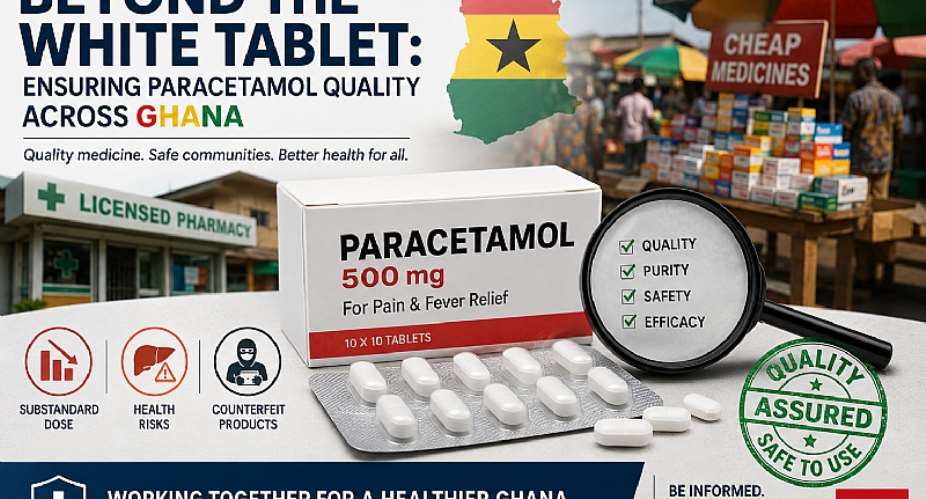
Paracetamol is widely regarded as the people’s medicine in Ghana. Found in almost every household, it is an essential over‑the‑counter remedy trusted to ease fevers, headaches, and the physical toll of daily labour. Yet behind the quiet familiarity of this unassuming white tablet lies a critical public health question: is the paracetamol sold on the Ghanaian market truly what it claims to be?
While paracetamol’s widespread accessibility makes it a vital healthcare asset, it also leaves the medicine highly vulnerable to substandard manufacturing and counterfeiting. The World Health Organization (WHO) estimates that one in every ten medical products circulating in low‑ and middle‑income countries is either falsified or substandard.
The everyday health consequences of these quality failures are serious:
- Tablets containing too little of the active ingredient fail to provide adequate pain relief and can allow underlying illnesses to worsen unnoticed.
- Conversely, tablets containing excessive amounts present a genuine toxic risk, potentially leading to severe liver damage.
Ghana hosts a highly diverse pharmaceutical marketplace, ranging from strictly regulated licensed pharmacies to informal open‑air market vendors operating outside formal oversight. The nation’s extensive borders position it along major trade routes, exposing local markets across various regions to the informal movement of unregistered pharmaceutical products.
Despite the vigilant efforts of the Ghana Food and Drugs Authority (FDA), resource constraints mean that monitoring every single product in a vast nationwide pharmaceutical market is an immense challenge. Because of this, independent quality checks and ongoing public health research are frequently required to supplement official surveillance.
To address these vulnerabilities, continuous monitoring of the medicines sold to the public is essential. By routinely evaluating the safety and purity of different brands of paracetamol, independent researchers can provide the Ghana FDA, the Pharmacy Council of Ghana, and the Ministry of Health with the evidence needed to remove substandard brands from the national supply chain.
Ultimately, keeping a watchful eye on the quality of everyday drugs reinforces a fundamental public health principle: ensuring that every patient, regardless of where they live, can trust the medicine they rely on to heal.

 Judiciary must earn public trust, not demand it — Asiedu Nketiah
 Any sod-cutting ceremony at Upper East Airport site this weekend will be 419 — G...
 Mahama must investigate GoldBod over alleged US$1.7bn loss — Abena Osei-Asare
 Attorney General opposes Wontumi’s bail application pending appeal in 20-year se...
 'I will continue to sit until Chief Justice revokes warrant' - High Court judge ...
 August 11: Cedi sells at GHS12.45 on forex market, GHS11.78 on BoG interbank
 Hopeson Adorye eats humble pie, retracts claim linking Ekow Assafuah to Ghana To...
 Legal vacation does not mean lawyers can halt court proceedings – Deputy Attorne...
 Forensic audit reveals how Ghana’s Embassy in the U.S. extorted $19.3 million fr...
 EVIDENCE: How Ghana’s Washington Embassy staff shared money extorted from visa a...

