




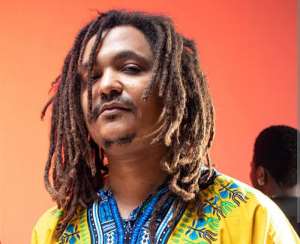
There are moments in an artist's career when the question stops being whether the music is good enough.
The question becomes whether the world is paying enough attention.
For Dr. Pushkin, that moment may be approaching.
The Ghanaian-American artist, scientist and entrepreneur born Paul Azunre has spent years constructing a career that refuses to fit into the conventional boxes of either academia or entertainment. He is an artificial intelligence researcher who makes hip-hop. A scientist who writes songs. An internationally exposed artist whose music repeatedly returns to the cultural vocabulary of Northern Ghana.
Now, five recordings associated with his work have been submitted for consideration for the GRAMMY Awards.
They include “Lazy No Go Chop,” his collaboration with celebrated kologo musician Stevo Atambire, and “No Miracles,” featuring Ataman Nikita and American rapper Jon Connor. The recordings span Gurene, Ghanaian Pidgin and English and bring together musicians and influences from Ghana and the United States.
To be clear, these are submissions for consideration, not confirmed GRAMMY nominations.
But perhaps the more important question is this:
Why should Dr. Pushkin be taken seriously in the first place?
The answer begins far from Los Angeles, New York or any of the traditional centres of the global music industry.
It begins in Bolgatanga.
The sound of a place
Northern Ghana has never lacked musical talent.
What it has often lacked is sustained visibility.
The region has produced musicians who have carried the kologo, traditional rhythms and Northern storytelling far beyond Ghana's borders. Yet the national music narrative has historically been dominated by sounds emerging from Accra, Kumasi and other major cultural centres.
Dr. Pushkin's work challenges that imbalance.
He does not treat Northern Ghana as merely the geographical location of his childhood.
He treats it as part of his artistic vocabulary.
That distinction matters.
His collaboration with Stevo Atambire on “Lazy No Go Chop” is perhaps the clearest example. The song brings contemporary hip-hop together with the kologo tradition, creating a meeting point between a deeply rooted Northern Ghanaian sound and a globally recognised musical language.
The significance is not simply that an American-based Ghanaian rapper has collaborated with a kologo player.
It is that the collaboration refuses to suggest that one musical tradition must disappear for another to become internationally relevant.
The kologo remains the kologo.
The Gurene remains Gurene.
And yet the music travels.
That is the kind of cultural confidence African music needs.
A scientist with a microphone
Dr. Pushkin's academic background makes his artistic journey even more intriguing.
He was part of the Opoku Ware School team that won the 2002 National Science and Maths Quiz and went on to build an impressive career in science and technology, including studies and work connected to the Massachusetts Institute of Technology.
But somewhere along that journey, music refused to disappear.
Instead of choosing between the laboratory and the recording studio, he kept both.
That decision challenges an old assumption about African artists: that serious intellectual achievement and artistic ambition are somehow incompatible.
Dr. Pushkin's career suggests otherwise.
The same mind capable of thinking about artificial intelligence can think about rhythm.
The same person who studies complex technological systems can write a protest song.
And perhaps there is a connection after all.
Science asks questions about how the world works.
Art asks questions about why it matters.
Dr. Pushkin has chosen to do both.
When rap becomes social commentary
For Dr. Pushkin, hip-hop is not merely a vehicle for personal expression.
It is also a platform for interrogation.
His music repeatedly ventures into questions of politics, society, ambition, morality and human behaviour.
“No Miracles,” one of the recordings submitted for GRAMMY consideration, takes aim at political dependency and the culture of waiting for politicians or self-proclaimed miracle workers to solve problems that societies must ultimately confront themselves.
This places him within one of hip-hop's oldest traditions.
At its best, hip-hop has always been more than entertainment.
It has been a newspaper for communities without newspapers.
A microphone for people without institutional power.
A record of social frustrations that official histories sometimes ignore.
Dr. Pushkin appears to understand that tradition.
He is not simply asking listeners to dance.
He is asking them to think.
Then came “Empty Grave”
If “Lazy No Go Chop” represents Dr. Pushkin's cultural bridge-building, “Empty Grave” demonstrates his capacity for storytelling.
The collaboration with B-Wayne became one of the defining moments of his recent career, with reports noting that the music video became the first by a Northern Ghanaian rapper to surpass one million YouTube views.
But the number is only part of the story.
The visual narrative surrounding “Empty Grave” explores betrayal, loss, resilience and the recovery of a legacy.
The imagery is deliberately dramatic.
Dr. Pushkin is buried.
Literally.
It is a metaphor made physical: an artist confronting the possibility of being forgotten and then fighting his way back into relevance.
That idea resonates beyond music.
Every emerging cultural movement knows what it means to struggle for visibility.
Every region that feels overlooked knows what it means to wonder whether the world will ever pay attention.
“Empty Grave” therefore becomes more than a music video.
It becomes a statement.
You may bury the artist, but you cannot necessarily bury the story.
Why the GRAMMY conversation matters
The GRAMMYs are not simply a popularity contest.
The Recording Academy's awards process involves submissions, screening and voting by music professionals before nominations are determined.
That makes the current stage significant.
The recordings have entered the arena.
Now they must compete.
And that competition should be based on the music—not nationality, novelty or sentiment.
Dr. Pushkin should not be considered because he is Ghanaian.
He should not be considered simply because he is a scientist who raps.
He should not be considered because Northern Ghana deserves representation.
Those may provide context.
They are not the artistic argument.
The artistic argument is much stronger:
Listen to the records.
Listen to the musicianship.
Listen to the cultural fusion.
Listen to the languages.
Listen to the stories.
Listen to the production.
Then decide.
A nomination would mean more than one man's success
If Dr. Pushkin were eventually nominated, the significance would extend beyond his personal career.
It would be a powerful moment for Northern Ghana.
For the kologo.
For Gurene music.
For independent African hip-hop.
For artists who work across borders.
And perhaps most importantly, for young Africans trying to understand whether they must choose between their heritage and the global stage.
A GRAMMY nomination would tell them they do not.
You can carry Bolgatanga into Austin.
You can put the kologo beside hip-hop.
You can rap in English and still preserve your indigenous language.
You can be a scientist and an artist.
You can be African without diluting your Africanness to become globally acceptable.
That is the larger cultural argument sitting underneath Dr. Pushkin's GRAMMY campaign.
He is already inside the institution
There is another remarkable chapter to this story.
In 2026, Dr. Pushkin was invited to join the Recording Academy's Class of 2026 as a voting member.
That does not guarantee him a nomination.
It should not.
But it does place him inside one of the world's most influential music institutions.
And there is an almost poetic irony in that.
A musician from Bolgatanga, whose work incorporates a traditional Northern Ghanaian instrument, is now participating in the global institution that helps determine which recorded music receives one of the industry's most prestigious recognitions.
He is not merely knocking on the door anymore.
He has entered the building.
Now the music must speak.
The question Ghana should be asking
Perhaps the bigger question is not simply:
Will Dr. Pushkin receive a GRAMMY nomination?
Ghana should be asking:
What kind of music do we want the world to know us for?
Do we want international recognition only when our artists reproduce sounds already popular elsewhere?
Or can we create a global space for music that is unmistakably Ghanaian?
Dr. Pushkin's work suggests the latter is possible.
His music does not offer a rejection of global culture.
It offers a negotiation with it.
Hip-hop meets kologo.
Gurene meets English.
Bolgatanga meets Austin.
Science meets art.
Africa meets America.
And somewhere in that collision, something new emerges.
The verdict belongs to the music
There is no need to oversell Dr. Pushkin.
His story is already compelling enough.
The GRAMMY nomination, if it comes, should not be treated as a favour to a Ghanaian artist.
Nor should it be demanded as an entitlement.
It should be earned through the recordings.
That is why the current moment matters.
For years, Dr. Pushkin has been building music at the intersection of identity, intellect and experimentation. He has taken Northern Ghanaian sounds into international spaces, collaborated across continents and continued to make socially conscious music despite operating outside the conventional centre of Ghana's music industry.
Now, the recordings have been submitted.
The Academy will decide.
But before the votes are cast, there is one thing worth doing.
Listen.
Not to the PhD.
Not to MIT.
Not to the novelty of a scientist who raps.
Not even to the story of Bolgatanga.
Listen to the music.
Because if the music can stand without the biography, then perhaps Dr. Pushkin has already made the strongest case of all.
And if the world is finally ready to listen, it may discover something that Northern Ghana has known for a long time:
Some of the most interesting sounds in Ghana are coming from places the global music industry has not been looking closely enough.


 'The height of absurdity' — Ayew Afriye slams BNI over invitation of Efya Royal ...
 US envoys arrive in Moscow to thrash out plan to end war in Ukraine
 'Chief Justice was talking as a citizen; you have to look at the context in whic...
 Mandatory towing to remove broken-down, stationary vehicles from roads to begin ...
 Domelevo backs OSP probe into alleged GH¢70,000 payment to Appiagyei despite den...
 WAEC releases 2026 WASSCE results, cancels entire results of 861 candidates for ...
 Baffour Agyeman-Duah explains why profitability may not be only reason behind SO...
 Kofi Bentil defends Mahama’s dissolution of nine State Boards
 5-year-old girl dies after falling into water-filled manhole at Winneba
 Sierra Leone ex-president to return after treason case dropped

