




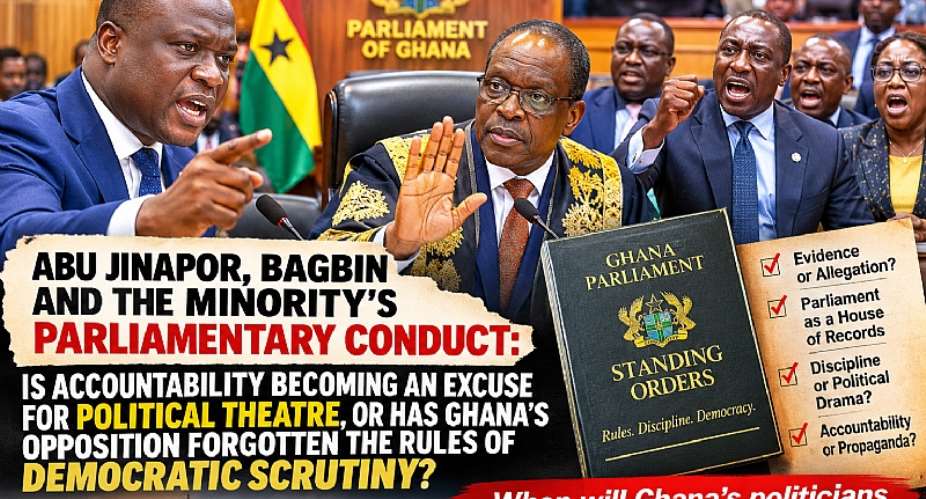
When allegations are made without evidence being placed before Parliament, when the Speaker gives a directive and an MP challenges the authority of the Chair, and when an entire caucus walks out in solidarity, one question becomes unavoidable: Is Ghana's Parliament becoming a place for establishing facts and holding government accountable, or a political battlefield where making headlines matters more than protecting the integrity of the institution?
Introduction: The incident that has reopened questions about parliamentary discipline
On Tuesday, November 3, 2026, Ghana's Parliament witnessed another confrontation that raises serious questions about parliamentary discipline, political accountability and the conduct of elected representatives.
The Speaker of Parliament, Rt. Hon. Alban Sumana Kingsford Bagbin, directed the Parliamentary Marshal to escort the Member of Parliament for Damongo, Hon. Samuel Abu Jinapor, out of the Chamber following a disagreement over allegations concerning the alleged sale of Ghanaian diplomatic passports.
The allegation was particularly serious. Abu Jinapor, who is also the Ranking Member of Parliament's Foreign Affairs and Regional Integration Committee, claimed that diplomatic passports were being sold for amounts ranging between US$10,000 and US$50,000.
He maintained that he had evidence and demanded accountability from the Minister for Foreign Affairs, Samuel Okudzeto Ablakwa.
However, the Majority Leader, James Agalga, challenged him to substantiate the allegation or withdraw it. Speaker Bagbin subsequently directed him to withdraw the statement and indicated that he could return to the matter through the appropriate parliamentary process with supporting evidence.
The disagreement escalated, and the Speaker eventually ordered his removal. The Minority Caucus, led by Alexander Afenyo-Markin, subsequently walked out in solidarity with their colleague.
But beyond the dramatic scenes, there is a much bigger question Ghana must confront.
Can Parliament become an institution where serious allegations are made against individuals without the immediate responsibility to demonstrate their factual basis, simply because the person making them occupies an elected seat?
And if parliamentary privilege is intended to protect representatives who speak on behalf of the people, should that privilege also become a shield against parliamentary discipline?
These are not comfortable questions, but they are necessary ones.
1. What really happened before Abu Jinapor was asked to leave?
To understand the confrontation, it is important to examine the sequence of events rather than simply accept the political interpretations being offered by either side.
The controversy arose during a discussion concerning Ghana's diplomatic passports, which are important state documents associated with diplomatic representation and international privileges.
Abu Jinapor took the opportunity to raise concerns about alleged irregularities in their issuance. He claimed that there was credible evidence that some diplomatic passports were being sold for between US$10,000 and US$50,000.
His argument was that the alleged practice, if established, could undermine Ghana's international reputation and compromise the integrity of the country's diplomatic processes.
He also called for the Foreign Affairs Minister to account.
However, Majority Leader James Agalga objected. He argued that the accusation was a serious allegation of criminal conduct and should not be placed on the parliamentary record without supporting evidence.
Agalga therefore requested that the Speaker direct Abu Jinapor to withdraw the allegation.
Speaker Bagbin intervened and asked the Damongo MP to withdraw the statement, indicating that he could return to the matter through the appropriate parliamentary process with evidence.
This was where the disagreement became particularly important.
According to Graphic Online's account, Jinapor initially maintained that he had evidence and that the allegation was already in the public domain. He subsequently indicated that he would withdraw the statement and return to the matter through the appropriate procedure.
However, the Speaker considered his response insufficient and instructed the Parliamentary Marshal to escort him out.
The Minority then walked out.
There is an important distinction in the reporting that deserves attention: some accounts describe Jinapor as refusing to withdraw, while Graphic Online reports that he eventually indicated his willingness to withdraw but that the Speaker was dissatisfied with the manner or timing of his compliance.
That distinction matters because the public deserves an accurate account of what happened, not a politically convenient version.
2. Did Abu Jinapor actually have evidence, or was he making an allegation?
This is arguably the most important question arising from the entire confrontation.
Abu Jinapor reportedly used the expression "unimpeachable evidence" when making his allegation.
That is a powerful statement.
When a Member of Parliament, particularly the Ranking Member of the Foreign Affairs Committee, makes such a declaration, the public is entitled to expect something more substantial than rumours, political intelligence or information circulating on social media.
If the evidence is unimpeachable, where is it?
* Are there identifiable individuals who allegedly paid for these passports?
* Are there payment records, bank transactions or receipts?
* Are there witnesses willing to testify?
* Are there communications linking any official to the alleged transactions?
* Are there passport application records demonstrating irregularities?
* Has any investigative institution received a formal complaint?
* Does the evidence establish the involvement of the Foreign Affairs Minister, or does it merely raise questions about the administrative process?
These questions are not intended to protect any minister from scrutiny. They are intended to protect the credibility of parliamentary accountability.
There is an important difference between having evidence, claiming to have evidence and presenting evidence that can withstand independent examination.
A politician's declaration that evidence exists is not itself proof that the allegation is true.
Equally, the fact that evidence was not presented during that particular parliamentary exchange does not establish that the allegation is false.
Abu Jinapor deserves the opportunity to present whatever evidence he says he possesses through the appropriate channels.
But the Foreign Affairs Minister also deserves protection against an allegation being treated as established fact before an investigation has taken place.
If the evidence exists, why not submit it to the appropriate parliamentary committee and demand an investigation?
Why should the public be left debating dramatic figures of US$10,000 and US$50,000 without knowing the identities of the alleged beneficiaries, the transactions involved or the officials supposedly responsible?
And perhaps the most uncomfortable question is this:
If an opposition MP announces that he possesses unimpeachable evidence against a government minister, but the evidence is not subsequently produced, should the public be expected to accept the accusation simply because it came from Parliament?
That is not accountability. Accountability requires verification.
3. Parliament is a House of Records, not a marketplace for unverified accusations
Parliament is one of the most important democratic institutions in Ghana.
It is where national policies are debated, public expenditure is scrutinised, ministers are questioned and government decisions are subjected to legislative oversight.
Its records are important because they preserve the official proceedings of the country's highest legislative institution.
Consequently, what an MP says on the floor of Parliament carries considerable public weight.
An accusation made outside Parliament may generate political controversy. But when that accusation is made inside the Chamber, it becomes part of a formal institutional process and potentially enters the official parliamentary record.
That responsibility cannot be taken lightly.
This does not mean MPs must possess a completed judicial investigation before raising every concern. That would make parliamentary oversight unnecessarily restrictive and could prevent legitimate wrongdoing from being exposed.
However, there must be a distinction between raising a concern, identifying suspicious conduct, presenting preliminary evidence and directly imputing criminal wrongdoing to an identifiable person.
An MP can say:
"I have received information suggesting possible irregularities in the issuance of diplomatic passports, and I am requesting an investigation."
That is a legitimate avenue for scrutiny.
But saying that a minister is involved in the sale of diplomatic passports is a substantially different matter.
The second statement carries a direct implication of wrongdoing and requires a more careful parliamentary approach.
Ghana's Standing Orders are clear on this principle.
Order 123(2)(b) prohibits a Member from imputing improper motives or impugning the integrity of another person. Order 123(3) empowers the Speaker to direct a Member to withdraw words that violate that provision. Order 131 also establishes a procedure for dealing with statements considered defamatory.
Therefore, the question is not whether Abu Jinapor has the right to question the Foreign Affairs Minister. He absolutely does.
The question is whether that right permits him to disregard the rules governing how such accusations should be presented.
Does parliamentary privilege mean parliamentary responsibility should disappear?
If Ghanaian MPs can accuse ministers of corruption, criminality or misconduct without observing the rules of debate, what protection remains for the integrity of parliamentary proceedings?
And if Parliament cannot regulate the language and conduct of its own members, how can citizens expect other public institutions to uphold discipline?
4. Was Speaker Bagbin right, or was he simply enforcing the rules?
The Speaker's decision deserves an examination based on parliamentary procedure rather than party affiliation.
Under Order 20 of Parliament's Standing Orders, the Speaker is the head of the institution and is required to uphold its honour, dignity and sanctity while acting impartially, fairly and firmly.
Order 126 makes the Speaker responsible for maintaining order and enforcing the rules of debate.
Order 123 also empowers the Speaker to require the withdrawal of statements that impute improper motives or impugn someone's integrity.
These provisions provide a legitimate procedural basis for the Speaker's intervention.
However, there is another important consideration.
Order 129 addresses persistent disorderly conduct and provides for a direction to withdraw from the Chamber. Order 132 addresses the withdrawal of members who are ordered to leave under the relevant provisions.
The public therefore deserves to understand precisely which procedural basis the Speaker relied upon for the final removal, particularly given the conflicting accounts about whether Jinapor had already indicated his willingness to withdraw.
It would be simplistic to declare that every action taken by a Speaker is automatically correct merely because the Speaker occupies the Chair.
The Speaker must also exercise authority fairly.
But it would be equally dangerous to suggest that a parliamentary directive becomes optional whenever a Member disagrees with it.
The Speaker is not expected to surrender the authority of the Chair every time an MP challenges a ruling.
There is a fundamental difference between questioning a ruling through established parliamentary procedures and refusing to comply with a directive while proceedings are underway.
My position is that the Speaker had a legitimate responsibility to protect the integrity of the House and could not allow the disagreement to become an endless confrontation.
Nevertheless, the exact basis for the removal and the chronology of Jinapor's attempted withdrawal should be examined against the official parliamentary record.
The Speaker must be firm, but firmness must always be accompanied by fairness.
If the Speaker cannot enforce the rules, who will? And if the Speaker can exercise authority without being held to procedural standards, who will hold the Speaker accountable?
Both questions matter to democracy.
5. Why did Abu Jinapor find it difficult to comply with the Speaker's directive?
This question deserves serious consideration.
Abu Jinapor is not a newcomer to parliamentary politics. He is a former Attorney-General and Minister for Justice and an experienced legislator.
He understands the importance of institutional authority, legal procedure and the distinction between allegations and established facts.
As a former Attorney-General, he should appreciate perhaps more than many other politicians that accusations involving criminal conduct require careful treatment.
So why did the exchange escalate?
Was he convinced that withdrawing the statement would weaken his political position?
Did he believe that complying would be interpreted as abandoning an important accountability issue?
Was he attempting to demonstrate political courage in the face of what he considered an attempt to silence the opposition?
Or did the confrontation become a matter of political pride rather than the substance of the diplomatic passport allegation?
These are legitimate questions, although the available reporting does not establish his private motivations.
There is also a bigger institutional lesson.
An MP can disagree with the Speaker and still obey a procedural directive while reserving the right to challenge it through the appropriate channels.
Compliance does not necessarily mean surrender.
Withdrawing an allegation from the floor pending the presentation of evidence does not mean abandoning the investigation.
In fact, it could strengthen the case for accountability by ensuring that the eventual presentation is supported by documentary evidence and a clear investigative process.
Why should an experienced legislator allow a disagreement over parliamentary procedure to overshadow the very issue he wanted investigated?
And if his evidence is as strong as he claims, would presenting it through the appropriate process not be a more effective way of exposing any wrongdoing?
6. The Minority walkout: Solidarity or a missed opportunity for accountability?
Perhaps the most politically significant development was the decision by the Minority Caucus to walk out in solidarity with Abu Jinapor.
Minority Leader Alexander Afenyo-Markin described the Speaker's decision as harsh, high-handed and unfair.
His argument was that MPs should be able to raise matters of public concern for further investigation without necessarily establishing every fact before the House.
He also argued that the Majority Leader could have supported an investigative process rather than insisting on withdrawal.
This is an argument that deserves consideration.
Parliament should not become a place where government misconduct cannot be raised unless the opposition has already completed an investigation.
The Minority has a constitutional and democratic responsibility to scrutinise the government.
However, the question is whether walking out was the most effective way to discharge that responsibility.
What exactly did the walkout achieve for the Ghanaian taxpayer?
Did it bring the alleged passport transactions closer to an independent investigation?
Did it establish whether diplomatic passports were actually being sold?
Did it produce documentary evidence against any official?
Did it compel the Foreign Affairs Minister to answer specific questions?
Or did it simply transform a potentially important accountability debate into another political confrontation between the Majority and Minority?
There is a difference between standing in solidarity with a colleague and abandoning the parliamentary platform through which the issue could be pursued.
If the Minority genuinely believes that diplomatic passports are being sold illegally, should its members not remain in the Chamber and insist on an investigation?
Why walk away from the very institution where they have the opportunity to question the government?
And if they believe the Speaker acted unfairly, why not pursue the appropriate parliamentary mechanisms to challenge his decision?
The Minority Leader's position is that the Speaker's action was unfair. That position should not be dismissed.
But the public is equally entitled to ask whether the walkout was a strategic decision in the national interest or a political demonstration designed to communicate displeasure.
Is the Minority more interested in winning the political argument of the day or securing answers to the questions it claims to be asking on behalf of Ghanaians?
7. Is the Minority becoming more interested in scandals than solutions?
This is perhaps the most uncomfortable political question emerging from the incident.
Ghana operates a multiparty democracy. The opposition is not expected to applaud everything the government does. Its responsibility includes questioning government decisions, exposing corruption, demanding transparency and offering alternative policies.
Indeed, a government without effective opposition risks becoming complacent.
But there is a difference between constructive opposition and opposition that appears to define its political relevance almost entirely through controversy.
In recent times, the Minority has consistently raised questions about the conduct of government officials, financial decisions and administrative processes.
Some of these concerns may be legitimate and deserve thorough investigation. Others may turn out to be politically exaggerated or unsupported.
The public should not automatically dismiss an allegation because it comes from the NPP. Equally, it should not automatically accept an allegation because it is directed against the NDC government.
That is what responsible democratic scrutiny demands.
Nevertheless, there are questions the Minority must answer.
* Does the Minority have a responsibility to acknowledge government decisions that are demonstrably beneficial to the country?
* Is its political identity now dependent on finding scandals rather than presenting alternative policies?
* Why does every controversy have to become a confrontation between the government and the opposition?
* Where are the detailed alternative proposals on employment, education, healthcare, infrastructure, agriculture and economic transformation?
* Can the Minority demonstrate that it is scrutinising the government while also helping to improve the quality of national debate?
* Is the objective to make the government accountable, or to make the government politically unpopular regardless of the evidence?
And here is an even more difficult question:
If the government performs well in a particular sector, should the opposition acknowledge that achievement, or would doing so be considered political disloyalty within its own party?
Democracy is not a competition to see which political party can make the other look worse.
It is a competition of ideas, policies, competence and results.
The Minority should never be expected to become an extension of the government. But neither should it expect Ghanaians to mistake constant political confrontation for effective parliamentary representation.
There is also a question for the NPP itself.
Having previously governed Ghana, does the party believe that its current parliamentary strategy is sufficient to rebuild public confidence and demonstrate readiness to govern again?
If the party wants to return to power, it must demonstrate not only its ability to criticise the government but also its ability to offer credible solutions.
The electorate deserves more than political outrage.
It deserves policy alternatives.
8. What are the rules actually saying about parliamentary behaviour?
Ghana's Parliament has a clear set of Standing Orders governing how MPs should conduct themselves.
The relevant provisions are particularly important in understanding this incident.
| Standing Order | What it establishes |
| Order 20 | The Speaker's general responsibilities and duty to uphold Parliament's dignity. |
| Order 123 | Restrictions on offensive language, improper motives and attacks on personal integrity. |
| Order 124 | A procedure for dealing with objectionable words and a Member who fails to retract or explain them. |
| Order 126 | The Speaker's responsibility for maintaining order and enforcing debate rules. |
| Order 129 | Procedures concerning persistent disorderly conduct. |
| Order 131 | Procedures for dealing with statements considered defamatory. |
| Order 132 | Withdrawal from the House following specified orders or suspensions.
These rules are not designed to protect the Majority against the Minority.
They are intended to protect Parliament as an institution.
If the rules are applied selectively, the Speaker must be challenged through the appropriate procedures.
But if the rules are ignored whenever they become inconvenient, Parliament risks becoming an institution where the loudest political voice determines what happens.
The Minority cannot demand respect for parliamentary privilege while dismissing parliamentary discipline.
Similarly, the Majority cannot use parliamentary rules to prevent legitimate scrutiny of government officials.
Both sides must be accountable.
9. What are Parliament's political leaders saying?
The reactions from parliamentary leadership reveal the deeper disagreement.
Alexander Afenyo-Markin – Minority Leader
Afenyo-Markin considered the Speaker's action harsh, high-handed and unfair.
He argued that the allegation should have been referred for further investigation and maintained that MPs should be allowed to raise concerns requiring parliamentary scrutiny.
He also questioned why the Speaker proceeded with the removal after the Minority believed Jinapor had withdrawn the statement.
His position raises a legitimate concern about protecting the opposition's ability to scrutinise the executive.
Alban Bagbin – Speaker of Parliament
The Speaker's intervention was based on the need to maintain parliamentary order and ensure compliance with the Standing Orders.
The proceedings, as reported by Ghana News Agency, reflected his insistence that MPs must adhere to parliamentary rules and that statements made on the floor must be supported by credible evidence.
Samuel Abu Jinapor – MP for Damongo
In a statement published on November 4, Jinapor defended his decision to raise the matter.
He said the allegations were already circulating publicly and had serious implications for Ghana's international reputation.
He maintained that his responsibility as Ranking Member required him to raise consequential foreign-affairs concerns without fear or favour.
He also expressed gratitude to Minority MPs who walked out in solidarity with him. MyJoyOnline
The disagreement therefore goes beyond whether the allegation was true or false.
It concerns the boundaries between parliamentary privilege, accountability, procedural discipline and the authority of the Speaker.
10. What are ordinary Ghanaians entitled to expect from their representatives?
The incident has generated political debate, with competing interpretations of the Speaker's decision and the Minority's response.
Some may see the Speaker's action as necessary to protect parliamentary discipline.
Others may see it as unnecessarily confrontational, particularly if Jinapor had already indicated his willingness to withdraw the allegation.
Some will support the Minority's insistence that the diplomatic passport matter must be investigated.
Others will question why MPs who claim to have evidence would rather engage in a confrontation than produce the evidence through an established investigative process.
However, it would be irresponsible to claim that all Ghanaians share one particular opinion. No representative nationwide opinion poll has been established here.
What is beyond dispute is that citizens have a legitimate interest in the outcome.
Ghanaians do not elect MPs simply to watch them exchange accusations, stage walkouts and engage in parliamentary drama.
They elect them to represent their interests, scrutinise public expenditure, defend national institutions and help formulate policies that improve their lives.
A teacher struggling with inadequate resources, a graduate searching for employment, a businessman battling high operating costs and a farmer struggling to access markets all have legitimate expectations of Parliament.
They need legislation, oversight and practical solutions.
They need a Parliament that takes national problems seriously.
They do not need political theatre to become a substitute for governance.
The question is whether both sides understand the enormous responsibility attached to the positions they occupy.
11. The bigger diplomatic passport question must not disappear
There is one issue that must not be lost in the political argument: the actual allegation concerning the sale of Ghanaian diplomatic passports.
It would be a mistake for the Majority to assume that because Abu Jinapor was ordered out, the underlying matter should be forgotten.
It would also be a mistake for the Minority to assume that because it raised the allegation, the government must automatically be considered guilty.
The Ministry of Foreign Affairs should be prepared to provide appropriate explanations concerning the eligibility criteria, approval procedures, safeguards and oversight mechanisms governing diplomatic passports.
If irregularities exist, they must be identified and addressed.
If criminal conduct has occurred, the appropriate investigative institutions must establish the facts and take action.
If the allegations are false, those responsible for making them must also be prepared to answer for the damage caused to individuals and national institutions.
The government must not hide behind parliamentary procedure to avoid legitimate questions.
The opposition must not hide behind parliamentary privilege to avoid producing evidence.
And Parliament must not allow political disagreements to prevent the truth from emerging.
The diplomatic passport controversy deserves an investigation that is independent of party loyalty.
12. The questions Ghana's political class must answer
This incident should provoke a much deeper national conversation about the quality of Ghanaian parliamentary democracy.
Consider these questions:
1. If an MP claims to possess unimpeachable evidence of corruption, why should presenting that evidence become secondary to a confrontation with the Speaker?
2. If the Minority genuinely wants the truth about diplomatic passports, why should walking out of Parliament be more attractive than remaining in the Chamber to demand an investigation?
3. Can the opposition explain why it sometimes appears more comfortable exposing government controversies than presenting detailed alternative policies?
4. Is every government action necessarily wrong simply because it comes from a political opponent?
5. If the NPP expects Ghanaians to trust it with another mandate, what evidence is it providing that it has learnt the lessons of its previous administration?
6. Can an MP claim to defend democratic accountability while refusing to comply with the procedural authority of the institution in which that accountability is exercised?
7. Should parliamentary privilege be used to expose wrongdoing, or should it become a political shield for making accusations that have not been substantiated?
8. If the Speaker's rulings can be challenged, what is the proper procedure for challenging them without bringing parliamentary business into disrepute?
9. Why should the Ghanaian taxpayer continue financing a Parliament where political confrontation sometimes appears to receive more attention than national problem-solving?
10. And perhaps the most important question: If both the Majority and Minority genuinely claim to be fighting for Ghana, why does the country so frequently become a spectator to their political battles rather than a beneficiary of their collective work?
Conclusion: Ghana needs an opposition that can challenge, a government that can answer and a Parliament that can enforce its rules
The Abu Jinapor incident must not be reduced to a contest between the NDC and NPP.
It is a test of Ghana's democratic maturity.
The Minority has a legitimate responsibility to question the government. It must not be intimidated into silence whenever it raises uncomfortable issues.
The Foreign Affairs Minister must be prepared to account for the administration of diplomatic passports. Public office is not immunity from scrutiny.
The Speaker must exercise authority fairly and consistently, regardless of the political identity of the Member involved.
But MPs must equally understand that parliamentary privilege comes with parliamentary responsibility.
There is nothing wrong with exposing corruption. There is nothing wrong with demanding accountability. There is nothing wrong with challenging government decisions.
What is wrong is allowing allegations to become substitutes for evidence, political loyalty to become more important than institutional responsibility, and parliamentary disagreements to become spectacles that distract from the real problems confronting the country.
The Minority must understand that its responsibility is not simply to oppose the government. It is to provide effective opposition.
The Majority must understand that winning an election does not give it ownership of the truth.
And the Speaker must remember that the authority of the Chair is strongest when it is exercised with fairness, consistency and respect for the rights of every Member.
My final question to the Minority is this:
If your ultimate ambition is to return to government, are you demonstrating to Ghanaians that you are ready to govern differently, or are you merely demonstrating that you can oppose loudly?
And to the entire House:
When will Ghanaian politicians stop treating Parliament as a battlefield for party survival and start treating it as an institution for national development?
Ghana does not need an opposition that wants the government to fail simply to secure political advantage. It needs an opposition that wants the government to succeed where it is right, correct it where it is wrong and expose it where it abuses public trust.
That is what responsible democracy demands.
Because ultimately, Parliament does not belong to the NDC, the NPP, the Majority Leader, the Minority Leader or even the Speaker.
Parliament belongs to the people of Ghana. And the people deserve better.
Author: Patrick Belebang Yagsori
0240292413
[email protected]

 NPP accuses Mahama govt of abandoning Bolga–Bawku–Pulmakom road while prioritisi...
 Close to 300 unqualified persons including drug traffickers hold diplomatic and ...
 US midterm elections must serve as a lesson to NDC – Osahen Afenyo-Markin
 Sammi Awuku earns LL.M. in international energy law
 Speaker Bagbin defends decision to eject Abu Jinapor, dismisses Minority walkout...
 'I cannot be intimidated by any caucus' – Speaker Bagbin warns
 Sam George pushes for probe into Ningo-Prampram military brutalities
 Democrats warn Trump camp to ‘lawyer up’ as anger over corruption drives midterm...
 'They must be sacked now' – NPP demands dismissal of NACOC, GACL, GPHA, National...
 AMA gives traders 48 hours to vacate unauthorised bus stops ahead of enforcement


