




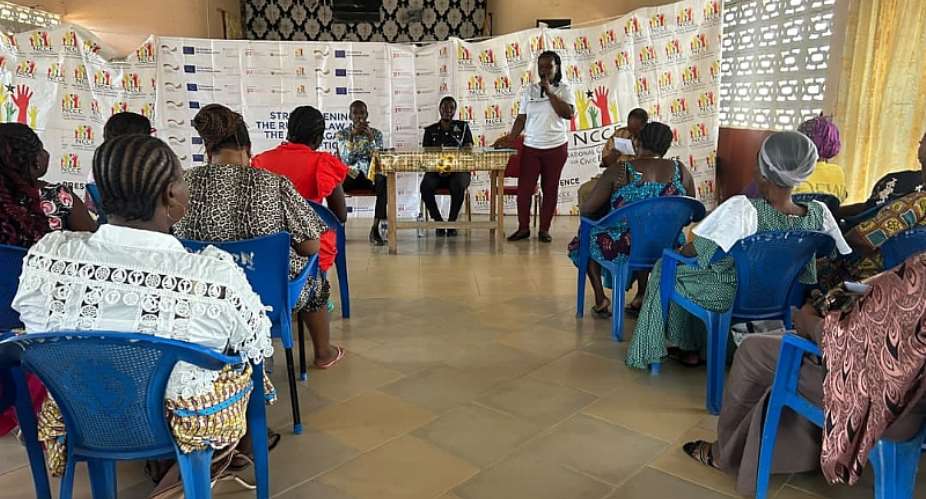
In a decisive move to foster transparency and grassroots accountability, women in the Fanteakwa North District have formally renewed their commitment to combating corruption and championing the rule of law.
On October 7, 2026, the National Commission for Civic Education (NCCE), in collaboration with the Deutsche Gesellschaft für Internationale Zusammenarbeit (GIZ) and backed by funding from the European Union (EU), hosted a strategic follow-up engagement at the Apostolic Church Hall in Bethlehem, Begoro. The initiative was designed to solidify women’s vital roles in promoting societal integrity and built directly upon a previous educational campaign focused on citizens' rights and corruption prevention.
The engagement gave local women a crucial platform to reflect on their lived experiences and evaluate practical strategies for tackling systemic issues, including bribery, discrimination, harassment, and the abuse of authority. Facilitators utilised interactive discussions, targeted case studies, and knowledge assessments to help participants deepen their understanding of their civic responsibilities and the legal protections available to them.
Crucially, the forum did not shy away from the realities of whistleblowing. Participants critically examined the socio-cultural barriers that often silence victims and witnesses, citing the fear of retaliation, intense social pressure, and a pervasive lack of awareness regarding safe reporting mechanisms. By addressing these roadblocks head-on, the session clarified the appropriate, secure channels for reporting corruption and human rights violations.
To ensure long-term impact, the programme emphasised the power of collective mobilisation. Women’s associations and local peer-support groups were encouraged to act as vanguards of transparency within their respective neighbourhoods. Participants were given a clear mandate: educate their peers, actively engage with local authorities, and demand a seat at the table in community decision-making.
The day concluded with participants drafting concrete individual and collective action plans. These blueprints are designed to seamlessly translate the civic knowledge gained into practical, community-led initiatives, ultimately striving to build a society where fairness, integrity, and strict adherence to the rule of law are upheld at every level.

 Sir Sam Jonah appeals to Mahama for restoration of Acheampong's military rank of...
 Macron says limiting Ukraine aid would pave way to 'another war'
 Ukraine's relationship with NATO 'back on the table': Zelensky
 Agriculture will be a national security priority under my government – Bawumia
 Galamsey damage accumulated over years cannot be reversed immediately – Kwesi Sc...
 Government must fulfil 25,000 public sector recruitment promise – Kpebu
 Ken Ofori-Atta did better in his first two years as Finance Minister than Ato Fo...
 Ato Forson must acknowledge previous governments' contributions to economic reco...
 November 14: Cedi sells at GHS12.35 on forex market, GHS11.70 on BoG interbank
 'I never imagined my father was a Nazi': Born in a German-run 'baby factory'


