




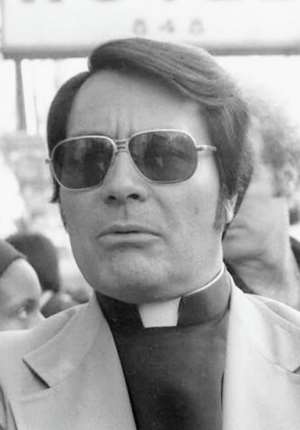
How did a preacher who spoke about racial equality, love, justice and community become responsible for one of the most horrifying mass deaths in modern history? Why did hundreds of adults surrender their judgment to one man? And what happens when religious authority becomes more powerful than conscience, evidence and the Bible itself?
On 18 November 1978, the world witnessed the catastrophic consequences of a movement that had begun with promises of hope, equality and a better society. Deep inside the jungles of Guyana, South America, more than 900 people associated with an American religious movement known as Peoples Temple died in what became known as the Jonestown tragedy. More than 200 of the dead were children.
At the centre of the catastrophe was Jim Jones, a charismatic preacher who had built a following by promising to challenge racial discrimination, economic inequality and social injustice. Yet, as his movement grew, the ideals that had attracted many followers were increasingly overshadowed by demands for unquestioning loyalty, isolation from outsiders, punishment of dissent and ultimately the loss of hundreds of lives.
The Federal Bureau of Investigation's historical account documents allegations of beatings, forced labour, imprisonment, drug use and rehearsals for mass suicide before the final catastrophe. The tragedy culminated in the killing of an American congressman and the deaths of the people Jones had persuaded to follow him to Guyana. FBI +1
Jonestown is often dismissed with a convenient explanation: They were members of a cult, and they were foolish enough to believe their leader.
But that explanation is too easy.
It allows the rest of society to distance itself from the victims without examining the conditions that made such a disaster possible. It avoids uncomfortable questions about authority, religious manipulation, fear, social pressure and the human desire to belong.
The more difficult question is this: How does a person surrender the right to think independently, and how can religious faith become a weapon in the hands of someone who demands to be obeyed rather than questioned?
Jonestown was an extraordinary tragedy. Yet the questions it raises remain relevant wherever leaders use sacred language to discourage scrutiny, exploit vulnerable people or place themselves beyond accountability.
1. Who was Jim Jones, and where did he come from?
James Warren “Jim” Jones (1931–1978)
American religious leader and founder of Peoples Temple
Jim Jones was born on 13 May 1931 in Crete, Indiana, United States. He grew up in a difficult family environment and became interested in religion at a young age. His parents were James Thurman Jones, a disabled First World War veteran, and Lynetta Putnam Jones.
Accounts of his childhood describe a socially isolated boy who developed an early fascination with religious rituals, preaching and the lives of disadvantaged people. His family circumstances and childhood experiences provide background to his life, but they do not, by themselves, explain or excuse his later actions. PBS +1
Jones's father was frequently absent from family life, while his mother worked hard to support the household. His mother later became involved in her son's religious movement. Jones encountered different Christian traditions as a child, observing their practices and experimenting with preaching.
He eventually discovered that he possessed a remarkable ability to attract an audience.
He could speak passionately, command attention, identify what people were worried about and present himself as someone who understood their suffering. These abilities would become central to his rise.
But an important distinction must be made: being persuasive is not the same as being truthful, and being charismatic is not the same as being spiritually trustworthy.
Jones's early life may help historians understand the background of his personality. It does not establish that he was destined to become a mass-murdering cult leader.
The real issue is what happened when his ability to influence people became concentrated in an organisation with inadequate safeguards against his power.
2. Did Jim Jones really become a pastor?
Yes. Jones was not simply a man who invented a religious title and began preaching in isolation.
He developed a genuine religious ministry, established congregations, attracted members and eventually became an ordained minister. Historical records document his early ministry at Somerset Methodist Church in Indianapolis in 1952, followed by the development of his own congregation.
His church went through several names before becoming known as Peoples Temple. The congregation later affiliated with the Christian Church (Disciples of Christ), and Jones was ordained within that denomination in 1964. Spencer - The Archival Collections Catalog +1
This history matters because it demonstrates that religious credentials, church membership and institutional recognition do not automatically guarantee the integrity of a leader.
Jones initially preached themes that many people considered admirable. He opposed racial segregation at a time when discrimination was deeply embedded in American society. He welcomed Black and white worshippers into an integrated congregation, supported social programmes and presented his church as a place where disadvantaged people could find dignity and assistance.
For some members, Peoples Temple offered something they could not find elsewhere: a community that appeared to practise the equality it preached.
Jones and his wife, Marceline, also adopted children from different racial and ethnic backgrounds, reflecting the movement's public commitment to integration. PBS +1
This is one of the most disturbing lessons of the story.
A destructive movement does not necessarily begin by announcing destructive intentions. It can begin by addressing genuine social problems, providing meaningful support and giving people a reason to believe that they have finally found somewhere they belong.
The question is not merely how Jones attracted people. It is how the organisation that initially offered hope became a system in which loyalty to Jones could override personal freedom, family relationships and even the instinct to survive.
3. What did Jones preach, and what was his real ideology?
Jones's ideology changed over time. His movement combined elements of Christianity, racial integration, socialism, communal living and increasingly radical revolutionary politics.
His early message attracted people who were frustrated by racial injustice, poverty and the failure of established institutions to treat everyone equally. His church offered social assistance, community support and the promise of a society in which people would not be judged by the colour of their skin.
As the movement developed, however, Jones increasingly rejected traditional Christianity and promoted his own radical interpretation of religion and politics. He attacked established religious institutions, portrayed the outside world as corrupt and dangerous, and increasingly presented himself as the authority around which the movement had to organise itself. Historical scholarship documents the transition from social and religious activism towards a system built around Jones's personal control. PBS +2
This distinction is crucial: the ideals that attracted people to Peoples Temple were not necessarily the same as the ideology that ultimately controlled them.
A person could have joined because they wanted racial equality, social justice or a supportive community. Years later, that same person could find themselves in an organisation where leaving meant losing friends, family, security and the identity they had built around the movement.
Jones also cultivated a narrative of persecution. He portrayed the movement as being under attack by hostile forces, reinforcing the idea that outsiders could not be trusted.
When criticism is presented as proof that the critic is an enemy, the leader creates a dangerous circle of reasoning: every accusation becomes evidence of persecution, and every attempt to investigate becomes another reason to obey him.
The questions that follow are uncomfortable:
* If a pastor begins by preaching love but ends by demanding absolute loyalty, at what point should the congregation recognise that something has gone wrong?
* If a church's declared mission is justice, why should its leader be exempt from justice?
* If a preacher claims to represent God, should that claim give him greater accountability or less?
* When the leader's personal interests conflict with the welfare of the congregation, whose interests should come first?
And perhaps the most important question: Did the followers remain committed to the original ideals of the church, or had the church gradually taught them that loyalty to Jones was more important than those ideals?
4. Why did people follow him? Were they all foolish?
It is tempting to imagine that the victims of Jonestown were ignorant, irrational or incapable of independent thought.
The historical record makes that explanation inadequate.
Peoples Temple attracted people from different backgrounds, including workers, professionals, older adults, political activists and families. Some were deeply committed Christians before joining. Others were attracted by the movement's social programmes, racial integration and promise of collective security.
Many believed they had found a community that cared about them.
For people who had experienced discrimination, loneliness, poverty or personal hardship, the Temple could offer genuine friendship, practical help and a sense of purpose. Some members invested years of their lives in the movement and came to see it as their family.
Once a person has invested so much emotionally, socially and sometimes financially in a leader, admitting that the leader may be dangerous can become profoundly difficult.
It means questioning not just the leader but also one's own past decisions, sacrifices and relationships.
That is one reason people can remain in destructive organisations even after disturbing information emerges.
How trust becomes control
Stage 1: Belonging
The leader offers hope, friendship, community, practical support or a compelling mission. Members feel seen and valued.
Stage 2: Identity
The group becomes central to a member's life. Leaving begins to feel like betraying friends, family and a cause they believe in.
Stage 3: Isolation and fear
Critics are portrayed as enemies. Doubt may attract humiliation or punishment, while obedience is praised as loyalty.
Stage 4: Entrapment
Members may find it difficult to leave because of threats, dependence, social pressure, surveillance or fear of what will happen to their loved ones.
This is a useful framework for understanding coercive control, not a claim that every member experienced every stage in precisely this order.
Accounts of Peoples Temple describe the weakening of family ties, punishment of dissent and increasing control over members' lives. The FBI's historical account also records allegations of confinement and forced labour at Jonestown. FBI +1
Consider what that means for the question of personal responsibility.
Yes, adults must think critically. But critical thinking becomes harder when a person is isolated, exhausted, threatened, surrounded by people expressing the same beliefs and told that disobedience will bring disaster.
A person can be intelligent and still be manipulated. Education does not make anyone completely immune to fear, group pressure or the influence of a trusted authority.
The appropriate lesson is therefore not to mock the victims. It is to understand how manipulation works so that it can be recognised before it becomes deadly.
If a religious leader gradually makes himself the only trusted source of truth, how will his followers know when he starts lying to them?
5. Why was nobody able to question Jim Jones?
The premise that nobody ever questioned Jones is not entirely accurate. Former members and concerned relatives raised objections, people left the movement, and some members eventually tried to expose abuses.
The deeper problem was that dissent increasingly carried a cost.
Jones's authority became so centralised that challenging him could be treated as betrayal. Historical accounts describe humiliating punishments, physical abuse, intimidation and other methods of enforcing compliance. His followers were also encouraged to see outside criticism as evidence of a campaign against them. FBI +1
This creates a serious problem in any organisation, religious or otherwise.
When a leader can control the message, punish critics, define who counts as an enemy and claim exclusive authority to interpret the truth, ordinary checks and balances become ineffective.
A congregation may still appear to have meetings, sermons, prayers and leaders. Yet the appearance of collective worship can conceal a system in which meaningful decisions are made by one person.
The real test of leadership is not how loudly people applaud when the leader speaks. It is whether they can disagree without being threatened, humiliated or cast out.
The dangerous use of “Do not touch my anointed”
In some Christian circles, the phrase “Do not touch my anointed” is used to warn people against criticising a pastor or questioning a church leader.
The expression draws on biblical language, including Psalm 105:15 and 1 Chronicles 16:22. But using it to prohibit all scrutiny is a serious interpretive problem.
The biblical context concerns God's protection of his anointed people. It does not establish a universal rule that every person claiming to be a pastor is beyond correction, investigation or accountability.
Consider other biblical passages:
* Acts 17:11: The Bereans are commended for examining the Scriptures daily to determine whether the teaching they received was true.
* 1 John 4:1: Believers are instructed not to believe every spirit but to test the spirits.
* Matthew 7:15–20: Jesus warns about false prophets and teaches that they can be recognised by their fruits.
* Galatians 1:8: Paul warns against accepting even a message delivered by an apparently authoritative religious messenger if it contradicts the gospel.
These passages establish an important principle: religious claims must be tested rather than accepted simply because of the person making them. Bible Gateway +1
There is a difference between maliciously attacking a pastor and responsibly questioning a pastor's conduct.
There is a difference between gossip and asking for evidence.
There is a difference between disrespect and refusing to surrender one's conscience.
And there is a difference between a congregation that respects its leadership and a congregation that has been taught to fear it.
If the Bible itself encourages discernment, why should a preacher be afraid of a congregation that reads it carefully?
If a pastor teaches that every question is rebellion, every critic is an enemy and every financial demand must be obeyed, should believers interpret that as evidence of spiritual authority or as a warning sign?
The issue is not whether religious leaders deserve respect. It is whether respect should ever mean unconditional obedience.
6. What does the Stanley Milgram experiment teach us?
In the early 1960s, psychologist Stanley Milgram conducted influential experiments investigating obedience to authority.
Participants were instructed by an experimenter to administer what they believed were increasingly severe electric shocks to another person whenever that person answered questions incorrectly. The person receiving the supposed shocks was an actor, and no actual shocks were delivered to him.
In the best-known version, conducted at Yale University, 65% of participants continued to the experiment's maximum labelled level of 450 volts despite hearing the apparent distress of the other person.
The experiment was not a direct test of religious belief, and it does not prove that all people will obey all authorities. Its significance lies in demonstrating how strongly an apparently legitimate authority can influence ordinary people's decisions under particular conditions. YSU Library
The broader lesson is disturbing.
People who consider themselves decent can sometimes continue actions that conflict with their conscience when an authority figure assumes responsibility, insists that they continue or makes disobedience feel unacceptable.
Now consider the environment of a high-control religious movement.
The authority figure may not wear a laboratory coat. He may stand behind a pulpit, carry a Bible, wear an expensive suit and speak with the confidence of someone who claims to know God's will.
His followers may not be instructed to administer electric shocks. They may be told to donate money they cannot afford, cut off relatives, submit to humiliating treatment, conceal misconduct or accept dangerous instructions.
These situations are not morally or historically identical to Milgram's experiment. But the question of obedience is relevant to both.
When people believe that authority is legitimate, that others will comply and that they alone will be responsible for disobedience, resistance can become psychologically difficult.
And when somebody finally refuses, that refusal can give others permission to question the order as well.
The question for churches is not whether every pastor is like Jim Jones. That would be an unjustified generalisation.
The question is whether religious communities create the conditions that make it possible for members to disagree, seek outside advice, report abuse and leave without intimidation.
A healthy church should not need to eliminate independent thought to preserve faith.
7. The “White Nights”: how the poison rehearsals prepared the ground for disaster
One of the most chilling aspects of Jonestown was the use of events known as “White Nights.”
These were emergency gatherings in which Jones claimed the community faced imminent danger. Some included rehearsals in which members were told they might have to die collectively rather than surrender to their enemies.
On some occasions, members drank a liquid they were told was poison. They were later informed that the exercise had been a test of their loyalty.
The practice normalised the idea that collective death was an acceptable response to an alleged external threat. It also gave Jones an opportunity to observe his followers' reactions and reinforce his authority.
Historical records and former members' accounts document these rehearsals before the final tragedy. archives.sdsu.edu +1
Think about the psychological implications.
If someone repeatedly tells you that your enemies want to destroy you, that your community is surrounded by danger, and that you must be prepared to die rather than surrender, the concept of death may gradually become part of the group's identity.
If the leader then stages a supposed test of loyalty and subsequently declares that the threat was a rehearsal, members may become accustomed to following extraordinary instructions under pressure.
But a question remains: why did more people not reject the entire premise?
Some did resist, leave or attempt to expose what was happening. Others remained because of their commitment to the group, their fear of the consequences of leaving, or their belief that Jones was protecting them.
By the final day, the movement had been conditioned by years of increasingly extreme demands. The earlier rehearsals did not make the final outcome inevitable, but they formed part of the environment in which Jones could present mass death as a political act rather than a crime against human life.
When a leader repeatedly asks followers to demonstrate that they are willing to die for him, should the next question be whether they have enough faith or whether the leader has become dangerously powerful?
8. The authorities knew something was wrong. Why could they not save everyone?
It is important to distinguish between the authorities' response before the tragedy and their response after it began.
Warnings did exist. Former members and relatives had raised concerns about coercion, mistreatment and the possibility of mass suicide. Those concerns reached American officials and helped motivate a congressional investigation.
California Congressman Leo Ryan travelled to Guyana in November 1978 to investigate the situation. His visit followed complaints from constituents whose relatives had joined Peoples Temple and who feared for their welfare. Government correspondence and congressional records document the concerns surrounding the trip. Office of the Historian +1
Ryan and his delegation arrived at Jonestown on 17 November. During the visit, they interviewed residents, and some members asked to leave with the delegation.
That development threatened Jones's control over the community.
On 18 November, as the delegation and departing members gathered at the Port Kaituma airstrip, armed members of Peoples Temple attacked. Congressman Ryan, three journalists and a Temple defector were killed. Other people were wounded.
Back at Jonestown, Jones convened the final gathering and urged residents to consume a lethal drink containing cyanide. FBI +1
Why was there no immediate rescue?
Jonestown was a remote settlement in the Guyanese jungle. It was not a conventional American town with a nearby police station, hospital and emergency response network.
American officials had received warnings, but the existence of warnings did not mean they had sufficient legal authority, physical access or reliable evidence to remove hundreds of people from the settlement by force before the disaster.
The congressional visit was an investigative mission, not a military rescue operation. The situation escalated rapidly after the attack at the airstrip.
It would therefore be inaccurate to claim that American authorities simply believed Jones and deliberately allowed the entire community to die. The record instead reveals a troubling combination of prior warnings, concerns about citizens abroad, difficult access, limitations on intervention and a catastrophe that unfolded with devastating speed.
What happened after the deaths?
The Guyanese authorities and the United States government coordinated the response. The scale of the deaths required an enormous operation to reach the remote settlement, identify victims, recover bodies and arrange their return to the United States.
American military personnel helped transport and repatriate the remains, while FBI investigators assisted with identification and the investigation into the killings. The FBI also investigated the assassination of Ryan and pursued legal action against surviving Temple member Larry Layton, who was eventually convicted in the United States and sentenced to life imprisonment. military-response-to-jonestown.sdsu.edu +1
Afterward, the United States Congress investigated the circumstances surrounding Ryan's mission and the government's handling of information about Peoples Temple.
These investigations matter because they demonstrate that the tragedy was not merely a private religious dispute. It involved allegations of serious abuse, the killing of public officials and journalists, failures to protect vulnerable people and questions about how authorities should respond when citizens may be held under coercive conditions.
The question that remains is uncomfortable:
When relatives repeatedly report that a religious organisation may be abusing its members, should authorities wait for a crime to become undeniable before acting or should credible evidence of coercion trigger earlier protective intervention?
The challenge is to protect people without criminalising legitimate religious freedom. But religious freedom cannot reasonably mean that leaders are entitled to imprison, threaten or endanger their followers without scrutiny.
9. How many people died? Were children among the victims?
THE FINAL TOLL 18 NOVEMBER 1978
918 people
Total deaths associated with the Jonestown tragedy in Guyana
304
Children and minors under 18
909
People who died at Jonestown itself
Historical death counts include different locations and circumstances. The 918 total comprises deaths at Jonestown, the Port Kaituma airstrip and the Temple's Georgetown headquarters. Jonestown & Peoples Temple +1
The inclusion of children is central to understanding why the event cannot be described adequately as a voluntary mass suicide.
Children could not meaningfully consent to a decision made by their parents or by Jones. Babies and young children were given the poisoned liquid before many adults consumed it themselves. The surviving audio recording documents Jones urging the community forward as people expressed different reactions, including objections. PBS +1
Some adults apparently took the poison willingly. Others may have faced threats, pressure or physical coercion. The evidence does not justify treating every adult's circumstances as identical.
The presence of so many children, however, makes one point indisputable: whatever Jones called the event, hundreds of victims never had a meaningful opportunity to decide whether they wanted to live.
What kind of leader tells parents that killing their children is an act of loyalty?
What kind of community reaches a point where a child's instinct to survive can be overridden by an adult's devotion to a leader?
And what does it mean when an ideology becomes so powerful that the protection of children is sacrificed to preserve the authority of the person preaching it?
These are not questions that can be answered by simply labelling the victims foolish.
They demand an examination of the leader who created the conditions, the coercive environment that restricted resistance, and the failure of those around him to prevent the final catastrophe.
10. What happened to Jim Jones himself?
Jones died on 18 November 1978, the same day as the mass deaths.
His body was found with a gunshot wound to the head. The Guyanese pathologist who examined him reported that the wound appeared consistent with a self-inflicted gunshot, although the circumstances were not established through a complete autopsy. The historical evidence supports describing his death as an apparent suicide, rather than claiming that every detail has been conclusively established. Jonestown & Peoples Temple +1
Jones did not survive to face a trial for the events he had orchestrated.
That is one of the great ironies of Jonestown: the man who demanded extraordinary sacrifice from others died during the catastrophe, while the people whose lives he controlled were left to bear its consequences.
The leader who had presented himself as the solution to his followers' suffering became the central figure in their destruction.
His death did not erase the evidence. Recordings, government documents, eyewitness accounts, survivor testimony and historical research have preserved a record of the final hours and the years of control that preceded them.
Among the most important records is the so-called Death Tape, an audio recording of the final gathering. It captures Jones urging his followers to take their lives, people expressing support, and others objecting or struggling with what was happening. It is a disturbing primary source because it reveals that the crowd was not psychologically uniform: there were different reactions, but dissent did not prevail. Jonestown & Peoples Temple +1
The final lesson is not that every follower was equally responsible. It is that an environment built around one person's unchecked authority can become so destructive that even the most fundamental moral obligations protecting children, preserving life and allowing people to leave are overturned.
11. What did his wife, mother and surviving family say about him?
Jim Jones's family story is complicated. His relatives were not all present at Jonestown, and their experiences of him differed.
His wife, Marceline Jones, remained associated with Peoples Temple and died in the tragedy. His mother, Lynetta Jones, also died at Jonestown. Their presence among the dead illustrates how deeply the movement had drawn even members of Jones's own family into its final catastrophe.
His surviving sons, however, have offered different reflections on their father.
In a 2018 interview with ABC News, Stephan Jones described his father's early public mission as an effort to break down barriers and create a community in which people from different backgrounds could belong. But he also said that the movement's ideals had become superficial as his father changed. Stephan recalled a man increasingly concerned with how others perceived him. ABC News +1
His half-brother, Jim Jones Jr., had a different experience. He said he had been a true believer in what Peoples Temple could have been and expressed gratitude for the opportunities he had received through his adoption into the family.
The brothers' differing perspectives are significant. One saw more clearly the gap between his father's public image and his later conduct; the other remained attached to the positive possibilities he believed the movement had once represented.
These are not simply two competing explanations of the tragedy. They reveal how the same leader can be experienced differently by people close to him, even within the same family.
Was there something psychologically wrong with Jim Jones?
Former members and surviving relatives described Jones as increasingly manipulative, demanding and preoccupied with maintaining control. ABC News also reported former members' accounts of his drug and alcohol use. ABC News +1
However, it would be irresponsible to diagnose him retrospectively without sufficient clinical evidence. Drug use, family difficulties and psychological characteristics may be relevant to understanding his behaviour, but none alone explains the full catastrophe.
Nor should the tragedy be reduced to the notion that Jones was simply mentally ill. Doing so risks overlooking the organisational, political and social conditions that enabled his authority to grow.
The more useful questions concern observable conduct:
* Why was his authority allowed to become so concentrated?
* Why were dissenters punished rather than heard?
* Why did the organisation tolerate practices that harmed members?
* Why did the leader's personal demands increasingly take precedence over the welfare of the community?
A psychological explanation cannot replace moral responsibility or institutional accountability.
12. Does Jim Jones have descendants living in the modern world?
Yes. Jones's family line did not end with him.
He and Marceline had one biological son, Stephan Gandhi Jones, and adopted several children, including James Warren Jones Jr., commonly known as Jim Jones Jr. The family also included children of Korean, African-American, Native-American and white backgrounds. PBS +1
Jim Jones’ sons recall Jonestown massacre, describe cult leader’s drug addiction in new doc | Fox News
Stephan Jones
Biological son
He was away from Jonestown during the final catastrophe. He has spoken publicly about his father's legacy and has worked to remember the people who died.
40 years after the Jonestown massacre: Jim Jones' surviving sons on what they think of their father, the Peoples Temple today - Good Morning America
Jim Jones Jr.
Adopted son
He was also away when the deaths occurred. He has spoken about surviving the tragedy, losing loved ones and rebuilding his life.
ABC News reported in 2018 that the surviving sons had continued their lives after the tragedy and were still working through its emotional consequences. Stephan discussed his efforts to remember former Temple members by identifying people in historical photographs, while Jim Jr. described the complicated relationship between his father's legacy and his own identity. ABC News +1
Jones's descendants and extended family should not be confused with the crimes of the man who led Peoples Temple. His surviving relatives did not become responsible for his actions merely because they share his family history.
As for where his descendants live today, publicly available accounts do not establish the current residences of all family members, and it would be inappropriate to speculate about private addresses. Some descendants may live relatively private lives, and they should be afforded that privacy.
The broader point is that family members can inherit the consequences of a historical tragedy without inheriting responsibility for it.
13. Was Jonestown biblical, or was it Jim Jones's own belief system?
This question deserves a direct answer.
The mass killing at Jonestown cannot be justified by the Christian biblical principles discussed in this article. Jones increasingly promoted his own radical ideology and used religious language to support it.
His early ministry had Christian roots, but the fact that a leader begins as a recognised pastor does not mean that every later teaching or action represents Christianity.
In the final gathering, Jones described the deaths as “revolutionary suicide,” presenting them as a response to an allegedly inhumane world. The surviving recording shows him urging followers to accept death while invoking fears about the community's enemies. PBS +1
But where is the biblical justification for poisoning children? Where is the authority for forcing people to surrender their lives to preserve a leader's ideology?
The New Testament repeatedly emphasises discernment, the rejection of false teaching and the importance of examining the character of those who claim spiritual authority.
Jesus's warning in Matthew 7:15–20 is particularly relevant: people should examine the fruits of a teacher's conduct, not merely accept the teacher's claims.
Acts 17:11 praises those who examined the Scriptures to determine whether what they were being taught was true. The passage does not portray questioning as an act of disloyalty.
And 1 John 4:1 explicitly warns believers not to accept every spiritual claim without testing it.
These passages offer a powerful standard for religious accountability: a leader's claim to divine authority does not eliminate the duty to examine what that leader teaches and does.
The name of God can be invoked in support of truth, but it can also be invoked by someone pursuing personal power. Religious language, by itself, does not establish that a teaching is righteous.
The central test must be the substance of the teaching, its consistency with Scripture, its ethical consequences and the treatment of the people subject to its authority.
14. From Jonestown to modern churches: when does faith become a business of control?
Jonestown should not be used to accuse every pastor, church or religious movement of being a cult. Many churches provide genuine support, encourage service, promote education and help vulnerable people.
But neither should the scale of the Jonestown tragedy prevent society from examining abuses of religious authority when they occur.
In contemporary religious settings, particularly where charismatic leaders command large followings, questions about money, accountability, personal power and the interpretation of Scripture remain important.
Consider a congregation in which the pastor tells members that giving a particular sum of money will guarantee a miracle. What evidence supports that promise? Can members ask how church funds are used? Can they refuse to give without being publicly humiliated or threatened with divine punishment?
Consider a leader who claims that a member's illness, unemployment or financial hardship proves that the person lacks faith. Does that teaching provide spiritual support, or does it transfer blame to people who may already be suffering?
Consider a church where the pastor's family controls every important position, the congregation cannot inspect financial records and critics are accused of attacking God.
At what point should members recognise that a spiritual organisation may be serving the interests of its leadership rather than its congregation?
These questions are not accusations against all pastors. They are questions of governance and accountability that any organisation claiming moral authority should be prepared to answer.
Five questions every congregation should be able to ask
1. Where does the money go?
Are donations and offerings accounted for transparently? Are members able to understand how funds are used?
2. Can the pastor be challenged?
Is there an independent process for reporting misconduct, examining allegations and holding leaders accountable?
3. Is giving genuinely voluntary?
Can members decline financial demands without being told that God will curse them, destroy their families or deny them salvation?
4. Are members free to think and leave?
Can people consult other religious leaders, speak with their families, disagree with teachings and leave the congregation without threats?
5. Does the leader practise what is preached?
Are the standards demanded of ordinary members also applied to the pastor, or is the leader treated as an exception to every rule?
These questions are not hostile to Christianity. They are consistent with the principle that truth should withstand examination.
A church that genuinely serves its members should not need to hide its finances, intimidate critics or make people dependent on one individual's approval.
A pastor who preaches generosity should be willing to account for donations. A leader who preaches honesty should welcome scrutiny of his own conduct. A church that teaches love should not use fear to keep people from leaving.
If a pastor's authority depends on preventing members from asking questions, what exactly is that authority protecting?
15. The most uncomfortable question: how could adults allow one man to control their thinking?
This question is often asked with contempt, as though the people who died at Jonestown were fundamentally different from everyone else.
But consider how people become committed to leaders in ordinary life.
People trust doctors because of their training. They trust judges because of their office. They trust political leaders because of their promises. They trust religious leaders because they believe those leaders understand spiritual matters.
Trust is essential to human society. Without it, cooperation becomes difficult.
The danger begins when trust is converted into unconditional obedience.
An individual may initially trust a pastor because the pastor has offered wise advice or helped during a difficult period. That trust may then extend to areas where the pastor has no special expertise. Eventually, the member may feel that disagreeing with the pastor is equivalent to disagreeing with God.
If the pastor then introduces increasingly extreme demands, the member may struggle to separate personal loyalty from moral judgment.
This process does not require every follower to be unintelligent. It requires an environment in which independent judgment is progressively discouraged and the social costs of dissent become increasingly severe.
That is why the question must go beyond, “How could they be so foolish?”
We should ask instead:
* What warning signs did the organisation suppress?
* What did members risk losing if they challenged Jones?
* How were children taught to understand authority and obedience?
* Why did collective agreement become more powerful than individual conscience?
* What opportunities existed to question the leader without fear?
* Why did the voices of those who objected fail to change the outcome?
The tragedy is a warning about human vulnerability, not proof that the victims lacked intelligence or dignity.
And it reminds us that the most dangerous leaders may be those who initially give people something genuinely valuable belonging, purpose, solidarity or hope and later use that trust to control them.
16. The final lesson: no pastor should become more important than the truth
Jim Jones did not begin with a congregation of people who knew that they were joining a movement that would end in mass death.
He built his following through promises of equality, community and social transformation. Over time, his authority grew, dissent became dangerous, and the movement's members were increasingly subjected to his personal demands.
On 18 November 1978, the consequences became irreversible.
More than 900 people died. Hundreds were children. Congressman Leo Ryan and others were murdered while trying to investigate the situation and help people who wished to leave. Survivors and families were left to live with the consequences of a catastrophe that could never be undone. Jonestown & Peoples Temple +1
The story of Jonestown should make every society examine the relationship between belief and power.
In Ghana, as in other countries, churches are part of the social fabric. Religious leaders can provide valuable guidance, and faith can offer comfort and hope during difficult times. But neither a clerical title nor a claim of divine anointing should place an individual beyond reasonable scrutiny.
A pastor is not God. A congregation is not the personal property of its leader. Donations do not remove the need for financial accountability. And biblical language should never be used as a substitute for evidence, ethical conduct or the protection of human life.
The phrase “Do not touch my anointed” should never be allowed to become a blanket excuse for misconduct. Respect for religious authority does not require surrendering one's conscience.
The real test of a spiritual leader is not the number of followers, the size of the church, the value of the offerings or the intensity of the applause.
It is whether the leader serves the people entrusted to his care, welcomes accountability and respects their freedom to think, question and make informed decisions.
And the real test of a congregation is whether it can recognise the difference between faith and fear.
The questions we must not be afraid to ask
What happens when a pastor's words become more important than the Bible he preaches?
What happens when questioning a leader is treated as rebellion, while obeying him is presented as proof of faith?
What happens when members give money they cannot afford because they are afraid that God will punish them if they refuse?
What happens when the congregation knows that something is wrong but remains silent because nobody wants to be the first person to speak?
And what happens when a leader convinces people that their salvation, security and future depend entirely on him?
Jonestown demonstrates the catastrophic possibilities of unchecked authority. It does not establish that every religious leader is dangerous, but it shows why no leader should be exempt from scrutiny.
The lesson is not to abandon faith. It is to refuse to confuse faith with surrendering one's judgment.
A person who asks for evidence is not necessarily rebellious. A member who questions a pastor is not necessarily an enemy of God. And a leader who genuinely serves the truth should not need to make people afraid of asking questions.
The next time someone tells you, “Do not question the man of God,” ask a different question:
If the truth is on his side, why should an honest question threaten him?
Because the most dangerous moment in any institution is not necessarily when a leader begins to abuse his power.
It is when everyone around him becomes too afraid to say so.
By:
Patrick Belebang Yagsori
0240292413
[email protected]

 NDC must maintain policy consistency to perform better – Asiedu Nketia
 South Africa evacuation: Ablakwa failing to meet standards he set in opposition ...
 Mahama eyes Russian investment in Ghana’s energy sector ahead of meeting with Pu...
 ECOWAS deploys pre-election mission to Nigeria ahead of 2027 polls
 Real Madrid apologise to China over Mbappé's Mao Zedong comments
 Netanyahu bloc leads after half of Israeli votes counted but no majority
 Bagbin calls for private member's bill for professional certification, charterin...
 'You can’t make money in journalism' — Speaker Bagbin
 GES sets November 16 date for payment of 2025 promotion arrears
 Wontumi’s lawyers seek recall of prosecution witness in illegal mining case


