




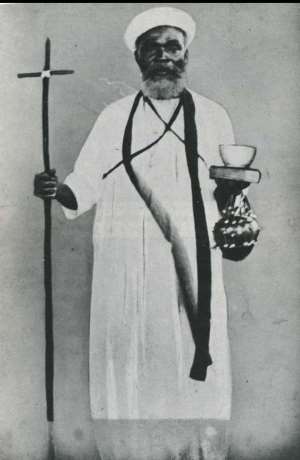
The forgotten Liberian prophet who transformed Christianity in West Africa, challenged colonial authority, and left a religious legacy that continues to shape Ghana and Côte d’Ivoire.
What happens when an African preacher, without the financial backing of a powerful missionary organisation, travels barefoot across colonial territories and persuades tens of thousands of people to abandon their traditional religious practices and embrace Christianity?
What happens when that preacher tells his followers that other Christians will eventually arrive with Bibles to teach them more about the faith and the colonial authorities decide that his growing influence has become too dangerous to tolerate?
And what does it say about our understanding of African history when a man associated with one of the most remarkable religious movements in twentieth-century West Africa remains largely unknown to many Africans, despite the continuing existence of churches that trace their origins to his ministry?
His name was William Wadé Harris, a Liberian religious leader of Grebo heritage whose extraordinary evangelistic movement swept through Côte d’Ivoire and parts of what is now Ghana during the 1910s.
Harris did not command an army. He did not establish a wealthy missionary empire. He did not arrive with the political protection of a European government or the financial resources of an established church.
Yet his preaching contributed to a major transformation of Christianity in the region.
Historical accounts associate his 1913–1915 campaign with the baptism of more than 100,000 people. His movement helped prepare the ground for established Christian missions, while also inspiring independent African churches that challenged the assumption that Christianity had to be introduced, supervised and controlled by Europeans.
His story is not simply about religion. It is about African agency, colonial power, cultural identity, political resistance, the ownership of history and the question of whose achievements deserve to be remembered.
Historical accounts of Harris are preserved in the Dictionary of African Christian Biography, including scholarly studies by David A. Shank and Gabriel Leonard Allen, as well as Sheila S. Walker’s research on the Harrist movement. These records offer a deeper story than the familiar image of a barefoot preacher who supposedly performed miracles and disappeared into poverty.
1. Who was William Wadé Harris, and where did he come from?
William Wadé Harris was born around 1860, although some historical accounts give 1865. He belonged to the Grebo people, an ethnic community in the Cape Palmas region of present-day southeastern Liberia.
Some biographical accounts identify his birthplace as Half-Graway or Glogbale, in the territory historically inhabited by the Grebo. His early life unfolded in a society where African traditional religion, Christianity, indigenous political institutions and the influence of foreign missionaries existed alongside one another.
Harris was not born into a family that was entirely Christian. According to the detailed biography by Gabriel Leonard Allen, his mother was Youde Sie, a Methodist Christian, while his father, Poede Wadé, followed the traditional religion of the Grebo people.
This background is important because it challenges the simplistic assumption that African Christianity began when Europeans arrived to introduce Africans to a completely unfamiliar religious world.
Harris grew up at the intersection of two religious traditions. His mother exposed him to Christianity, while his father maintained the spiritual and cultural practices of their community.
As a boy, Harris was taken by his maternal uncle, the Reverend John C. Lowrie, a Methodist minister and teacher, to Sinoe, where he received a Christian education. He learned to read and write in English and Grebo and became familiar with biblical teaching and church discipline.
He later returned to the Cape Palmas area and experienced further changes in his religious life. He worked aboard merchant vessels travelling along the West African coast, gaining exposure to different communities and religious environments.
His experiences as a sailor, labourer, teacher and interpreter would later form part of the background to his extraordinary ministry.
Harris was not merely a man who suddenly appeared in 1913 with a Bible and a message. He was the product of a complex society shaped by African traditions, Christian missions, political tensions and competing ideas about the future of Liberia and West Africa.
That complexity is essential to understanding the man who eventually became known as the Black Elijah.
2. Who were his parents, and what became of his family?
The names of Harris’s parents are preserved in scholarly biographical accounts: his father was Poede Wadé and his mother was Youde Sie.
His mother’s Methodist faith appears to have played an important role in his early exposure to Christianity, while his father introduced him to Grebo culture and traditional religious life.
Harris later married Rose Bedo Wlede Farr, also recorded in historical accounts as Rose Farr or Rose Bodede Farr. She was the daughter of an Episcopal church teacher or catechist.
Their marriage took place in the 1880s, commonly dated to around 1885–1886. The marriage produced six children, according to the detailed biography published by the Dictionary of African Christian Biography.
Rose was not merely a name in the background of his life. Harris’s dramatic religious transformation reportedly caused concern within his household. The man who had previously lived within the expectations of an established Christian community adopted the appearance and lifestyle of a prophet, eventually abandoning the familiar comforts associated with his earlier life.
Harris’s later life also included relationships with other women, and historical accounts document that he practised polygamy. This aspect of his life complicates attempts to portray him as a conventional missionary in the European ecclesiastical tradition.
He died in April 1929, in poverty, with five of his six children reported to have survived him.
But what became of his descendants?
That is one of the most important unanswered questions surrounding his legacy.
Historical biographies establish that Harris had children and grandchildren. However, the published accounts consulted for this article do not provide a sufficiently verified, comprehensive list of his living descendants, their current locations or their individual family histories.
It would therefore be irresponsible to invent names or claim that a particular modern family is descended from him without reliable genealogical evidence.
The question deserves further investigation through family records in Liberia, church registers, cemetery records, oral histories and the archives of the Harrist Church and related African Christian movements.
If the descendants of a man who helped transform the religious landscape of West Africa are still alive, have historians and church institutions made a serious effort to document their story?
And if they have, why is that family history not more accessible to the public?
These are questions worth asking, not because descendants must inherit fame, but because documenting families is an important part of preserving African history.
By:
Patrick Belebang Yagsori
0240292413
[email protected]

 Netanyahu bloc leads after half of Israeli votes counted but no majority
 One dead, 14 seriously injured in Akuse-Akosombo Highway crash
 Dr. Bawumia meets TUC leadership to discuss living wage, jobs and pensions
 Bagbin calls for private member's bill for professional certification, charterin...
 Lands Commission to invest GHS1.8 billion in land administration reforms
 'Ghana Airways will be back in the air before I leave office' — Ghana's Presiden...
 'You can’t make money in journalism' — Speaker Bagbin
 GES sets November 16 date for payment of 2025 promotion arrears
 Wontumi’s lawyers seek recall of prosecution witness in illegal mining case
 Minority urges independent audit of GHS49.7m South Africa evacuation


