




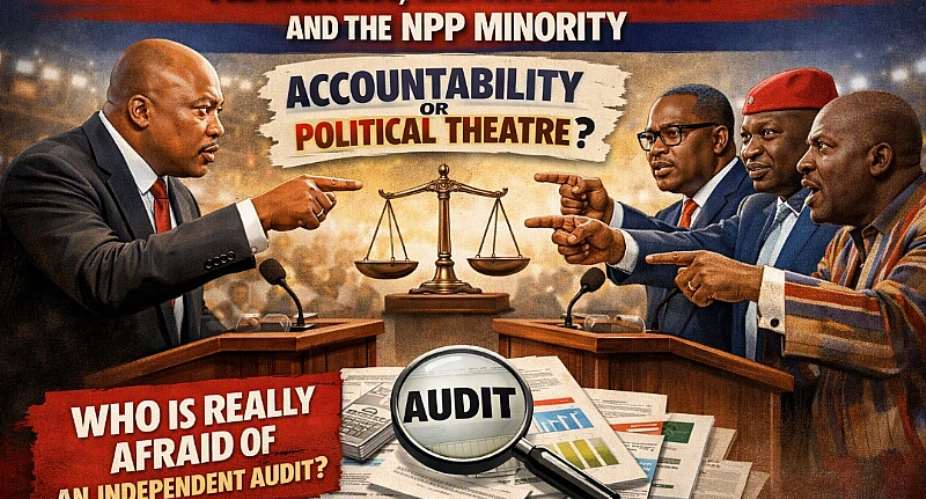
As allegations of missing evacuation funds, disputed allowances and questionable payment records dominate public debate, Ghanaians must ask a more fundamental question: Is this a genuine fight for accountability, or are vulnerable citizens being turned into instruments of partisan politics?
Introduction: When saving lives becomes a political battlefield
When xenophobic attacks and intimidation threaten the lives of Ghanaian citizens in another country, the responsibility of the government is clear: protect its people, facilitate their safe return and help them rebuild their lives.
But when that humanitarian operation involves nearly GH¢50 million, another responsibility immediately follows: account for every cedi.
This is the controversy surrounding the evacuation of 1,964 Ghanaians from South Africa between May 27 and September 4, 2026. Foreign Affairs Minister Samuel Okudzeto Ablakwa announced that the operation cost GH¢49,721,786, comprising GH¢33,721,786 in government funding and GH¢16 million contributed by Engineers & Planners, a company owned by businessman Ibrahim Mahama. The government also announced that each returnee received GH¢5,000 as reintegration support and GH¢500 for transportation.
The controversy has since intensified. The NPP Minority has questioned the financial records and demanded an independent audit. JoyNews Research has reported alleged discrepancies, including claims that some evacuees received less than the announced allowance. Ablakwa has rejected the allegations of underpayment and missing funds.
Now, here is the uncomfortable question that Ghana's political class and media must confront: Are we investigating the evidence, or have we already decided who is guilty and are searching for facts to support our preferred political conclusion?
The answer must not depend on whether the person under scrutiny belongs to the NDC or the NPP.
Who is Hon. Samuel Okudzeto Ablakwa?
Samuel Okudzeto Ablakwa is a Ghanaian politician from Aveyime-Battor in the North Tongu area of the Volta Region. Born on August 11, 1980, he rose to national prominence through student leadership, political activism and public service.
He served as President of the National Union of Ghana Students (NUGS) from 2005 to 2006. He subsequently entered government under President John Evans Atta Mills, becoming Deputy Minister for Information in 2009. Under President John Dramani Mahama, he served as Deputy Minister for Education, with responsibility for tertiary education.
Ablakwa has represented North Tongu in Parliament since 2013. His academic background includes studies in Political Science and Philosophy at the University of Ghana, an MA in Communications and Public Relations from the University of Leicester, an MSc in Defence and International Politics from the Ghana Armed Forces Command and Staff College, and an LLB from the University of London.
Between 2017 and 2024, he served as Ranking Member of Parliament's Foreign Affairs Committee, scrutinising the foreign policy decisions of the NPP-led government. In February 2025, he became Minister for Foreign Affairs under President Mahama. His career and ministerial appointment are documented by the Ministry of Foreign Affairs.
His political history is relevant because the man now facing questions over an evacuation exercise previously spent years questioning the decisions of an NPP government.
That history, however, should neither condemn nor vindicate him.
Ablakwa's past reputation for demanding accountability cannot serve as evidence that every financial transaction under his watch is correct. Equally, the fact that he is an NDC minister cannot make allegations against him automatically credible.
The standard must be the evidence, not the political identity of the person being investigated.
What happened in South Africa, and how much money was involved?
The evacuation followed renewed xenophobic attacks and intimidation against foreign nationals in South Africa. Ghana's government organised the return of 1,964 citizens over a period of slightly more than three months.
The reported financial breakdown is as follows:
| Item | Reported amount |
|---|---|
| Total evacuation expenditure | GH¢49,721,786 |
| Government contribution | GH¢33,721,786 |
| Engineers & Planners contribution | GH¢16,000,000 |
| Reintegration and transport allowances | GH¢10,802,000 |
| Allowance announced per evacuee | GH¢5,500 |
| Number of evacuees | 1,964 |
The allowances comprised GH¢5,000 for reintegration and GH¢500 for transportation. The remaining expenditure covered flights, ground transport, accommodation, feeding, medical care and other evacuation-related costs. The Ministry also reported spending GH¢84,274 on repatriation and related procedures for two deceased Ghanaians.
These figures matter for two reasons. First, the operation involved the safety and welfare of vulnerable citizens. Second, a substantial portion of the money came from public resources, while a private contribution formed part of the overall funding.
The public therefore has a legitimate interest in knowing how the money was spent, whether the private contribution was properly documented and whether every beneficiary received the support announced.
There is nothing unreasonable about asking these questions.
But there is also nothing reasonable about converting questions into convictions before the evidence has been independently examined.
Who raised the allegations, and what evidence have they presented?
The controversy was brought into parliamentary scrutiny by the NPP Minority, with Nana Asafo-Adjei Ayeh, Deputy Ranking Member of Parliament's Foreign Affairs Committee, among the leading voices.
Following a Right to Information request, the Minority examined records supplied by the Foreign Affairs Ministry. On October 11, MyJoyOnline reported that the Minority claimed more than GH¢16.4 million required further explanation. Its concerns included discrepancies involving payment registers, flight records, duplicate entries, allowances and payments associated with minors.
The Ministry subsequently supplied a report exceeding 200 pages, containing records relating to the evacuation. It also submitted documentation to Parliament and said it had requested a special audit by the Auditor-General covering the South African evacuation and earlier evacuation exercises dating back to 2017.
This is where responsible journalism must make an important distinction.
A discrepancy in a financial register is a legitimate reason to investigate. A duplicate name, an unexplained entry, a missing signature or a receipt that cannot be located may indicate a problem requiring correction or further investigation.
However, each of these issues must be examined in context.
A duplicate entry does not automatically establish that a second payment was made. A missing signature does not, by itself, prove that money was stolen. A mismatch between two registers does not necessarily establish that the difference represents cash that disappeared.
The question is whether the records can be reconciled with the actual transactions, the beneficiaries and the services provided.
The Minority deserves credit for demanding scrutiny if its concerns are evidence-based. But it must also demonstrate precisely how its calculations were made, what documents support them and how the alleged discrepancies translate into the figure of GH¢16.4 million.
A large figure announced at a press conference is not a substitute for a transparent financial reconciliation.
The same standard applies to the government. Producing hundreds of pages is important, but the public also needs to understand what the documents prove, what remains disputed and what an independent auditor concludes.
The GH¢5,500 controversy: Did every evacuee receive the full amount?
The allegations took another turn on October 24, when JoyNews Research reported that at least three people it contacted from the evacuation list said they received GH¢2,000 instead of the announced GH¢5,500 package.
The research team also raised concerns about duplicate names, payment records without signatures and expenditure for which supporting receipts were reportedly unavailable. These are claims made by the media organisation and require verification against the original records.
Ablakwa rejected the broader claim of underpayment. He maintained that all 1,964 evacuees, including children, received the announced GH¢5,000 reintegration grant and GH¢500 transport allowance.
On October 26, the Ministry requested the names and contact details of the alleged underpaid beneficiaries and the supporting information from JoyNews.
This creates a straightforward test that neither party should fear.
If three people were underpaid, can their identities be verified confidentially? Can their arrival dates, payment records, receipts and bank or cash-disbursement records be examined? Can the officials responsible for the payments explain any difference?
And if the allegations are mistaken, can the media organisation explain the source of the discrepancy and publish a correction where necessary?
There is no reason for an honest investigation to fear these questions.
The public should also understand that the announcement of an allowance and proof of its actual receipt are two different things. A signed register can be useful evidence, but its reliability must be assessed alongside other records. Likewise, a person's account of receiving less money deserves investigation, but it must be independently corroborated before being treated as conclusive proof of widespread underpayment.
The decisive evidence will come from matching individual beneficiary records against actual disbursements.
Four months without a complaint: Does the delay prove anything?
One of Ablakwa's strongest public arguments is that his ministry received no complaints about the alleged shortfall during the months following the evacuation.
He questioned why the allegations emerged through media inquiries months after the returnees had received their money.
This is a reasonable question, but it is not a complete answer.
If people received less than the amount promised, why did they not report it earlier? Did they know the full amount they were entitled to receive? Were they given a clear complaints channel? Did they understand how to approach a government ministry? Did they fear that speaking publicly might expose them to political hostility or other consequences?
These questions matter because the absence of a complaint is not the same as proof that no problem occurred.
At the same time, the timing of the allegations deserves scrutiny. If a media investigation contacted the evacuees months later, the public has a right to know how the interviewees were selected, how their identities were verified and whether their accounts were independently checked.
The question is not whether someone should have complained sooner. The question is whether the evidence supports the complaint now.
Were evacuees coached to make allegations?
Reports published on October 26 carried claims from Michael Addo, who presented himself as representing returnees, that some evacuees had received calls and had been coached to speak against the government. He maintained that the returnees he represented received the full GH¢5,500 package.
This is a serious counter-allegation, and it must be handled with the same care as the allegations against the Ministry.
Who allegedly made the calls? Were the callers political operatives, journalists, private individuals or people with another interest? Are there call records, messages, recordings or independent witnesses? What exactly was allegedly said?
Without verifiable evidence, it would be wrong to declare that the Minority or JoyNews coached witnesses. It would be equally wrong to dismiss a potentially important claim without investigating it.
The proper course is to identify the alleged conduct, obtain corroborating evidence and allow the relevant parties to respond.
There is a crucial difference between contacting a potential witness to establish facts and coaching that witness to provide a predetermined account.
Journalists must be able to contact evacuees without intimidation. Political actors must not manipulate vulnerable citizens. And evacuees must be allowed to tell their stories freely, whether those stories support or contradict the government.
If coaching occurred, expose it with evidence. If it did not, do not turn an unverified counter-allegation into another political weapon.
Is this accountability, or is it propaganda?
This is the question that should trouble every Ghanaian who wants public institutions to work.
Accountability requires evidence, a fair opportunity to respond, transparent methods and a conclusion that follows the facts. Propaganda begins when the desired political outcome determines how the facts are presented.
The NPP Minority has a constitutional and democratic responsibility to scrutinise government expenditure. It should not abandon that responsibility merely because the minister belongs to the NDC.
But scrutiny is not a licence to imply that a minister stole money when theft has not been established.
If the Minority believes GH¢16.4 million remains unexplained, it should publish a clear reconciliation showing the expenditure it disputes, the documents it examined, the amount it believes cannot be accounted for and the reason each item remains unresolved.
If it has evidence of actual diversion, it should refer that evidence to the appropriate investigative authorities.
If it has identified only accounting inconsistencies, it should say so accurately.
There is no disgrace in discovering that a financial record requires correction. The disgrace would be to inflate an unresolved accounting question into a declaration of criminal guilt without proof.
The media, too, must answer difficult questions.
Did JoyNews independently verify the identities of the three alleged underpaid evacuees? Did it establish exactly how much each person received and whether any other payments were made separately? Were the interviewees asked to explain why they had not complained earlier? Were contrary accounts from other returnees included in the reporting?
Did the newsroom distinguish between an allegation of underpayment, a discrepancy in records and evidence of theft?
These are not attacks on journalism. They are questions that strengthen journalism.
Media organisations should be free to investigate the powerful. But freedom from political interference does not mean freedom from verification, fairness or accountability for published claims.
Equally, government officials should not use accusations of political motivation to avoid answering legitimate questions.
The public deserves more than competing press conferences. It deserves evidence that can withstand independent scrutiny.
The NPP's own record: Where is the consistency?
Perhaps the most uncomfortable issue for the NPP Minority is the standard of accountability it now demands.
Between 2017 and 2024, Ghana was governed by the NPP under President Nana Addo Dankwa Akufo-Addo. During that period, Ghana also faced emergencies that required assistance for citizens abroad, including the COVID-19 pandemic and the war in Ukraine.
The Foreign Affairs Ministry has itself identified evacuation exercises from 2020, 2022 and 2023 among the operations covered by its request for a special audit. The government has said it asked the Auditor-General to examine evacuation exercises undertaken since 2017, not merely the current administration's operation.
This presents an opportunity to establish a consistent national standard.
How much did Ghana spend evacuating citizens during the NPP administration? How many people were evacuated from each country? What were the costs of flights, accommodation, medical assistance and transport? What financial support was provided to individual returnees? Were private donations involved, and how were they recorded?
What reports were submitted to Parliament? Were the expenditure records reconciled? What did the Auditor-General or other oversight bodies conclude? Were any discrepancies identified, and what action followed?
These questions must be answered with records, not assumptions about what the previous administration did or did not disclose.
If the NPP expects the current government to account for the South African evacuation, it should welcome the same scrutiny of the evacuations undertaken while it was in office.
If it believes the current operation was overpriced or poorly documented, it should provide a comparable analysis of the earlier exercises.
And if the earlier records were complete and satisfactory, producing them should strengthen the Minority's case for accountability rather than weaken it.
Why should the Ghanaian taxpayer accept a system in which transparency is demanded from political opponents but treated as optional when one's own party holds power?
This is not a demand that the NPP be silenced. It is a demand that its principles remain consistent.
The same standard applies to the NDC. A government that demanded accountability while in opposition cannot reasonably claim immunity when it takes office.
Public money has no party card.
The former Finance Minister and the wider accountability question
The debate also raises questions about the record of Ken Ofori-Atta, Ghana's Finance Minister during much of the NPP administration.
His tenure involved major national financial decisions, including debt management, public borrowing and the economic difficulties that culminated in Ghana's debt restructuring and IMF-supported programme.
Those matters deserve examination on their own evidence and through the relevant parliamentary, audit and legal processes.
The public should ask: What financial commitments were made? What did the government spend? What did the country receive in return? What were the consequences for public debt, public services and the taxpayer? Were the warnings of financial risk properly addressed?
Where public officials are subject to investigations or legal proceedings, they should cooperate with the lawful processes and answer the relevant questions. Any specific claim about an individual's conduct, however, must be supported by reliable evidence rather than political rhetoric.
The same principle applies to the present controversy. A former finance minister's record cannot prove or disprove an allegation against the Foreign Affairs Minister.
Nor should the evacuation controversy be used to distract from broader questions about Ghana's public finances.
The real issue is whether Ghana can establish a culture in which every administration publishes adequate records, responds to audit findings and accepts responsibility for proven wrongdoing.
The public should not have to choose between demanding accountability from Ablakwa and demanding accountability from former NPP officials.
A country that investigates only its political opponents is not fighting corruption. It is merely changing the identity of the people who escape scrutiny.
Will Ghana still help its citizens in danger abroad?
There is a humanitarian dimension to this controversy that risks being lost in the political shouting.
Imagine being a Ghanaian living in a foreign country when hostility turns into threats, intimidation or violence. You fear for your family. You do not know whether your business, home or personal safety will survive the next day. You look to your government for protection.
Now imagine that, when the government brings you home, the operation becomes the centre of a political battle in which your experience is questioned, your payment records become public controversy and your name is discussed as part of a partisan argument.
What message does that send to Ghanaians who may need evacuation in the future?
Should a government hesitate to rescue citizens because an opposition party might question the cost? Certainly not.
Should a government be allowed to spend public money without adequate documentation because the operation was humanitarian? Absolutely not.
Both propositions are wrong.
A responsible government must be capable of doing two things at once: saving lives and maintaining transparent financial records.
The controversy should therefore lead to better emergency-response systems, clearer rules for allowances, verifiable beneficiary registers, transparent contracts and independent post-operation audits.
The goal must be to ensure that the next Ghanaian in danger abroad receives help promptly and that the public can later establish exactly how the operation was funded.
We should never create a political environment in which saving citizens becomes a liability. But neither should humanitarian emergencies become a shield against financial scrutiny.
The figures themselves deserve a transparent reconciliation
The reported figures provide a starting point for an independent audit.
The government says GH¢10.802 million was spent on allowances. At GH¢5,500 per person for 1,964 evacuees, the arithmetic produces GH¢10.802 million.
That calculation is internally consistent.
But the calculation alone does not prove that every individual received the full amount. Nor does it prove that any individual was underpaid. That question depends on the actual disbursement records.
Similarly, the difference between total expenditure of GH¢49,721,786 and the reported allowance expenditure of GH¢10,802,000 is GH¢38,919,786. That remainder must be reconciled against the costs of flights, accommodation, transportation, medical care and other expenses, including the reported GH¢84,274 associated with the repatriation of two deceased citizens.
The audit should establish which expenses were paid by government and which were covered by the private contribution, ensuring that no expense was counted twice and that all material transactions have appropriate supporting records.
It should also examine the treatment of children and infants, the basis for their allowances, the identity and authorisation of recipients, and any payments made through representatives or guardians.
The public needs a clear schedule showing the amount budgeted, the amount committed, the amount actually paid, the recipient or service provider, the supporting evidence and any outstanding differences.
Where discrepancies exist, the report should identify whether they arose from clerical errors, missing documentation, duplicate records, legitimate adjustments, unpaid entitlements or suspected misconduct.
These categories must not be confused. A discrepancy is a reason to investigate. An audit finding is a reason to correct or explain. Evidence of deliberate misappropriation is a different and more serious matter.
Only evidence that establishes the relevant facts can justify the appropriate conclusion.
The questions that Parliament, the media and the Auditor-General must answer
The following questions should guide the next stage of the investigation:
- Can the Ministry produce a complete, independently verified list of all 1,964 evacuees and reconcile it with flight manifests and arrival records?
- Can the government demonstrate, for every beneficiary, whether the full GH¢5,500 was paid, when it was paid and who acknowledged receipt?
- What evidence supports JoyNews Research's reports that at least three people received only GH¢2,000? Have their accounts been independently corroborated?
- What specific documents led the Minority to conclude that more than GH¢16.4 million required further explanation? Does that figure represent an actual cash shortfall, disputed expenditure, missing receipts or a combination of concerns?
- If the Ministry has supplied more than 200 pages of records, which specific items remain unresolved, and what explanations has it offered?
- Were any duplicate entries associated with duplicate payments, or were they administrative errors? Can the audit establish this conclusively?
- What evidence exists to support the claim that evacuees were coached, and has anyone independently investigated it?
- What was the contractual basis for the evacuation costs, and were the prices reasonable compared with the services delivered?
- What were the total costs of the COVID‑19, Ukraine and Sudan evacuation exercises under the previous administration, and what do the relevant financial records and audits show?
- Will the NPP Minority publish comparable evidence from its own period in government, and will the NDC accept the same level of scrutiny for every evacuation undertaken under its administration?
- Will the Auditor-General's report be published in full, with appropriate protection for personal information, and will the Ministry act on every substantiated finding?
- If no money is missing, will those who made demonstrably false claims correct the record? If money was misappropriated, will the government pursue the responsible individuals regardless of party affiliation?
These are the questions that matter. They demand evidence rather than insults, records rather than speculation, and consequences rather than political theatre.
Conclusion: Ghana needs accountability, not selective outrage
As of October 27, 2026, the reports examined for this article do not establish that Samuel Okudzeto Ablakwa stole money intended for the evacuation of Ghanaians from South Africa.
They do, however, establish that the Minority has raised questions about financial documentation, that JoyNews Research has reported allegations of underpayment, that the Minister has denied the claims, and that the Ministry has requested supporting details while seeking an independent audit.
That is where the public debate should stand until the evidence establishes more.
Ablakwa must not be condemned simply because he is an NDC minister. He must also not be excused simply because the operation was humanitarian or because his political opponents are questioning it.
The NPP Minority should not be dismissed merely because it is in opposition. But it must substantiate its figures and distinguish genuine discrepancies from proven wrongdoing.
The media should investigate the government without fear. But it must also verify its sources, present competing evidence fairly and correct errors when they occur.
And the government must ensure that the independent audit is not merely announced but completed, published and acted upon.
The most important test is not whether Ablakwa wins the political argument or whether the NPP wins the news cycle. It is whether Ghanaians can eventually see a reliable account of the money, the beneficiaries and the services delivered.
For a country seeking stronger public institutions, the principle should be simple: every government must account, every allegation must be tested, and every proven wrongdoing must have consequences.
The final question is not whether the NDC or the NPP is more righteous. It is whether Ghana is prepared to build a system in which neither party can escape accountability when the evidence points in its direction.
That is the standard Ghanaians deserve. Nothing less.
By: Patrick Belebang Yagsori 0240292413 [email protected]

 Judicial independence does not shield judges from scrutiny, accountability — Jus...
 Adu-Boahene trial: Justice Achibonga must be free from political pressure — Rev....
 'Free speech is not a licence for defamation' – Supreme Court Judge warns
 Court adjourns Wontumi’s Exim Bank case to November 2 and 3 for prosecution’s di...
 Mahama receives honorary doctorate from Russian university nearly 40 years after...
 Oppong Nkrumah demands clarity on Women’s Development Bank, One Million Coders p...
 Obuasi SHTS sex scandal: Three students withdraw from State interventions
 'Ghana has same medium sweet crude with Ivory Coast and Nigeria; If TOR refines ...
 'For an institution keen on responsible sourcing; there's no way our CEO will en...
 Ghanaian twin brothers plead guilty in US romance fraud case involving $9m losse...


