




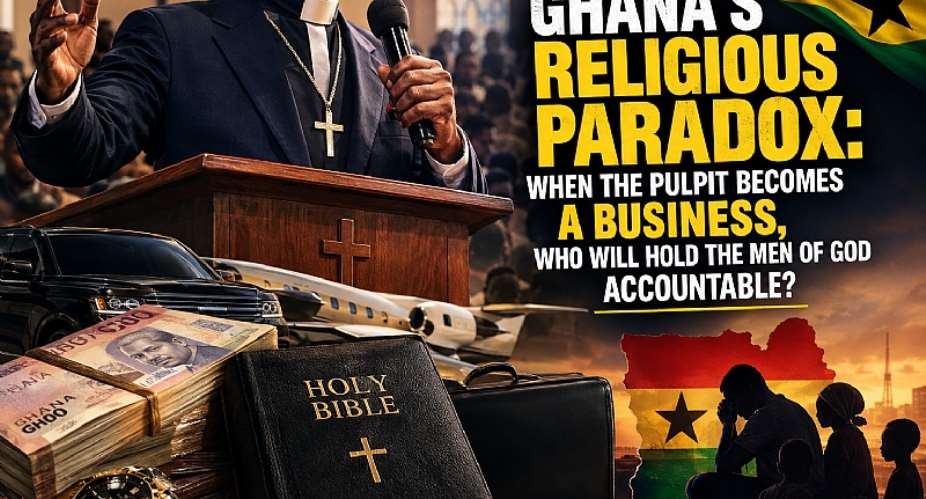
From traditional African spirituality to imported Christianity, from colonial evangelisation to the modern prosperity gospel, Ghana must confront an uncomfortable question: Is religion transforming the nation, or are some religious leaders exploiting the faith of the very people they claim to serve?
Introduction: A Nation That Prays, Yet Continues to Struggle
Ghana is one of Africa’s most visibly religious countries. Churches operate in residential communities, markets, university campuses, shopping centres and converted warehouses. Prayer meetings are held at dawn, all-night services continue until morning, and radio and television stations broadcast sermons, prophecies, deliverance sessions and declarations of national prosperity.
From political campaigns to public ceremonies, the language of God has become deeply embedded in Ghanaian public life. Politicians seek prayers from religious leaders, businesspeople attend church services for divine favour, and ordinary citizens turn to pastors for hope when confronted with unemployment, sickness, poverty, family problems and economic uncertainty.
Yet an uncomfortable contradiction persists.
If a nation’s religious commitment is measured by the frequency of its prayers, the number of its churches and the public influence of its clergy, Ghana should have an abundance of moral confidence. But religious visibility alone does not guarantee integrity, economic progress, accountable leadership or social justice.
Many Ghanaians continue to struggle with unemployment, unaffordable housing, inadequate public services, financial insecurity and the rising cost of living. Meanwhile, allegations of financial exploitation, fraudulent prophecies, abuse of spiritual authority and questionable conduct involving some religious leaders periodically provoke public outrage.
This raises a question that Ghana must be mature enough to confront: What is the purpose of Christianity if the people who practise it remain vulnerable to exploitation by those who claim to represent God?
This is not an argument against Christianity or the millions of sincere Christians who serve their communities, educate children, care for the vulnerable and offer genuine pastoral support. It is an examination of religious power, accountability and the dangerous possibility that some individuals have turned faith into a commercial enterprise.
The central issue is not whether Ghanaians should pray. It is whether prayer is being used to encourage responsibility and transformation or to discourage critical thinking, excuse misconduct and enrich those who occupy the pulpit.
1. What was Ghana’s original religion before Christianity arrived?
Before European missionaries introduced Christianity to the Gold Coast, the people who inhabited what is now Ghana already possessed established religious systems, spiritual institutions and moral traditions.
There was no single, uniform religion practised by every ethnic group. The religious landscape was diverse, reflecting the histories, languages, political structures and cultural experiences of different communities.
Among the Akan, Ga-Dangme, Ewe, Mole-Dagbani, Guan and other peoples, religious beliefs differed in important ways. Nevertheless, many traditional African religious systems shared certain features: belief in a Supreme Being, reverence for ancestors, recognition of spiritual forces and an understanding that human conduct was connected to communal responsibilities and the spiritual world.
Among many Akan communities, the Supreme Being is known by names including Onyame or Nyame. Among the Ga, the name Ataa Naa Nyonmo is associated with the Supreme Being. Other Ghanaian communities have their own names, traditions and understandings of divine authority.
Traditional religious practice could involve libation, festivals, ancestral remembrance, sacred groves, community rituals, divination and the work of traditional priests and priestesses.
These practices were not merely isolated ceremonies. Religion was often intertwined with customary law, traditional leadership, agriculture, healing, family obligations, conflict resolution and the social organisation of communities.
For many people, spiritual life was inseparable from daily life.
It is therefore historically inaccurate to suggest that Ghana had no knowledge of God, morality, spirituality or organised religious belief before Christianity arrived.
Ghana did not become a spiritual society when European missionaries arrived. Christianity entered a society that already had religious traditions, ethical expectations and established ways of understanding the relationship between humanity and the spiritual world.
That history raises an important question: Why do some modern religious movements portray traditional African spirituality as proof that Africans were entirely without God before the arrival of European Christianity?
Can a people’s religious history be understood honestly without examining the spiritual and cultural systems that existed before colonial contact?
Equally, acknowledging traditional religion does not require romanticising every aspect of it. Like all human institutions, traditional religious systems varied, and their practices should be examined historically rather than treated as beyond criticism.
The point is simple: Ghana’s religious history began long before the first Christian missionary preached on its shores.
2. Who introduced Christianity to Ghana, and why did it come?
Christianity did not arrive in the Gold Coast at one particular moment through one individual. Its introduction and expansion occurred in stages, beginning with European maritime contact and continuing through missionary activity, education and the development of colonial institutions.
Portuguese sailors reached the coast in the late fifteenth century. Following their arrival in the 1470s, Portuguese traders established a presence in the area, and the construction of Elmina Castle began in 1482. Catholic religious activity accompanied Portuguese commercial and political interests.
The earliest European Christian presence was therefore associated with coastal trading settlements, royal contacts and the Portuguese imperial network. Christianity did not immediately spread throughout the territory, and early efforts at conversion had limited reach.
Subsequent European missionary initiatives included Protestant missions from the eighteenth century onward and more sustained efforts during the nineteenth century.
The Basel Mission, which began its work in the Gold Coast in 1828, became particularly influential in education, literacy, church development and commercial agriculture. The Wesleyan Methodist mission also played an important role in the nineteenth century, while the Bremen Mission contributed to the spread of Christianity, especially among Ewe-speaking communities. Catholic missionary work expanded further during the nineteenth century and beyond.
Missionaries established schools, trained teachers and ministers, translated religious materials and helped develop forms of formal education that profoundly influenced Ghanaian society.
Christianity spread for several reasons. Some people embraced the faith through conviction, personal experience, education, marriage and community relationships. Mission schools provided access to literacy and opportunities that became increasingly valuable in the colonial economy. African catechists, teachers, evangelists and converts were also essential to the expansion of Christianity; its growth cannot be explained as the work of Europeans alone.
However, the historical picture is more complicated than a story of missionaries arriving solely to save souls.
European expansion was also driven by trade, imperial competition and colonial power. Missionary activity sometimes overlapped with colonial interests and cultural assumptions that portrayed European institutions as superior to African traditions. In some contexts, conversion involved pressure to abandon customary religious practices and adopt European cultural norms.
This does not mean every missionary had the same motives or that Christian education brought no benefits. It means that the history of Christianity in Ghana must be examined honestly, recognising both its contributions and its connections to colonial transformation.
Schools, literacy, printing, healthcare initiatives and new forms of public organisation were among Christianity’s lasting influences. At the same time, colonial inequalities and cultural tensions shaped the environment in which the religion expanded.
The difficult question for contemporary Ghana is this: If Christianity helped establish institutions of education, literacy and moral instruction, why should the modern church be exempt from questions about how effectively it contributes to the country’s social and economic development?
3. From missionary churches to the modern religious marketplace
Christianity in Ghana has changed significantly since the colonial period.
The country now contains historic Protestant denominations, Catholic institutions, Pentecostal and Charismatic churches, African-initiated churches, independent ministries and numerous smaller congregations.
The growth of Pentecostal and Charismatic Christianity has made religious expression especially visible in public life. Many churches emphasise personal transformation, spiritual gifts, healing, deliverance, prosperity, prophecy and direct experiences of the Holy Spirit.
For many believers, these churches provide community, emotional support, moral guidance and a sense of hope in difficult circumstances.
The problem arises when religious authority becomes difficult to question, financial demands become excessive, and the promise of divine intervention is used to pressure vulnerable people into surrendering money or property.
A church can collect voluntary offerings without exploiting its members. A pastor can receive a reasonable salary without being corrupt. A religious organisation can operate schools and hospitals while making a genuine contribution to national development.
But when the success of a ministry is measured primarily by the wealth of its founder, the size of its congregation, the value of its vehicles or the luxury of its residence, an important question emerges: Has the mission of the church been displaced by the pursuit of personal status?
When a pastor presents every financial contribution as a seed that will supposedly guarantee a miracle, can the congregation distinguish voluntary generosity from spiritual coercion?
When a church member is told that financial hardship reflects insufficient faith, while the pastor's prosperity is presented as proof of divine favour, who benefits from that interpretation?
And when a religious leader promises a breakthrough in exchange for money, what happens to the believer who gives away money needed for food, rent, school fees or medical treatment and receives no promised breakthrough?
These are not attacks on faith. They are questions about power, ethics and the responsibilities that accompany religious leadership.
By:
Patrick Belebang Yagsori
0240292413
[email protected]

 Balancing the scale will dilute extreme partisanship – Hamza on new Deputy EC Ch...
 October 13: Cedi sells at GHS12.30 on forex market, GHS11.78 on BoG interbank
 ECOWAS begins implementation of 2026–2031 communication strategy
 IMF upgrades 2026 global growth forecast but war and debt threaten outlook
 Education Minister proposes 5–10% annual rent increase cap for public universiti...
 Haruna Iddrisu assures teachers of salary adjustments by October 16
 Madina police sergeant arrested for injuring two in shooting incident at Adenta ...
 Ghana’s rape laws must protect male victims – Kasapa FM’s Akosua Gyambiby
 Ghana needs comprehensive surrogacy law to address complex legal disputes — Afri...
 Value For Money: Govt to audit rural telephony project inherited from previous a...


