




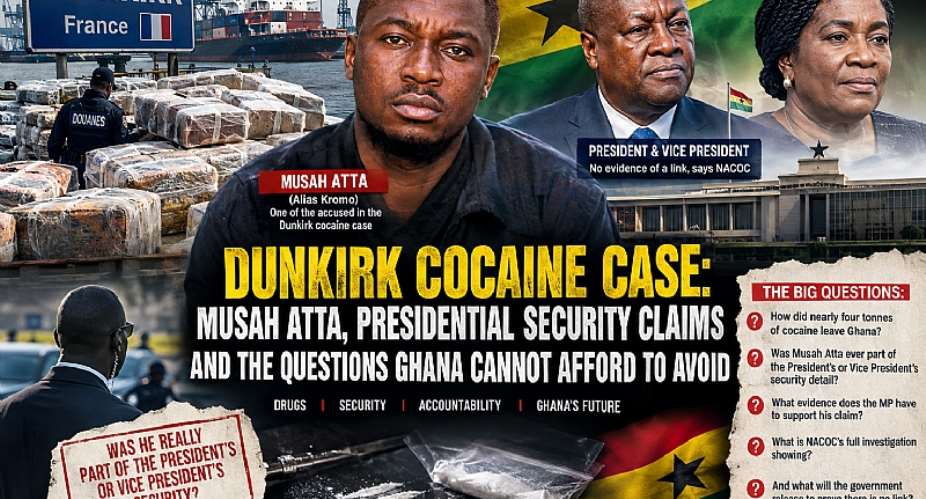
The nearly four-tonne cocaine seizure at the French port of Dunkirk has quickly moved beyond a conventional narcotics investigation. It has become a test of Ghana’s port-security system, the credibility of its anti-drug institutions, and most controversially the accuracy of claims that one of the accused persons had previously been connected to presidential security.
At the centre of that controversy is Musah Attah, alias “Kromo,” one of four Ghanaians charged in Ghana over the alleged exportation of nearly 3.9 tonnes of cocaine from Ghana to France.
But an important clarification is necessary from the outset: Dunkirk is not the name of the suspect. Dunkirk is the French port where the suspected cocaine was intercepted on September 10, 2026. The person at the centre of the presidential-security controversy is Musah Attah.
And that distinction matters because this story is no longer simply about drugs. It is about what the evidence actually proves.
DUNKIRK: THE PORT AT THE CENTRE OF GHANA'S LATEST COCAINE CONTROVERSY
Dunkirk, or Dunkerque, is a major port city in northern France, close to the Belgian border.
Historically, the city is internationally remembered for the 1940 Dunkirk evacuation, when hundreds of thousands of Allied troops were evacuated from continental Europe during the Second World War.
Today, however, Dunkirk is again in the international headlines but this time because French customs authorities reportedly intercepted a container originating from Ghana containing approximately 3.9 tonnes of suspected cocaine, concealed in a shipment declared as plastic waste.
The suspected shipment was estimated in court reporting at about €225 million in street value.
The significance is enormous.
This was not a small quantity of narcotics hidden in luggage.
It allegedly travelled through a sophisticated international commercial supply chain from Ghana, through maritime transportation, to France.
That immediately raises a question that should concern every Ghanaian:
If almost four tonnes of cocaine were allegedly inside a commercial container when it left Ghana, how did that container pass through Ghana's export-control system?
That question remains larger than any political argument about who is connected to whom.
WHO IS MUSAH ATTA?
Musah Attah, also known as “Kromo,” is the second accused person in the Ghanaian case.
According to court proceedings reported by the Ghana News Agency, Attah is 47 years old and described himself as a farmer. He was arrested by NACOC on September 14, 2026.
He is facing charges alongside:
Desmond Koranteng Curiel, alias “Biggs”;
Kweku Okyere;
Jessica Hartog;
while Dutch national Jos Leijdekkers, alias “Bolle Jos,” has been reported as being at large.
The four accused persons have pleaded not guilty.
That point must not be lost in the public debate.
Being arrested, charged or accused does not establish guilt. The allegations must ultimately be tested through the criminal justice process.
But the circumstances surrounding Attah have generated a second investigation in the court of public opinion.
THE VINCENT ASSAFUAH CLAIM
The controversy exploded after Old Tafo MP Vincent Ekow Assafuah, an NPP legislator, publicly alleged that Musah Attah had been part of the security detail of both President John Dramani Mahama and Vice President Prof. Naana Jane Opoku-Agyemang.
Assafuah published photographs which he said showed Attah in proximity to the President and Vice President.
He questioned how someone allegedly connected with presidential security could subsequently become an accused person in a cocaine trafficking investigation involving a shipment worth hundreds of millions of dollars.
His central question was essentially:
Who gave him access, and who was watching the watchers?
That is a legitimate question to investigate.
But there is an equally important question for the MP himself:
Can he prove that the person in those photographs is actually Musah Attah and can he prove the precise security position he claims Attah held?
That is where the debate becomes much more serious.
A photograph showing a person standing close to the President is not automatically proof that the person is a presidential bodyguard.
Someone could be:
a police officer;
a military officer;
a national security operative;
a temporary security reinforcement;
an event-security officer;
a member of another security formation;
or simply someone present at an official function.
Therefore, photographs require corroboration.
NACOC'S VERSION IS VERY DIFFERENT
The Narcotics Control Commission has now publicly challenged the claim.
NACOC Deputy Director-General Alexander Twum-Barimah said the Commission had conducted background checks on the suspects in its custody and had found no evidence identifying any of them as presidential escorts.
NACOC's later clarification was even more specific.
Twum-Barimah said the information available to NACOC identified Musah Attah as a farmer, not a member of the presidential security detail.
He said:
“There is nothing we have not gotten anything to prove that he is with the presidency.”
NACOC also rejected the idea that one person could simultaneously serve as the close protection officer of both the President and Vice President.
According to Twum-Barimah, presidential and vice-presidential protection arrangements operate through separate groups and a close protection officer would not ordinarily perform the same close-protection role for both principals simultaneously.
This creates a direct evidentiary conflict.
MP Vincent Assafuah says one thing.
NACOC says its checks have not established it.
And now the country needs evidence not political noise to determine what is true.
BUT THEN COMES ANOTHER CLAIM
The controversy does not end with NACOC's statement.
Ibrahim Oppong Kwarteng, CEO of the Crime Check Foundation, has separately claimed that Musah Attah did work with security personnel at Jubilee House and had provided security during presidential and vice-presidential travel.
He reportedly also claimed that Attah resigned from that position roughly three months before his arrest and had complained about his reported GH¢6,000 salary.
This is important but it must be handled carefully.
There is a substantial difference between:
“Musah Attah worked in security at Jubilee House”
and
“Musah Attah was a member of President Mahama's close-protection team.”
And there is another difference between:
“He was present during presidential or vice-presidential movements”
and
“He was officially assigned as the President's or Vice President's personal security officer.”
Those distinctions need documentary verification.
SO WHO IS TELLING THE TRUTH?
At this stage, the responsible answer is:
The publicly available evidence does not establish conclusively that Musah Attah was a serving presidential or vice-presidential close-protection officer.
NACOC has specifically said its background checks did not establish that connection.
At the same time, claims have been made by Assafuah and Ibrahim Oppong Kwarteng that Attah had worked in security around Jubilee House.
Those claims should not simply be dismissed because NACOC has not confirmed them.
But neither should they be accepted merely because photographs exist.
The missing piece is official documentation.
THE MP NOW HAS A VERY IMPORTANT BURDEN OF PROOF
If Vincent Ekow Assafuah maintains his allegation, the public deserves more than photographs.
He should be prepared to answer:
1. What was Musah Attah's official job title?
Was he:
a presidential escort?
a police officer?
a military officer?
a national security operative?
a Jubilee House security employee?
an event-security officer?
or something else?
2. Which institution employed him?
Was his employer the:
Ghana Police Service?
Ghana Armed Forces?
National Security?
Jubilee House?
another government institution?
3. What was his service number?
If he was genuinely a government security operative, there should ordinarily be an identifiable institutional record.
4. When exactly did his alleged presidential-security assignment begin?
And when did it end?
5. Was he serving when the alleged cocaine operation occurred?
This is crucial.
Even if it is eventually established that Attah previously worked around the Presidency, that does not automatically establish that the Presidency was connected to the alleged cocaine shipment.
6. Can the photographs be independently authenticated?
Who took them?
When?
Where?
What event?
What was Attah's official assignment that day?
7. Was he actually providing close protection or was he simply part of a broader security deployment?
That distinction could fundamentally change the meaning of the photographs.
AND GOVERNMENT MUST ANSWER QUESTIONS TOO
The government should not simply respond:
“There is no evidence.”
If the claim has become sufficiently serious to attract national attention, the public deserves clarity.
The government should establish, where security considerations permit:
Was Musah Attah ever employed by, assigned to, or attached to any security formation protecting the President or Vice President?
If the answer is no, the government should say so clearly.
If the answer is yes, it should explain the nature and period of that assignment, without compromising legitimate operational security.
If he previously served in such a capacity but had left before the alleged drug offence, that fact should also be established.
Because there is a huge difference between:
“A former security worker is accused of a crime.”
and
“A serving presidential security officer is accused of participating in international cocaine trafficking.”
The public should not be forced to guess which story is true.
THE BIGGER QUESTION: WHERE DID THE COCAINE ENTER THE SYSTEM?
This may actually be the most important question in the entire scandal.
NACOC has said investigations are continuing to establish how the shipment left Ghana and to identify others who may have been involved.
Reports have indicated that investigators are examining the exporter, freight-forwarding arrangements and Customs-scanning process surrounding the container.
That means the investigation should not stop with the people already arrested.
It should reconstruct the entire journey.
Who owned the container?
Who packed it?
Where was it packed?
Who transported it?
Who sealed it?
Who inspected it?
Who scanned it?
What did the scanner show?
Who reviewed the scan?
Was a physical inspection ordered?
If not, why not?
Who authorised the release?
What shipping company handled it?
What freight forwarder processed it?
Who had access to the container?
And most importantly:
Was the cocaine inside the container when it left Ghana or was it introduced somewhere later in the journey?
That distinction could change the entire direction of the investigation.
THE FRENCH DETECTION CREATES AN UNCOMFORTABLE QUESTION FOR GHANA
French authorities reportedly detected and seized nearly four tonnes of suspected cocaine.
So Ghana must confront an uncomfortable question:
If the cocaine was already in the container when it left Ghana, why did Ghana's controls not detect it?
Was it:
a technology failure?
an intelligence failure?
a human error?
a procedural failure?
a corruption problem?
deliberate interference?
Or something else?
At this point, none of those explanations should be presented as established fact.
They are precisely the questions an independent investigation must answer.
THE NACOC QUESTION
Another issue has emerged concerning the role of NACOC at Ghana's ports.
Akwatia MP Bernard Bediako Baidoo has argued that NACOC's exclusion from routine port checks contributes to vulnerabilities in Ghana's maritime narcotics-control system. He linked his argument to changes dating back to 2018 and said NACOC's specialised expertise should be incorporated more consistently into port inspections.
That argument deserves examination independently of party politics.
If NACOC possesses specialised narcotics-detection expertise, the country must determine whether its institutional position within the port-security architecture is adequate.
But again, evidence matters.
The question is not simply:
“Who should be blamed?”
It is:
What exact control failed, at what point, under whose responsibility, and why?
PEOPLE ARE ASKING THE WRONG QUESTION
Much of the political conversation has become:
“Was Musah Attah Mahama's bodyguard?”
But there is a bigger question.
How did nearly four tonnes of suspected cocaine allegedly move through Ghana's commercial export chain in the first place?
Even if tomorrow it is established that Attah had never worked anywhere near Jubilee House, Ghana would still have a major narcotics-control problem.
And if it is established that he once worked within a presidential security environment, that fact alone would still not prove that President Mahama, Vice President Opoku-Agyemang, or the government had anything to do with the alleged cocaine trafficking.
Evidence must establish any such connection.
THE QUESTIONS THAT SHOULD KEEP GHANA AWAKE
This case raises questions that go far beyond partisan politics.
Who financed the shipment?
Who sourced almost four tonnes of cocaine?
Who arranged the container?
Who prepared the export documentation?
Who knew what was inside?
Who had access to the container before it reached the port?
Who inspected it?
What did the scanner reveal?
Was the container flagged?
If it was flagged, who authorised it to proceed?
If it was not flagged, why not?
Who was responsible for the final clearance?
Were any officials compromised?
Were any security personnel involved?
Was Musah Attah actually a former security operative or is that claim unsupported?
If he was, what exactly was his role?
When did he leave?
Why did he leave?
Was his departure documented?
Did investigators examine his financial records?
Did investigators examine his communications?
Did investigators establish his relationship with the other accused persons?
And perhaps the most uncomfortable question:
If the government says there is no connection between the Presidency and this case, what evidence has it examined to reach that conclusion and will enough of that evidence be made public for Ghanaians to independently understand the conclusion?
THIS IS WHERE POLITICS MUST END AND EVIDENCE MUST BEGIN
The NPP MP has every right to raise questions about an alleged connection between an accused person and presidential security.
But once an elected parliamentarian makes such a serious public allegation, the standard cannot be suspicion alone.
He must provide the particulars.
At the same time, government cannot simply dismiss uncomfortable questions as political speculation.
It has a responsibility to provide credible answers.
And NACOC must continue following the evidence wherever it leads even if that evidence ultimately points toward individuals connected to powerful institutions.
The investigation must not become:
NPP versus NDC.
It must become:
evidence versus allegation.
THE REAL TEST FOR GOVERNMENT
The French authorities have already answered one question:
The suspected cocaine was there.
The Ghanaian authorities now have to answer another:
How did it get out of Ghana?
And the political controversy has created a third:
Was one of the accused previously connected to presidential security?
NACOC currently says its checks have found no evidence that any of the suspects was a presidential escort or member of the President's or Vice President's security detail.
But competing claims about Attah's alleged past security work mean the matter should not be settled by political declarations from either side.
It should be settled by employment records, service records, deployment records, photographs properly authenticated, witness testimony and the investigative evidence.
That is what Ghana deserves.
Because the most dangerous outcome would not simply be a cocaine shipment leaving Ghana.
The most dangerous outcome would be a national argument in which political parties fight over the narrative while nobody establishes, with evidence, exactly how nearly four tonnes of cocaine allegedly passed through the country's export system.
Until that question is answered, the Dunkirk cocaine case remains much bigger than Musah Attah, Vincent Ekow Assafuah, NACOC, Mahama or the Vice President.
It is a test of whether Ghana's institutions can follow a criminal trail without fear, without favour and without political convenience.
By:
Patrick Belebang Yagsori
0240292413
[email protected]

 Vacate by October 4 or face demolition – KMA warns Abrepo Junction occupants
 Star Oil and GOIL assure no fuel price increase for new window
 Diesel will not hit GH¢22 at pumps – NPA CEO assures
 Ghana records 3,876 cybersecurity incidents in seven months – Communications Min...
 “We never knew life was going to be hard like this in Ghana; we can’t even get j...
 $1.17bn GoldBod gave BoG is repayment, not new money’ – Dr. Gideon Boako
 Baffour Awuah didn’t help his case if he ignored EOCO’s invitation – Appiah Danq...
 Institutions, public policy must remove barriers facing women – Vice President
 Accra: Fire breaks out at Avenor Industrial Area; two feared dead
 Carlos Queiroz leaves Black Stars role after poor AFCON qualifying start


