




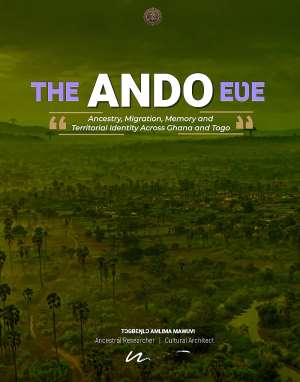
The history of the Eʋe people is often presented through broad narratives of migration, settlement and political formation. Yet within this larger history are numerous clans and communities whose own histories remain insufficiently documented. One such people are the Ando People (Andoawo).
The Ando are an Eʋe clan whose communities extend across present-day Ghana and Togo. According to the community records compiled by Mr. Shine Zidah in his book The History of Ando Ewes, the clan is represented in approximately 151 communities, including 59 communities in Ghana's Volta Region and a further 92 communities across present-day Togo.
Despite this geographical presence, much of the historical knowledge of the Ando clan remains preserved primarily through oral traditions, community memories, names, genealogies, festivals and the knowledge carried by elders.
My work " : Ancestry, Migration, Memory and Territorial Identity Across Ghana and Togo " is an introductory attempt to bring that history into clearer focus.
The Meaning of Ando:
At the heart of the research is the name Ando itself. The traditional account recorded by Shine Zidah associates the name with the people who were the first to come out from the wall of Notsie during the Eʋe Exodus. The paper places this tradition alongside Eʋe linguistic knowledge and the Adagana interpretation of the sounds forming A-N-D-O.
Within this framing, the name is examined through ideas of emergence, continuity, grounding and collective existence. Particular attention is given to the Eʋe expression “do” associated with getting out, coming out or emerging from within something.
The purpose is not to claim that linguistic interpretation alone proves a historical event. Rather, the research examines how name, language, oral tradition and ancestral memory converge around the idea of emergence.
The Notsie Connection:
The Ando tradition is also examined within the wider Eʋe memory of the Notsie Exodus. Different Eʋe communities preserve variations concerning the names of leaders, routes and the order in which groups departed. Yet the broader memory of emergence from Notsie and subsequent movement into new territories remains deeply embedded in Eʋe historical consciousness. The Ando tradition forms part of this wider network.
Another important connection is preserved through Aʋazɔliza, the tradition associated with six Eʋe clans - Ziavi, Mepe, Ando, Etordome, Botoku and Kpedze-Todzi - who maintain a shared memory of having migrated from Notsie as related communities. This is not merely an old historical account. Aʋazɔliza remains a living cultural practice through which relationships between these communities continue to be remembered.
The Ando Homeland:
The paper then turns to geography. The Ando ancestral homeland is presented as a continuous geographical landscape extending across what are today southeastern Ghana and southwestern Togo. Its core area includes Agɔtime and adjoining communities, with relationships extending toward areas around Assahoun, Agou and other neighboring territories.
The modern Ghana-Togo border therefore does not correspond neatly with the older geographical relationships of the Ando people.
The paper distinguishes between the core Ando homeland and later settlements established by Ando families and branches beyond that ancestral heartland. This distinction is important for understanding how an ethnic clan can maintain a recognizable ancestral center while simultaneously developing communities in the territories of related peoples.
The Adangbe Movement into Agɔtime:
One of the most significant sections of the paper examines the seventeenth-century movement of Adangbe populations into the Agɔtime area.
The Ando oral tradition maintains that the Adangbe arrivals entered an already-established Ando territory around 1680 as displaced people following warfare elsewhere.
Historical accounts concerning the expansion of the Akwamu Kingdom and the conquest of Ladoku around 1679 provide an important historical context. Contemporary reports cited by later historians record that communities fled the Akwamu advance, with some displaced populations moving toward Agɔtime, east of the Volta.
The paper does not treat this historical record as proof of every element of the Ando oral tradition. Instead, it identifies a significant point of convergence: Ando oral memory describes the arrival of displaced Adangbe people at approximately the same period that historical records document population movements from territories affected by Akwamu expansion toward Agɔtime.
This raises a larger historical question: What was already present in the territory when these displaced populations arrived?
What Do the Names of the Land Remember?
The research turns to the landscape itself. Names such as Aƒegame, Kpetoe and Agɔtime, together with geographical features such as the Tɔdzi River, are examined as possible layers of historical memory.
The argument is not that a place name by itself proves ownership or establishes a complete settlement history. Rather, the survival of linguistic forms within a landscape raises questions that deserve investigation. If a population arrives in an already inhabited region,
- what names did it inherit?
- Which names did it introduce?
- Which names belonged to the landscape before its arrival?
- Which were later transformed through linguistic contact?
These questions become particularly important where competing traditions provide different accounts of the origins of the same settlement.
Beyond Competing Narratives:
The paper does not present itself as the final history of the Ando. Instead, it calls for a broader research programme involving oral history, linguistics, archaeology, geography, genealogy, archival records, place-name studies and the histories preserved by neighboring Eʋe communities.
I argue that oral tradition should neither be accepted uncritically nor dismissed simply because it was not originally written down. Where different sources agree, their convergence should be documented. Where they disagree, those disagreements should become subjects for further research. This is particularly important for questions concerning territorial history.
Recovering the Ando Record:
The larger purpose of the paper is preservation. The Ando historical record remains distributed among communities and families across Ghana and Togo. Elders carry genealogies, migration traditions, names, cultural practices and memories that may not yet exist in formal archives.
The proposed work ahead includes visiting Ando communities, interviewing elders, mapping settlements, recording oral histories in their original languages, documenting traditional sites and landmarks, examining historical documents and creating an accessible archive for future generations.
The paper sees this work not simply as an academic exercise, but as an act of cultural preservation. A people whose history exists only in scattered memory remains vulnerable to historical disappearance. Documentation allows that memory to move from one generation to another without severing it from the communities that produced it.
The Beginning of a Larger Ando Revival:
: Ancestry, Migration, Memory and Territorial Identity Across Ghana and Togo is therefore intended as a beginning. It does not attempt to close every historical question surrounding the Ando. Instead, it establishes a foundation from which those questions can be investigated more systematically.
The larger objective is to reconstruct and preserve an ancestral record extending across Ghana and Togo - an account built from the voices of the people, the memories of their communities, the names embedded in the land, historical records and the wider Eʋe cultural landscape.
Read the full research paper on Zenodo:
[ : Ancestry, Migration, Memory and Territorial Identity Across Ghana and Togo ]

 Mahama, Chinese Vice President holds talks on sidelines of UN General Assembly
 Gov’t directs release of 50,000 bags of grain to settle Ghana's obligation to EC...
 'Stay away from Volta Region' — Togbe Afede warns Illegal miners
 ‘Common sense wasn’t working’ – Kumadoe takes on EOCO, MP standoff
 ‘Those saying they are beginning to regret coming home If that is the thank you ...
 Police interdict seven officers over alleged extortion in Accra
 Ghana facilitates return of 180 nationals from Libya
 Parliament to review dollar payment for locally produced crude
 Ghana to build 1,200MW gas-fired power plant, surpassing Akosombo capacity befor...
 “Those responsible should be imprisoned for life with no food” — Friend of murde...


