




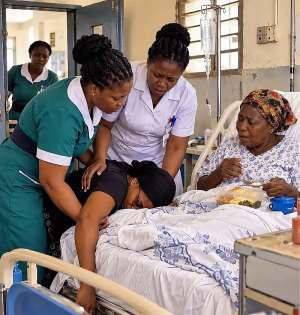
She came to the hospital carrying food for her mother. Her mother was eating. She reportedly rested her head on the hospital bed for a moment and never got up again.
If the account circulating on social media is accurate, this is not merely another tragic death. It is a disturbing reminder of how quickly an apparently ordinary moment can become a family’s worst nightmare.
She was reportedly a mother of two.
One moment, she was alive, caring for her mother.
The next, she was gone.
And now comes the question many people are asking:
What actually killed her?
Was she already sick?
Was there a condition nobody knew about?
Was it cardiac arrest? A stroke? A blood clot? A severe metabolic problem? Or something entirely different?
And perhaps the most dangerous question of all:
Are we too quick to call every unexplained sudden death “stress”?
WHO WAS SHE AND WHAT DO WE ACTUALLY KNOW?
At the time of publication, publicly available reliable sources have not established enough verified information about the woman's identity, age, medical history, occupation or previous diagnosis to responsibly construct a complete biography.
What is circulating is a story of a woman and mother of two who reportedly went to a hospital to take food to her sick mother.
That distinction matters.
In an age where social media can transform an eyewitness account into a national story within hours, the public deserves facts — not assumptions.
Being a mother of two does not tell us what medical conditions she may or may not have had.
Likewise, the fact that she appeared well enough to visit her mother does not prove that she was medically healthy.
Some serious conditions can remain undiagnosed until a catastrophic event occurs.
The American Heart Association notes that sudden cardiac arrest can occur in people who may or may not have previously been diagnosed with heart disease. It can happen suddenly, sometimes with little warning.
WAS SHE ALREADY SICK?
This is one of the biggest unanswered questions.
Did she have hypertension?
Diabetes?
A heart condition?
An abnormal heart rhythm?
Anaemia?
A blood-clotting disorder?
Kidney disease?
An infection?
A previous history of fainting or unexplained weakness?
Or was she genuinely unaware that something dangerous was happening inside her body?
At present, there is no verified medical information available to establish any of these possibilities in her particular case.
And that is precisely why the public should be careful.
A person can look perfectly normal and still have an underlying medical problem.
The CDC explains that cardiac arrest occurs when the heart suddenly and unexpectedly stops beating. Causes can include coronary artery disease, cardiomyopathy, heart-valve disease and abnormal heart rhythms.
COULD IT HAVE BEEN STRESS?
This is where the conversation needs to become more serious.
Social media has already begun asking whether stress killed her.
But stress is not a medical diagnosis explaining an unexplained death.
The American Heart Association says severe emotional stress can be associated with cardiac arrest risk, while also explaining that stress is not usually a direct cause of cardiac arrest. Long-term stress can affect cardiovascular health and is associated with conditions that increase cardiovascular risk.
Therefore, saying “stress killed her” without medical evidence would be speculation.
The real question is:
What physical event caused her body to fail?
Stress may be relevant to a person's health, but it cannot simply be inserted into a death certificate because someone appeared exhausted.
COULD IT HAVE BEEN SUDDEN CARDIAC ARREST?
It is one possibility but it cannot be declared the cause without medical evidence.
Sudden cardiac arrest occurs when the heart's electrical system malfunctions, producing a dangerous rhythm and preventing the heart from effectively pumping blood to the brain and other organs. A person can collapse and become unresponsive within seconds.
Importantly, cardiac arrest is not the same thing as a heart attack.
A heart attack is generally caused by interrupted blood flow to heart muscle. Cardiac arrest is primarily an electrical failure of the heart. A heart attack, however, can sometimes trigger cardiac arrest.
So when someone suddenly collapses and dies, saying “she had a heart attack” may be medically inaccurate unless doctors establish that diagnosis.
BUT WHAT ABOUT STROKE OR A BLOOD CLOT?
They also cannot be ruled in or ruled out from the social-media account alone.
Serious neurological, cardiovascular and respiratory events can sometimes present suddenly.
A pulmonary embolism a blood clot that travels to the lungs can be life-threatening. Severe allergic reactions, seizures, major bleeding, serious infections and other medical emergencies can also potentially result in sudden collapse.
The American Heart Association lists blood clots in the lungs, bleeding around the brain, seizures, severe allergic reactions and infection among possible causes of cardiac arrest in otherwise healthy young adults.
That is why the circumstances surrounding the collapse are not enough to establish the cause of death.
THE MOST IMPORTANT QUESTION: WHAT DID THE DOCTORS FIND?
This is where the story should go beyond social-media speculation.
If she died inside a hospital, what did the medical team document?
Was she examined immediately?
Were vital signs recorded?
Was she responsive?
Was she breathing normally?
Was a pulse detected?
Was CPR attempted?
Was an ECG performed?
Were blood samples taken?
Was there evidence of a cardiac event?
Was there evidence of stroke?
Was her blood sugar checked?
Was there evidence of infection, bleeding or another acute condition?
If the cause remained unclear, was a post-mortem examination recommended?
These are not accusations against doctors or nurses.
They are basic questions that any responsible investigation into an unexpected death should ask.
AND HERE IS THE QUESTION NOBODY WANTS TO ASK
What if the biggest lesson is not simply that life is fragile — but that we often don't know what is happening inside our own bodies?
How many people are walking around with undiagnosed hypertension?
How many dismiss recurring dizziness, unusual fatigue, palpitations, breathlessness or fainting as “stress”?
How many people are afraid to undergo routine medical checks until something goes seriously wrong?
And how many families discover an underlying illness only after a loved one is suddenly gone?
These questions matter because sudden death does not always announce itself dramatically.
Sometimes it arrives in the middle of an ordinary morning.
Sometimes it happens while someone is eating.
Sometimes it happens while someone is talking.
And sometimes, tragically, it happens while a person is simply sitting beside someone they love.
COULD SHE HAVE SHOWN WARNING SIGNS?
We do not know.
But investigators and doctors should ask her family whether she had recently experienced:
- unexplained fatigue;
- dizziness or fainting;
- chest discomfort;
- unusual shortness of breath;
- racing or irregular heartbeat;
- severe headaches;
- weakness or difficulty speaking;
- swelling of the legs;
- unexplained weight changes;
- or episodes of suddenly feeling unwell.
The American Heart Association notes that women experiencing acute coronary syndromes can present with symptoms that are sometimes less stereotypical, including fatigue, dizziness, nausea, gastrointestinal discomfort and a feeling that “something is off.”
That does not mean this woman had a heart condition.
It means that the assumption that serious heart problems always announce themselves with dramatic chest pain is unsafe.
WHAT SHOULD HAPPEN NOW?
The family deserves answers.
Not rumours.
Not WhatsApp theories.
Not Facebook diagnoses.
Not claims that “stress killed her.”
If the death was sudden and unexplained, the medical records, clinical assessment and, where appropriate, post-mortem findings are what should establish the cause.
And if an official cause of death is eventually released, the public should distinguish between:
the immediate mechanism of death,
the underlying medical condition,
and possible contributing factors.
Those are not necessarily the same thing.
THE DEEPEST QUESTION
Perhaps the most painful part of this story is not simply that a mother of two reportedly died suddenly.
It is that she was apparently doing something completely ordinary:
taking food to her mother.
She was caring for someone else.
She may have had responsibilities waiting for her at home.
Children who expected their mother to return.
A family that expected another ordinary day.
And then, in what reportedly appeared to be only a moment of rest, everything changed.
That should make us pause.
Not because we know what killed her.
We don't.
But because her death raises questions that deserve evidence-based answers.
Was there an undiagnosed illness?
Was there a warning sign that nobody recognized?
Was it a sudden cardiac event?
Was it something else entirely?
Could anything realistically have been done differently?
And perhaps the hardest question of all:
How many people are living their normal lives today, unaware that something dangerous is already developing inside them?
Until doctors establish the cause of this woman's death, we should mourn her without turning uncertainty into fact.
Her story is heartbreaking.
But if there is a lesson in it, perhaps it is this:
Never mistake appearance for health, never mistake stress for a diagnosis, and never let an unexplained death become an excuse to stop asking questions.
By:
Patrick Belebang Yagsori
[email protected]
0240292413
 Mysterious illness leaves children struggling to walk, hear in Mafi Kope
 ‘We’ve come back to make sure our father's ideas never die’ – Nkrumah family
 Ghana Jollof: Akosua Manu appeals to Naana Jane to use her influence to free Sal...
 Yellow fever confirmed in Sissala East after 21 mysterious deaths
 Kenyasi man allegedly attacked by prison officers and inmates over yam theft cla...
 Germany’s far-right AfD makes strong gains in two state elections
 Savannah Regional Minister, IGP Yohuno visit Gbindabuor following lynching of po...
 Jehovah's Witnesses make blood component decisions a matter of personal conscien...
 Road contractors fed on contracts for years without completing projects – Alhass...
 Ghana Jollof saga: ‘She has no right to do what she’s doing’ – Inusah Fuseini


