




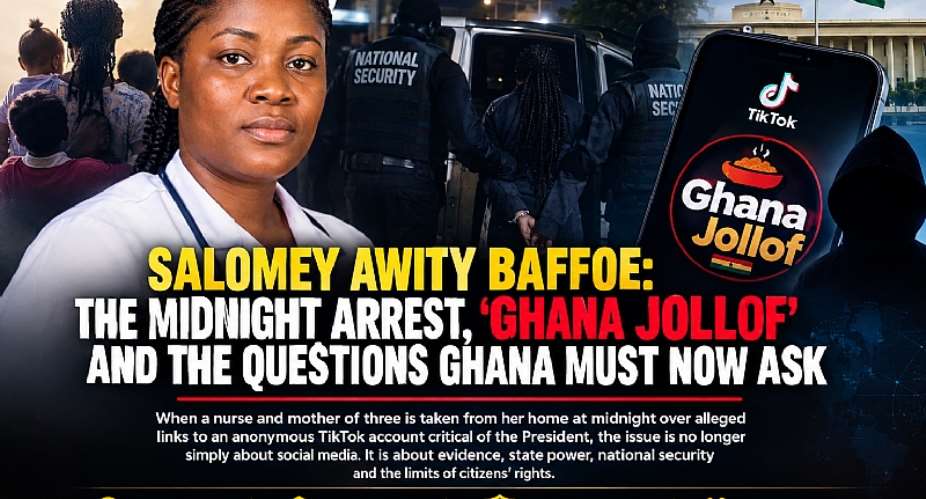
When a nurse and mother of three is taken from her home at midnight over alleged links to an anonymous TikTok account critical of the President, the issue is no longer simply about social media. It is about evidence, state power, national security and the limits of citizens’ rights.
Ghana is once again confronting an uncomfortable question: how far can the state go in the name of national security before the protection of the state begins to collide with the constitutional rights of the citizen?
The case of Salomey Awity Baffoe, a 40-year-old senior nursing officer and mother of three from Hansua in the Techiman Municipality, has rapidly developed from a reported midnight arrest into a national debate about anonymous political speech, national security investigations and the powers of security agencies.
On September 17, 2026, reports emerged that the Adenta Circuit Court 1 had remanded Baffoe for two weeks in connection with investigations into the controversial anonymous TikTok account known as “Ghana Jollof.” The account has reportedly attracted attention for its harsh criticism of President John Dramani Mahama and First Lady Lordina Mahama.
But the extraordinary part of this story is not merely that someone has been arrested.
It is how she was allegedly identified, how she was taken away, what evidence has been disclosed, what the state initially said about her whereabouts, and why a case involving an anonymous social-media commentator has acquired national-security implications.
And those questions deserve answers.
WHO IS SALOMEY AWITY BAFFOE?
Public reports identify Baffoe as a 40-year-old senior nursing officer working at Abrafi Women and Children’s Hospital in Techiman and a mother of three.
Before this controversy, there was no indication from the publicly available reporting that she was a prominent political activist or a nationally known public figure.
That is precisely why her arrest has generated such interest.
Her family says she is an ordinary working mother who has been caught up in an investigation surrounding somebody else the anonymous person behind the “Ghana Jollof” TikTok account.
Her relatives have consistently denied that she operates or controls the account.
That denial, however, is a family position not a judicial finding.
And equally important, the allegation against her should not automatically be treated as proof of guilt.
THE ACCOUNT THAT TRIGGERED THE CONTROVERSY
At the centre of the investigation is an anonymous TikTok account called “Ghana Jollof.”
According to multiple reports, the account has been highly critical of President Mahama and First Lady Lordina Mahama, allegedly using extremely offensive language against them. The anonymity of the account appears to have prompted security interest in identifying its operator.
But here lies the first major question:
Is operating an anonymous account that criticises a president automatically a national-security matter?
The answer depends entirely on what the account was actually doing.
Political criticism, even harsh criticism, exists within Ghana's constitutional framework of freedom of speech and expression. Article 21 of the 1992 Constitution expressly protects freedom of speech and expression.
That freedom, however, is not unlimited. Ghanaian law can criminalise particular conduct, including threats, incitement and other unlawful acts.
Therefore, the crucial distinction is not:
“Did she criticise the President?”
The crucial question is:
“What exactly did she allegedly do that constitutes a criminal offence?”
THE MIDNIGHT ARREST
According to her brother, Antwi Francis, three people two men and a woman dressed in black arrived at the family's home in Hansua at approximately 11:30 p.m. on September 13, 2026.
The family says the individuals identified themselves as National Security operatives.
Francis reportedly asked what his sister had done and was allegedly instructed to sit down and remain quiet. Salomey was then taken away.
That account is important because it raises another fundamental question:
Why was an ordinary mother allegedly taken from her home around midnight rather than summoned during the day if investigators already knew who she was?
There may be a perfectly legitimate operational explanation.
But the public has not yet been given it.
And when security agencies exercise extraordinary powers, the absence of explanation inevitably creates suspicion.
THE STRANGEST PART: WHO ACTUALLY ARRESTED HER?
Initially, the situation became even more confusing.
Reports by JoyNews said the family contacted security institutions after Salomey's disappearance.
The Bono East Regional Police Command reportedly said it had no record of her arrest or detention, while regional National Security officials also reportedly denied knowledge of the operation.
Think about what that means.
A citizen allegedly leaves her home in the middle of the night with people identifying themselves as state security officers.
Her family goes looking for her.
The regional Police say they do not have her.
Regional National Security officials reportedly say they do not have her.
So the obvious question becomes:
If state agents took her, which state institution authorised the operation?
And:
Who signed the order?
And:
Where was she taken immediately after leaving Techiman?
These are not political questions.
They are basic accountability questions.
HOW DID SECURITY AGENCIES CONNECT HER TO ‘GHANA JOLLOF’?
This is perhaps the most important unanswered question in the entire case.
The family says Salomey has no connection to the account.
Her mother reportedly received a call from a person said to be associated with National Security who allegedly accused her of being the mother of the person behind “Ghana Jollof.”
The family has rejected the allegation. A family spokesperson, Abraham Owusu Ansah, said the family's connection to Jema where First Lady Lordina Mahama also has roots does not establish any connection to the anonymous account.
But how did investigators arrive at Salomey?
Was it:
telephone records?
IP addresses?
device information?
social-media metadata?
financial transactions?
communications with the account?
witness statements?
surveillance?
information from another suspect?
or simply an intelligence lead?
The public does not yet know.
And that distinction matters enormously.
Intelligence that generates suspicion is not necessarily evidence capable of proving a criminal offence.
DID POLICE CATCH HER IN THE ACT?
This is another question that must be separated from speculation.
There is currently no publicly disclosed evidence showing that Salomey was allegedly operating the “Ghana Jollof” account when she was arrested.
Nor has publicly available reporting established that police caught her publishing one of the account's posts.
What has been reported is an alleged connection or link to the account and an investigation into individuals believed to be associated with it.
That leaves a critical evidentiary question:
What is the actual evidence against her?
Not intelligence.
Not rumours.
Not geography.
Not family relationships.
Not suspicion.
Evidence.
If investigators possess digital evidence linking her directly to the account, the eventual judicial process should test that evidence.
If they do not, then the public has every legitimate reason to ask why she was selected for detention.
WHAT DID THE COURT ACTUALLY DO?
The latest reports state that Adenta Circuit Court 1 remanded Baffoe for two weeks while investigations continue.
Her lawyer, Nana Agyei Baffour Awuah, reportedly challenged the basis for continued detention, particularly because authorities had told the court that the person believed to operate the “Ghana Jollof” account was in the United Kingdom.
His reported argument was essentially:
If the person operating the account is in Britain, why is his client being held in Ghana?
The court reportedly considered the matter to have national-security implications and granted the investigative period sought by the authorities.
But an important distinction must be made.
A remand order is not a conviction.
It does not establish that Baffoe committed the alleged offence.
It allows the authorities to continue with the judicially authorised process while investigations proceed.
The presumption of innocence remains fundamental.
WHAT DOES ‘NATIONAL SECURITY’ ACTUALLY MEAN?
This phrase deserves much more scrutiny than it normally receives.
Once authorities say a matter has “national security implications,” ordinary citizens may instinctively assume that something extremely dangerous must have occurred.
But national security is not a magic phrase that eliminates constitutional protections.
Ghana's Constitution protects personal liberty and requires that a person arrested on reasonable suspicion of committing a criminal offence be brought before a court within 48 hours if not released. It also requires that an arrested person be informed of the reasons for the arrest and of the right to a lawyer.
The Constitution also protects freedom of speech and expression.
So the real constitutional question is:
What specific national-security threat is alleged in this case?
Is it:
political criticism?
insult?
incitement?
threats against the President?
coordinated disinformation?
an alleged attempt to destabilise government?
a suspected conspiracy?
or something much more serious that the public has not yet been told?
Until that is clarified, “national security” remains a description rather than an explanation.
WHAT DOES THE POLICE HAVE TO SAY?
This is where the case becomes particularly uncomfortable.
The public needs a clear official account from the responsible security institution.
At the initial stage, regional police and National Security officials reportedly denied knowledge of the arrest. Later reporting has established that Baffoe is before court and has been remanded.
That progression requires explanation.
Who arrested her?
Who transported her from Techiman to Accra?
When did the Police formally take custody?
What offence is she suspected of committing?
Was a warrant involved?
What evidence was presented to the court?
Which security institution is leading the investigation?
Why was the operation apparently not known to regional security commanders?
These are questions the public should not have to answer through rumours and social media.
AND WHAT DOES HER FAMILY SAY?
Her family has been unequivocal.
They say she is a nurse, a mother of three and has no connection with the “Ghana Jollof” account.
Her mother has publicly appealed to President Mahama for help, saying she wants her daughter returned.
Family spokesperson Abraham Owusu Ansah has also appealed to the President, the Inspector-General of Police and the public to intervene.
The family maintains that the allegation is a case of mistaken identity.
But there is an equally important principle here:
Family denial cannot prove innocence any more than a security allegation proves guilt.
Both sides must ultimately be tested by evidence.
THE PRESIDENT SHOULD NOT BE THE JUDGE IN THIS CASE
Interestingly, the family has appealed directly to President Mahama.
That is understandable from a distressed family's perspective.
But it also raises an important institutional question.
If the executive becomes the body deciding whether an individual suspected of criticising the President should be released, what happens to the independence of the investigative and judicial process?
The stronger democratic approach is not for a president to personally determine the guilt or innocence of a critic.
It is for the Police, prosecutors and courts to demonstrate that the law has been followed.
That protects both the citizen and the state.
IS THE ARREST LEGALLY JUSTIFIED?
There is not enough publicly disclosed evidence to reach a definitive conclusion about the legality of Baffoe's arrest itself.
The Constitution allows arrest upon reasonable suspicion that a person has committed or is about to commit a criminal offence.
That is a lower threshold than the evidence required to convict someone at trial.
Therefore, investigators do not necessarily have to catch someone “red-handed” before making an arrest.
But reasonable suspicion cannot simply mean:
“We think she may know something.”
There must be a lawful basis connecting the individual to suspected criminal conduct.
And once the matter reaches court, the investigative process becomes subject to judicial oversight.
That is precisely why the court's role matters.
THE BIGGER ISSUE: WHAT HAPPENS TO ANONYMOUS SPEECH IN GHANA?
This case could eventually become bigger than Salomey Baffoe.
It could become a test of how Ghana treats anonymous political speech in the digital era.
The internet has fundamentally changed political communication.
A person can criticise a president without revealing their identity.
That anonymity can be abused.
It can facilitate threats, misinformation, harassment and incitement.
But anonymity can also protect citizens who fear retaliation for expressing unpopular political opinions.
Therefore:
When does anonymous political speech stop being protected expression and become a criminal act?
That is a question Ghana needs to answer carefully.
THE QUESTIONS GHANAIANS SHOULD NOT BE AFRAID TO ASK
This case raises questions that go beyond party politics.
1. What exactly did Salomey Baffoe allegedly do?
2. What specific criminal offence is she suspected of committing?
3. What evidence connects her personally to the Ghana Jollof account?
4. Did investigators identify her through digital evidence or human intelligence?
5. Did authorities obtain information from another person under investigation?
6. Was her phone or computer examined?
7. If so, what did investigators allegedly find?
8. Was she arrested because she operated the account, or because investigators believe she knows the operator?
9. If the suspected Ghana Jollof operator is in the United Kingdom, why is Baffoe being detained in Ghana?
10. What exactly did the prosecution tell the court about her alleged role?
11. What did the judge identify as the specific national-security concern?
12. Why did regional Police and National Security officials initially say they had no knowledge of her arrest?
13. Which institution actually conducted the arrest?
14. Who authorised the operation?
15. Was the family informed where she had been taken?
16. Did she have access to legal representation?
17. What evidence exists beyond association, suspicion or intelligence leads?
18. If the evidence is strong, why can the state not explain the allegation clearly?
19. If the evidence is weak, why should a mother of three spend two weeks in custody?
And perhaps the most uncomfortable question:
If the person being investigated had been praising the President rather than criticising him, would the same security machinery have been activated with the same urgency?
That question should not be answered politically.
It should be answered by the evidence, procedure and law.
GHANA MUST BE CAREFUL WITH THE WORD ‘NATIONAL SECURITY’
There is a legitimate role for national security agencies.
No democratic country can ignore genuine threats to national security.
But national security becomes stronger not weaker when its agencies operate transparently within the law.
The Constitution itself establishes that sovereignty resides in the people and that governmental power must be exercised within constitutional limits.
That means national security cannot become a black box into which citizens disappear and from which explanations emerge only after public pressure.
Nor should criticism of government automatically be treated as a security threat.
At the same time, citizens should not assume that because someone is described as a “critic” they cannot also be investigated for a separate criminal offence.
Both principles can exist simultaneously.
THE REAL TEST IS EVIDENCE
The state now has an opportunity to settle this controversy properly.
If investigators have credible evidence, they should allow the judicial process to determine the matter.
If the evidence concerns a genuine national-security threat, the appropriate legal process should deal with it.
If Salomey Baffoe is merely a witness or person believed to possess information, the authorities should clearly explain her status.
And if investigators eventually establish that she has no criminal connection to the matter, the public will expect her rights to be respected and her name protected from unnecessary public vilification.
Because there is a fundamental difference between:
investigating a citizen,
arresting a suspect,
charging an accused person,
and
convicting a criminal.
Those four things are not the same.
CONCLUSION: THE QUESTION IS BIGGER THAN SALOMEY
The Salomey Awity Baffoe case has now become a test of something larger than one TikTok account.
It is a test of whether Ghana can simultaneously protect national security and constitutional liberty.
It is a test of whether security agencies can investigate anonymous online activity without allowing suspicion to replace evidence.
It is a test of whether political criticism can remain political criticism without automatically becoming a security offence.
And it is a test of whether citizens can trust the institutions empowered to arrest them.
Perhaps the most important question is not:
“Is Salomey Baffoe guilty or innocent?”
That is ultimately for the evidence and the courts.
The question Ghanaians should be asking today is:
“What evidence does the state have, what exactly is she accused of doing, who arrested her, who authorised the arrest, and why should Ghanaian citizens accept silence when the state invokes national security?”
Because in a constitutional democracy, national security protects the nation but constitutional rights protect the people who constitute that nation.
And when those two principles appear to collide, citizens deserve more than whispers.
They deserve answers.
By:
Patrick Belebang Yagsori
+233240292413
[email protected]

 Mysterious illness leaves children struggling to walk, hear in Mafi Kope
 ‘We’ve come back to make sure our father's ideas never die’ – Nkrumah family
 Ghana Jollof: Akosua Manu appeals to Naana Jane to use her influence to free Sal...
 Yellow fever confirmed in Sissala East after 21 mysterious deaths
 Kenyasi man allegedly attacked by prison officers and inmates over yam theft cla...
 Germany’s far-right AfD makes strong gains in two state elections
 Savannah Regional Minister, IGP Yohuno visit Gbindabuor following lynching of po...
 Jehovah's Witnesses make blood component decisions a matter of personal conscien...
 Road contractors fed on contracts for years without completing projects – Alhass...
 Ghana Jollof saga: ‘She has no right to do what she’s doing’ – Inusah Fuseini


