




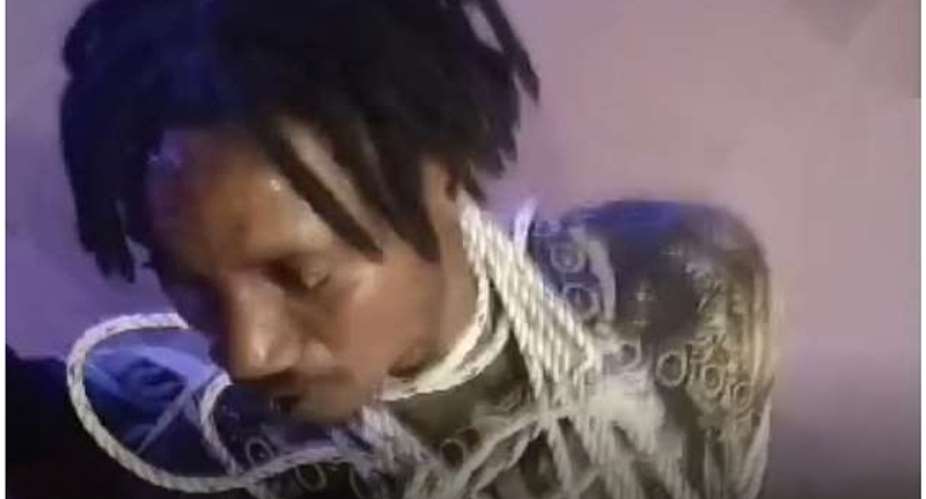
Bismark Amoh was allegedly abducted, beaten, stripped, threatened with death and held for ransom. But behind his rescue lies a bigger mystery: Who really took him, why, and how did an ordinary ransom operation become a case demanding national scrutiny?
On Sunday, September 6, 2026, something frightening allegedly happened in Assin Fosu.
A 30-year-old man, Bismark Amoh, disappeared and was reportedly taken captive.
For more than 48 hours, his family lived through what no family should experience: uncertainty, fear and the possibility that a loved one could be killed if money was not produced quickly enough.
Then came the messages.
According to reports, the abductors used Amoh's own mobile phone to communicate with his relatives through WhatsApp. They allegedly sent audio and video recordings showing him restrained and being physically assaulted.
The first reported ransom demand was GH¢45,000.
The family desperately mobilised money. Relatives, friends and well-wishers reportedly helped raise GH¢19,500, which was sent to the kidnappers.
But the payment did not end the ordeal.
Instead, the alleged captors reportedly demanded another GH¢30,500, pushing the total demand to about GH¢49,500–GH¢50,000, accompanied by another deadline and threats to kill him.
Then the police intervened.
Bismark Amoh was rescued in the Ashanti Region and taken for medical treatment. The Central North Regional Police Command subsequently said investigations were continuing to establish exactly what happened and to identify and arrest those responsible.
But this is where the story becomes even more complicated.
WHO IS THE VICTIM?
The victim is 30-year-old Bismark Amoh, an Assin Fosu resident.
Public reporting identifies him as the person allegedly abducted on September 6.
Beyond that, responsible journalism requires caution. There are claims circulating about his background and about the people allegedly behind his abduction, but those claims should not be presented as facts until investigators establish them.
What is not in dispute is that the incident left Amoh requiring medical attention after his rescue.
And perhaps the most disturbing evidence is the material reportedly sent to his relatives.
He was allegedly shown stripped, bound with ropes around his hands, legs and neck, and subjected to physical assault while his family was being pressured to produce money.
This was not merely a ransom demand.
It was psychological warfare against an entire family.
WHAT REALLY HAPPENED BEFORE HE WAS TAKEN?
This is one of the questions investigators must answer.
According to GNA reporting, a woman's voice could reportedly be heard in the background of one recording accusing Bismark of allegedly defrauding people connected to his detention.
That detail raises an extraordinary possibility.
Was the kidnapping purely about money, or was the ransom demand being used to settle another dispute?
Was there a financial disagreement before the abduction?
Did Bismark know his captors?
Was he deliberately targeted?
Was someone close to him involved?
Or was the alleged accusation simply a justification invented after the kidnapping?
At present, these questions remain unanswered publicly.
And that distinction matters.
A kidnapping victim can be accused of wrongdoing without being guilty of anything. Allegations are not convictions.
The police must therefore investigate both sides of the story without allowing the alleged accusation against the victim to become a justification for what was done to him.
WHO KIDNAPPED HIM?
This is perhaps the biggest unanswered question.
As of the latest credible reports, the police had rescued Bismark but had not publicly identified or announced the arrest of the alleged kidnappers.
That means names circulating on social media should not automatically be treated as the identities of the perpetrators.
The police themselves said investigations were continuing to establish the full circumstances and apprehend those responsible.
Therefore, claims that a particular military officer, his wife, businessman or other named individual organised the kidnapping require evidence.
And this is where Ghana must be extremely careful.
The allegation that a top military officer and his wife played a role is serious.
If investigators eventually establish that such powerful individuals were involved, Ghana would have a potentially explosive criminal case involving alleged abuse of influence.
But if the allegation is false, publishing names as though they are guilty could destroy innocent people's reputations and potentially interfere with an active investigation.
The right question is therefore not:
"Which military officer did it?"
The right question is:
"What evidence exists that connects any military officer or his wife to this crime?"
That is the standard Ghana must demand.
WHERE WAS Bismark KEPT?
The latest public reports establish that Bismark was held captive for more than 48 hours and was eventually rescued in the Ashanti Region.
But the exact location where he was detained has not been publicly established by the police in the reports reviewed for this article.
That creates another important investigative question:
How did a person allegedly abducted in Assin Fosu end up being held in another region without attracting attention?
Was he transported by road?
Was a vehicle used?
Did the kidnappers have a safe house?
Was the location deliberately chosen because it was difficult for police to monitor?
Were there accomplices?
Did anyone see him being moved?
These are not minor questions.
They could reveal whether this was a spontaneous criminal act or a coordinated operation.
HOW DID THE POLICE KNOW?
The public reporting does not yet provide a complete operational account of how the police located Bismark.
What we know is that after the matter became known and attracted public attention, the National Headquarters Criminal Investigations Department and the Central North Police Command mounted an operation that resulted in his rescue in the Ashanti Region. GNA described the operation as intelligence-led.
That raises another fascinating question:
What intelligence broke the case?
Was it information from the family?
Telephone and WhatsApp evidence?
Mobile-money transactions?
Telecommunications data?
Information from a member of the public?
Physical surveillance?
Or intelligence supplied by someone connected to the kidnappers?
The public deserves answers particularly because understanding how the rescue occurred could help Ghana improve future kidnapping investigations.
THE GH¢19,500 QUESTION
Perhaps one of the most revealing aspects of the case is the money trail.
The family reportedly raised GH¢19,500.
The alleged kidnappers reportedly received the money.
Yet Bismark was not released.
Instead, the demand increased.
This tells us something important about kidnapping economics.
Once criminals believe a family is capable of raising money, the payment itself can become evidence of vulnerability.
And that leads to a frightening question:
Was the GH¢19,500 payment interpreted by the kidnappers as proof that the family could find even more?
If so, Ghana may be facing something bigger than individual criminals.
It may be confronting the emergence of a ransom economy.
WHAT DOES NIGERIA TEACH GHANA?
Ghana should look carefully at Nigeria not to sensationalise Nigeria's problems, but to learn from them.
Nigeria's kidnapping crisis demonstrates what can happen when kidnapping becomes financially attractive.
A recent SBM Intelligence assessment reported that 7,825 people were abducted in Nigeria between July 2025 and June 2026, while confirmed ransom payments exceeded 7.78 billion naira, equivalent to about US$5.8 million. The report described kidnapping as increasingly entrenched as a criminal industry.
The consequences go far beyond the victims.
Schools become targets.
Businesses face insecurity.
Families lose savings.
Farmers fear travelling.
Communities lose confidence in government.
Investors worry about security.
And a country's international image suffers.
The United States currently advises travellers to reconsider travel to Nigeria, with kidnapping among the security risks identified in its advisory.
That is the danger Ghana must understand.
A country does not suddenly wake up one morning and discover that kidnapping has become an industry.
It begins with individual cases.
Then ransom payments.
Then repeat offenders.
Then organised networks.
Then safe houses.
Then informants.
Then corrupt protection.
Then communities become afraid to cooperate with authorities.
And eventually kidnapping becomes part of the country's security identity.
Ghana must not wait for that stage.
THE MOST IMPORTANT QUESTION: CAN POWER PROTECT CRIME?
This is where the alleged involvement of a military officer and his wife if investigators eventually substantiate it would become particularly disturbing.
The issue would no longer be merely kidnapping.
It would become a question about whether criminals can exploit powerful connections.
Can a person with access to influential individuals obtain protection?
Can security personnel be compromised?
Can ordinary citizens trust the police if people with influence are suspected of involvement?
Can investigators independently pursue suspects who may have connections to powerful institutions?
These questions should not be asked because someone has already been found guilty.
They should be asked because the rule of law requires that nobody be above investigation.
Military rank cannot be a shield.
Political connections cannot be a shield.
Money cannot be a shield.
Family connections cannot be a shield.
And social status cannot be a shield.
WHAT ARE PEOPLE SAYING?
The reaction from Assin Fosu has reportedly been one of relief following the rescue.
Relatives reportedly expressed gratitude that Bismark was alive, while also demanding answers and medical care for him.
Residents have also raised concerns about community security, including the need for stronger neighbourhood vigilance and better lighting.
But there is another conversation Ghana needs to have.
We must resist the temptation to turn kidnapping cases into entertainment.
The circulation of graphic videos, unverified names and accusations can assist criminals, traumatise victims and potentially compromise investigations.
The public should demand information but information supported by evidence.
THE QUESTIONS NOBODY SHOULD BE AFRAID TO ASK
Who knew where Bismark was before he disappeared?
Did he know his alleged captors?
Why was the ransom initially set at GH¢45,000?
Why did it increase after GH¢19,500 was reportedly paid?
Who received the money?
Through which account or number?
Was the payment traced?
Why were the kidnappers comfortable using the victim's own phone?
How did they obtain access to it?
Who supplied information about Bismark's movements?
Did anyone assist in transporting him?
Where exactly was he held?
How many people participated?
Were there women among them?
What does the woman's voice in the recording actually reveal?
Was the alleged accusation of fraud genuine?
If so, why was the matter not taken to the police or courts?
If it was false, why was it introduced into the kidnapping?
And perhaps the biggest question:
Was Bismark selected because he was financially valuable or because someone already knew him?
The answer could fundamentally change our understanding of this case.
WHAT DOES Bismark'S FAMILY DESERVE?
They deserve more than the return of their loved one.
They deserve answers.
They deserve to know who took him.
They deserve to know why.
They deserve to know whether anyone close to him betrayed him.
They deserve to know where he was held.
And if criminal suspects are identified, they deserve justice through the courts.
But justice must be based on evidence not public anger.
GHANA'S WARNING FROM NIGERIA
Nigeria's experience should be a warning, not an insult.
Kidnapping became deeply damaging because it evolved from isolated criminal acts into an ecosystem involving armed groups, ransom negotiations, criminal networks and vulnerable communities.
Recent reporting suggests the scale has become enormous, with thousands of people abducted within a single year and ransom payments reaching millions of dollars.
Ghana still has an opportunity to prevent that trajectory.
But prevention requires more than police patrols after someone disappears.
It requires intelligence-led policing.
Financial tracking of ransom payments.
Better telecommunications investigations.
Rapid-response kidnapping units.
Community intelligence networks.
Protection for witnesses.
Stronger prosecution.
Inter-agency cooperation.
And, critically, accountability regardless of the suspect's social or institutional status.
ASSIN FOSU SHOULD NOT BECOME GHANA'S WARNING STORY
Bismark Amoh survived.
That is the good news.
But his survival should not end the national conversation.
It should begin one.
Because the most dangerous outcome would be for Ghana to celebrate the rescue, forget the unanswered questions and wait for the next victim.
The real victory will not be rescuing one kidnapped person.
The real victory will be making kidnapping so difficult, so risky and so unprofitable that criminals abandon the business altogether.
And if investigators eventually establish that people with extraordinary power or connections participated in what happened to Bismark Amoh, Ghana must confront that truth without fear.
But until that evidence emerges, the country must distinguish allegation from fact, suspicion from evidence, and accusation from conviction.
That is how a serious country investigates serious crime.
And perhaps the question Ghana should be asking now is the simplest one:
How close are we to the day when kidnapping becomes a business in Ghana and what are we doing today to make sure that day never comes?
By:
Patrick Belebang Yagsori
+233240292413
[email protected]
 How IGP Yohuno led Police team to rescue victim, arrest four kidnappers in Assin...
 Akufo-Addo would have used Accra-Kumasi expressway for galamsey – Mahdi Gibrill
 Nigeria's Dangote refinery launches continent's biggest IPO
 Accra-Kumasi Expressway to cut travel time to 2hours, drive 120km per hour — Mah...
 'Our own money $2billion ready, we have not gone to borrow money from anywhere' ...
 Founder’s Day September 21 declared public holiday
 Council of State was not qualified to determine prima facie case against Torkorn...
 'Grounds for removal of Chief Justice and justice of superior court shallow, eph...
 Don't be a Bar that flips on principles but a Bar that is consistent — AG tells ...
 Prostate cancer may show no symptoms until advanced stage – Urologist warns


