




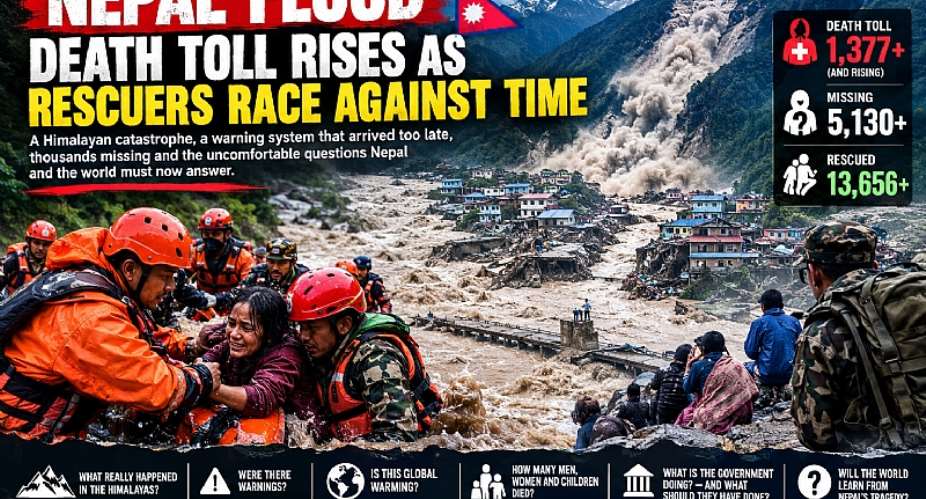
A massive cascade of ice, rock, mud and water surged through the Himalayan river system, devastating communities along the Bhote Koshi and Trishuli corridors. More than two weeks later, the scale of the catastrophe remains difficult to comprehend.
As of the latest Nepal government figures available on September 10, 1,377 bodies had been recovered and 5,130 people remained missing. More than 13,656 people had been rescued.
Reuters reported on September 13 that the broader disaster had claimed at least 1,386 lives, with about 5,130 still missing.
And behind those numbers are families still waiting for a knock on the door.
Nepal: A country built in the shadow of mountains and water
To understand why this disaster became so destructive, one must first understand Nepal itself.
Nepal is a predominantly mountainous country squeezed between India and China. The Himalayas dominate its northern landscape, while countless rivers descend from the mountains through steep valleys before flowing toward the plains.
The same geography that makes Nepal one of the world's most spectacular countries also makes it exceptionally vulnerable to landslides, flash floods, avalanches, glacier-related disasters and earthquakes.
The problem is becoming more complicated.
The Himalayas are warming rapidly, glaciers are retreating and frozen ground that once helped stabilize mountain slopes is weakening. Scientists increasingly warn that a warmer climate can increase the likelihood of cascading disasters involving glaciers, landslides, lakes and rivers.
That does not mean every flood can simply be labelled "climate change."
But it does mean the background conditions are changing.
And that distinction matters.
So what actually happened?
The August 26 disaster appears to have begun high in the Himalayas.
Experts say a huge section of ice and rock collapsed near the Langtang region, releasing an enormous mass of debris into the river system. The resulting torrent travelled rapidly downstream through the Bhote Koshi corridor.
Reuters reported that satellite imagery showed a major release of ice, rock and sediment, while researchers suggested unusually high temperatures and long-term warming may have contributed to the instability.
The disaster was therefore not simply:
"Heavy rain → river overflow → flood."
It was closer to:
warming → unstable mountain environment → glacier/rock collapse → enormous debris movement → sudden river surge → flash flooding → destruction downstream.
That distinction explains why traditional flood preparedness was not necessarily enough.
But here's the question Nepal cannot escape: Were people warned?
This is perhaps the most uncomfortable part of the story.
There were warnings.
Nepal's flood authorities reportedly received information shortly after the disaster began. Emergency alerts were subsequently issued.
But reports indicate that the warning came only after the catastrophic process had already begun.
One analysis found that Nepal's flood authorities received information about the major flood entering the Bhote Koshi system shortly after the glacier collapse, while an emergency alert was reportedly sent around 38 minutes after the collapse.
For an ordinary river flood, 38 minutes might provide valuable time.
For a wall of ice, rock, mud and water racing down a narrow Himalayan valley?
Thirty-eight minutes can be the difference between evacuation and death.
And that raises a question that deserves much more attention:
What is the value of an early-warning system if the warning arrives after the disaster has already begun?
Nepal needs to ask whether it has built an early-warning system or merely an early-reporting system.
Those are not the same thing.
Was the disaster completely unforeseeable?
Not necessarily.
Scientists have long warned that Himalayan glaciers and glacial lakes represent major hazards.
The region contains thousands of glaciers and glacial lakes, yet monitoring remains extremely limited. A recent assessment cited by Reuters found that only 21 of roughly 40,000 glaciers in the Hindu Kush-Himalaya region are currently monitored.
That number should frighten policymakers.
Because the question is no longer simply:
"Can we predict the next flood?"
It is:
"How many dangerous glaciers and unstable mountain slopes are we not monitoring at all?"
The destruction: Nepal's infrastructure was simply overwhelmed
The flood did not merely destroy homes.
It attacked the systems that keep modern society functioning.
Homes disappeared.
Roads were ripped apart.
Bridges collapsed.
Communications were disrupted.
Water systems were damaged.
Health facilities were affected.
Hydropower infrastructure was destroyed or severely damaged.
Nepal's government reported widespread damage across Rasuwa, Nuwakot, Dhading and other districts along the river system.
The Associated Press reported that approximately 7,500 homes were destroyed, while 12 hydropower projects were damaged, with estimated losses reaching about $2.56 billion.
That is an extraordinary economic blow to a country whose annual government budget is only around $14 billion.
And then came the hydropower nightmare
Nepal depends heavily on hydropower.
The disaster therefore struck one of the country's most important economic and energy sectors.
More than a dozen hydropower projects were affected, while hundreds of workers were among those missing.
Some workers were trapped inside tunnels.
And yet, amid the horror, there were extraordinary stories of survival.
A Nepali hydropower worker, Sanjay Sah, survived approximately nine days inside a flooded tunnel, surviving on water from the flood and seepage from surrounding rocks before rescuers reached him.
Another survivor, a 64-year-old woman, was reportedly rescued after spending about ten days trapped beneath a collapsed building.
These rescues demonstrate something important:
As long as there are people trapped, the rescue operation cannot simply become a body-recovery operation.
Rescuers are fighting geography itself
Nepal's rescue teams are facing an enemy that cannot be negotiated with: terrain.
Destroyed roads and bridges have made many communities extremely difficult to reach.
The Nepali Army, Nepal Police, Armed Police Force and disaster-management authorities have been mobilised.
The government says more than 13,600 people have already been rescued.
Special equipment including drones, LiDAR systems, Bailey bridges, underwater drones, pumps, generators, DNA-testing equipment and specialised tunnel-rescue equipment is being deployed.
The army has also begun using drones to deliver food, medicine, fuel and other supplies to areas inaccessible by conventional vehicles. Reuters reported that four large cargo drones were making multiple deliveries each day.
Meanwhile, forensic teams from countries including India, China, Japan, Singapore and South Korea have joined Nepali authorities in identifying bodies through DNA analysis.
But more than 5,000 people are still missing
And this is where the numbers become almost unbearable.
Nepal's September 10 government update recorded 5,130 missing people.
The missing include Nepalis and hundreds of foreigners.
Families have been forced to wait for DNA identification, search updates or any information that could explain what happened to their loved ones.
For some families, "missing" is more painful than death.
Because there is no grave.
No funeral.
No certainty.
Only waiting.
Where are the women and children in these statistics?
This is another question governments and international media must ask.
The official updates have provided overall death and missing figures, but a verified comprehensive breakdown of the dead by men, women and children has not been published in the government updates reviewed for this article.
That matters.
Because disasters do not affect everybody equally.
UN agencies have warned that women and girls face heightened risks following the flooding, particularly because of shortages of food, clean water, healthcare, sanitation and protection.
UNICEF reported that at least 17,000 children had been affected by the disaster in its early assessment, with children urgently requiring water, sanitation, hygiene, health and protection services.
So the question should not merely be:
"How many people died?"
It should also be:
How many mothers lost children?
How many children lost parents?
How many women are now heading households without the family members who once provided income?
How many children have lost their homes, schools and sense of security?
Those are the statistics that will define Nepal's real recovery.
Is global warming responsible?
The answer requires honesty.
Global warming did not necessarily "cause" this single event by itself.
The immediate trigger appears to have been a catastrophic glacier/ice-rock collapse.
But climate change can alter the conditions that make such collapses more likely or more severe.
Scientists have pointed to accelerating glacier retreat, warming temperatures and weakening mountain systems as contributing risk factors.
Nepal's Foreign Minister Shisir Khanal has argued that the disaster demonstrates the disproportionate burden placed on vulnerable countries by climate change.
Nepal contributes less than 0.1% of global greenhouse-gas emissions, yet is suffering devastating consequences from a warming planet.
And this creates one of the greatest injustices of the climate crisis:
Those who contributed least may be among those paying the highest price.
Is this the first time Nepal has experienced something like this?
No.
Nepal has experienced catastrophic floods, landslides and glacial lake outburst floods before.
The country has repeatedly suffered from monsoon flooding and mountain disasters.
But the scale and cascading nature of the 2026 catastrophe make this event extraordinary.
The current disaster combined an extreme mountain collapse with a massive downstream flood, infrastructure destruction, hydropower losses and thousands of missing people.
It is being described as one of Nepal's deadliest disasters in decades.
The real concern is therefore not simply whether this event will happen again.
It is:
What happens when the next one occurs in a valley where nobody is watching the glacier above?
What are Nepalis saying?
The response on the ground has included gratitude toward rescuers but also frustration.
For families who watched relatives disappear, the existence of an early-warning system means little if the warning cannot reach them quickly enough.
For communities cut off by destroyed bridges, government announcements from Kathmandu cannot substitute for food arriving at their doorstep.
For families still waiting for missing relatives, statistics do not provide closure.
And this creates an uncomfortable political question:
Should citizens be expected to accept "natural disaster" as an explanation when part of the devastation may also reflect weaknesses in monitoring, infrastructure, evacuation planning and preparedness?
A glacier may collapse naturally.
But vulnerability is not always natural.
Nepal's government is responding but the bigger test has only begun
The government has mobilised its disaster agencies, military, police and health authorities.
It has coordinated with neighbouring countries and international organisations.
Emergency medical and public-health surveillance has also been strengthened because damaged water and sanitation systems create risks of disease outbreaks. WHO says teams are monitoring illnesses including diarrhoeal disease, dengue, malaria, influenza, leptospirosis and other threats.
Nepal has also appealed internationally for substantial assistance to rebuild.
India has approved emergency electricity exports to Nepal following the destruction of hydropower infrastructure.
But rescue is only phase one.
Reconstruction is phase two.
Prevention is phase three.
And phase three will determine whether Nepal learns from this tragedy.
The questions nobody should be afraid to ask
The disaster raises questions that go beyond compassion and emergency relief.
1. Why were so few Himalayan glaciers being monitored when the region contains tens of thousands?
2. If authorities knew that a catastrophic flood had entered the Bhote Koshi system, why couldn't more people be evacuated before the water arrived?
3. Was the warning system designed for the speed of a modern glacier-collapse disaster or for ordinary river flooding?
4. How much money has Nepal spent preparing for climate-related disasters compared with what it will now spend rebuilding what was destroyed?
5. Were roads, bridges, hydropower facilities and settlements built with future climate extremes in mind or yesterday's climate?
6. How many other dangerous glaciers and unstable slopes are currently being watched by nobody?
7. Are development projects increasing exposure to disasters by putting people and infrastructure deeper into vulnerable valleys?
8. Who will be held responsible when the next warning arrives too late?
And perhaps the most uncomfortable question of all:
If scientists have been warning for years that the Himalayas are becoming increasingly unstable, why is disaster preparedness still largely reactive?
Nepal and Ghana: Different disasters, same uncomfortable lesson
Comparing Nepal's catastrophe with flooding in Ghana requires caution.
They are not the same phenomenon.
Ghana's flooding is predominantly associated with intense rainfall, drainage problems, urbanisation, blocked waterways, development patterns and, in some cases, dam releases.
Nepal's 2026 catastrophe involved an extraordinary Himalayan glacier and debris collapse.
The physical mechanisms are therefore fundamentally different.
But the political lesson is remarkably similar.
In Ghana, flooding can turn deadly because rainwater has nowhere to go.
In Nepal, water and debris became deadly because communities and infrastructure were located in the path of an extreme mountain event.
In both cases, the question eventually becomes:
How much of the destruction was unavoidable and how much was made worse by human decisions?
That is the question every country facing climate disasters must confront.
The next disaster is already being created
Perhaps the most important lesson from Nepal is that climate disasters are no longer isolated events.
A warming world can produce cascading risks:
melting ice → unstable slopes → landslides → river blockage → sudden flooding → destroyed roads → isolated communities → delayed rescue → disease outbreaks → economic collapse.
One event can trigger ten others.
That is why simply building higher flood walls is not enough.
Nepal needs stronger glacier monitoring, real-time satellite surveillance, seismic and geological monitoring, faster mobile-phone warnings, evacuation routes, community drills, resilient bridges and roads, emergency communication systems and clear rules governing development in high-risk valleys.
Experts have specifically called for improved early-warning and evacuation systems, including seismic monitoring and rapid mobile-phone alerts.
Nepal's tragedy is a warning to the world
There is a temptation to look at Nepal and say:
"That is a Himalayan problem."
It is not.
The Himalayas feed major river systems across Asia.
What happens to the mountains affects Nepal, India, China, Bangladesh, Bhutan and millions of people downstream.
The glaciers are not merely tourist attractions.
They are water towers.
And if those water towers become unstable, the consequences will reach far beyond the mountains.
A recent assessment warns that the Himalayas are approaching critical thresholds as glacier melt accelerates, with enormous implications for water security and livelihoods across the region.
The question Nepal and the world must now answer
The dead cannot be brought back.
The missing may never all be found.
The destroyed bridges can be rebuilt.
The hydropower stations can be reconstructed.
Homes can be replaced.
But rebuilding concrete is easier than rebuilding trust.
The real test of Nepal's government will therefore not be how many helicopters it deploys after the flood.
It will be whether it can ensure that the next warning reaches people before the water does.
And the real test of the international community will not be how many condolences it sends.
It will be whether countries responsible for the largest share of historical emissions are willing to help vulnerable nations adapt to a climate crisis they did little to create.
Nepal is asking the world to look at its mountains.
But perhaps the world should also look at itself.
Because the terrifying question is no longer:
"Could this happen again?"
The more frightening question is:
"When the next glacier collapses, will humanity have learned anything from the people Nepal lost in 2026?"
And if the answer is no, then the next disaster will not simply be a natural catastrophe.
It will be a failure of preparation.
By:
Patrick Belebang Yagsori
+233240292413
[email protected]

 How IGP Yohuno led Police team to rescue victim, arrest four kidnappers in Assin...
 Akufo-Addo would have used Accra-Kumasi expressway for galamsey – Mahdi Gibrill
 Nigeria's Dangote refinery launches continent's biggest IPO
 Accra-Kumasi Expressway to cut travel time to 2hours, drive 120km per hour — Mah...
 'Our own money $2billion ready, we have not gone to borrow money from anywhere' ...
 Founder’s Day September 21 declared public holiday
 Council of State was not qualified to determine prima facie case against Torkorn...
 'Grounds for removal of Chief Justice and justice of superior court shallow, eph...
 Don't be a Bar that flips on principles but a Bar that is consistent — AG tells ...
 Prostate cancer may show no symptoms until advanced stage – Urologist warns


