




For decades, African countries have been told that development requires discipline, borrowing, reform, austerity, structural adjustment and, when things go badly, another programme with the International Monetary Fund.
But a different question is now becoming increasingly difficult to ignore:
What if the problem is not simply that Africa has borrowed too much but that Africa has spent decades operating inside a global economic system that gives others enormous power over the rules?
That question sits at the heart of the growing interest in BRICS.
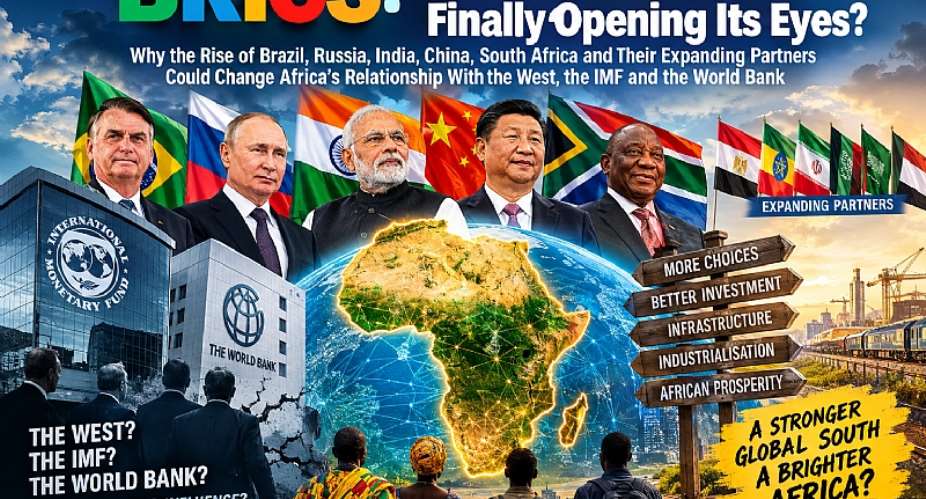
BRICS began in 2006 as BRIC Brazil, Russia, India and China with South Africa joining in 2011. It has since expanded dramatically. The current BRICS grouping comprises Brazil, Russia, India, China, South Africa, Egypt, Ethiopia, Indonesia, Iran, Saudi Arabia and the United Arab Emirates, according to the BRICS presidency's official information.
And its significance is no longer merely economic.
BRICS is increasingly becoming a political argument about who gets to make the rules of the international system.
That is precisely why the debate deserves much closer African attention.
What Exactly Is BRICS?
BRICS is a cooperation mechanism bringing together major emerging economies.
It is not a country.
It is not a military alliance like NATO.
It does not have a single parliament or government.
And despite frequent speculation, BRICS does not currently have a common currency replacing the US dollar.
Instead, it has developed cooperation around three broad areas: politics and security; economics and finance; and people-to-people cooperation.
Its broader ambition is to increase cooperation among emerging economies and give developing countries greater influence over international institutions.
South Africa's government describes BRICS as a mechanism aimed at peace, security, development and cooperation, while also seeking a more equitable world order.
That sounds harmless.
But the implications are enormous.
Because if countries representing a huge share of the world's population, production, commodities and markets begin coordinating their economic interests, the balance of global power inevitably begins to shift.
Why Was BRICS Created?
The origins of BRICS cannot be separated from dissatisfaction with the existing international order.
After the Second World War, institutions such as the IMF and World Bank became central pillars of the international economic system.
They played and continue to play important roles in financial stability, development financing, poverty reduction and crisis response.
But the question increasingly became:
Do the institutions created for the economic realities of the 1940s adequately represent the economic realities of the 2020s and 2030s?
That is one of BRICS' central arguments.
South Africa's government has explicitly described BRICS' objective as contributing to restructuring the global political, economic and financial architecture so that it becomes more equitable and balanced.
The argument is straightforward:
China is no longer a marginal economy.
India is no longer a peripheral power.
Brazil is a major agricultural and commodities powerhouse.
Russia is a major energy and minerals producer.
South Africa is an important African industrial and mineral economy.
And now BRICS includes major Middle Eastern energy producers as well as Egypt, Ethiopia and Indonesia.
So why should the governance of global finance remain structured primarily around the realities of the twentieth century?
That is the question BRICS is asking.
The Principles Behind BRICS
BRICS' philosophy is built around several recurring principles:
1. Sovereign equality
Countries should be able to determine their domestic policies without external political coercion.
2. Multilateralism
Global problems should be addressed through multilateral institutions rather than unilateral decisions by powerful countries.
3. South-South cooperation
Developing countries should cooperate directly rather than depending overwhelmingly on institutions headquartered in the traditional Western powers.
4. Reform of global governance
BRICS has repeatedly called for greater representation for developing countries within institutions such as the United Nations, IMF and World Bank.
5. Greater economic cooperation
This includes trade, infrastructure, investment, finance, technology and increasingly local-currency transactions.
6. Strategic autonomy
Countries should be able to maintain relationships with different powers without being forced into one geopolitical camp.
South Africa, for example, has explicitly described its foreign policy as seeking strategic partnerships rather than domination by any major power bloc.
That principle may be particularly important for Africa.
So Why Does BRICS Make Washington and Some Western Policymakers Nervous?
The answer is not simply that BRICS exists.
The deeper concern is what BRICS could become.
Imagine a world in which major commodity exporters increasingly trade with major manufacturing economies without using the dollar for every transaction.
Imagine African countries obtaining infrastructure financing from institutions outside the traditional Western financial architecture.
Imagine developing countries coordinating positions inside the United Nations.
Imagine alternative payment systems developing alongside existing Western financial networks.
Imagine countries possessing sufficient economic alternatives that sanctions from one major power become less devastating.
That would not necessarily destroy the Western economic system.
But it would reduce its leverage.
And that distinction matters.
Trump and the BRICS Question
Former U.S. President Donald Trump made the issue particularly explicit.
In January 2025, Trump threatened BRICS countries with 100% tariffs if they attempted to replace the US dollar with another currency.
But here is the uncomfortable question:
If BRICS is economically insignificant, why threaten it with extraordinary tariffs?
The answer is that the issue is not necessarily BRICS' current ability to destroy the dollar.
It is the possibility of gradual fragmentation of the financial system.
The dollar remains overwhelmingly important to global finance. BRICS has not produced a unified currency, and even within BRICS there are major disagreements about how quickly or whether to pursue "de-dollarisation."
Indeed, Russia's Kremlin said shortly before the 2026 summit that Russia was not seeking formal "de-dollarisation" and remained open to different payment methods.
So the reality is more complicated than the popular slogan:
BRICS is not about tomorrow morning waking up and the dollar disappearing.
It is about creating options.
And in geopolitics, options are power.
Why Would the IMF and World Bank Care?
Again, it would be inaccurate to say that the IMF or World Bank are literally "scared" of BRICS.
But BRICS presents a structural challenge to the dominance of traditional multilateral financial institutions.
The most important institution in this discussion is the New Development Bank (NDB).
Created by BRICS, the NDB was designed to mobilise resources for infrastructure and sustainable-development projects in emerging markets and developing countries.
By the end of 2025, the NDB had approved about US$43 billion for 140 projects, with 115 projects and approximately US$35.6 billion in financing remaining in its portfolio.
That matters.
Because developing countries have historically had limited choices when seeking international development finance.
BRICS is trying to expand those choices.
And the 2026 BRICS summit pushed further.
The New Delhi Declaration encouraged strengthening the NDB, expanding its membership, mobilising new funding and increasing local-currency lending.
The bloc also called for reforms of institutions such as the IMF and World Bank to give emerging economies greater representation.
That is perhaps the real contest:
Not BRICS versus the World Bank.
But choice versus dependency.
What Does This Mean for Africa?
This is where the BRICS debate becomes particularly important.
Africa needs enormous amounts of financing for:
roads;
railways;
ports;
electricity;
water;
sanitation;
digital infrastructure;
manufacturing;
agriculture;
industrialisation;
healthcare;
education.
And Africa cannot solve these problems through Western development assistance alone.
The NDB's increasing emphasis on infrastructure, local-currency financing and sustainable development could therefore provide another source of capital.
But there is a crucial warning:
BRICS financing is not free money.
China does not invest in Africa purely because it loves Africa.
India does not trade with Africa purely out of charity.
Russia, the UAE, Brazil and other BRICS countries also pursue strategic and commercial interests.
Therefore, Africa must not replace one dependency with another.
The objective should be:
African strategic autonomy not replacing Western dependency with BRICS dependency.
Africa Is Already Inside BRICS
Africa is not merely watching from outside.
Three African countries are currently members:
South Africa
South Africa became a BRICS member in 2011.
Its government said the objective included strengthening South-South relations and helping reshape global political, economic and financial structures.
Egypt
Egypt joined the expanded BRICS grouping in 2024.
Its location, population, Suez Canal, trade relationships and economic interests make it strategically important to the bloc.
Ethiopia
Ethiopia also joined the expanded BRICS grouping in 2024.
For Addis Ababa, membership provides another platform for diplomatic engagement, trade, investment and development cooperation.
The expansion itself was a major geopolitical statement.
BRICS was no longer just Brazil-Russia-India-China-South Africa.
It was becoming a broader Global South platform.
But What Has Africa Actually Gotten From BRICS?
This is where African governments need to be intellectually honest.
Membership alone does not create development.
South Africa's participation has expanded diplomatic influence and created access to BRICS institutions and partnerships, while its government has argued that BRICS cooperation can strengthen investment, development finance, infrastructure, climate cooperation and South Africa's international influence.
But BRICS has not magically eliminated unemployment, inequality or poverty in South Africa.
Egypt and Ethiopia still face major economic challenges.
Therefore, the question should not be:
"Is BRICS good?"
It should be:
"What can African countries negotiate from BRICS that advances African industrialisation?"
That is a much more intelligent question.
And Then There Is Ghana
Ghana provides perhaps one of the most fascinating cases.
Ghana has been an IMF member since 1957 and, according to IMF data, has entered into 18 arrangements since joining the institution.
Think about that number.
Eighteen arrangements.
And yet Ghana continues to experience recurring fiscal crises, debt problems, currency pressures and IMF programmes.
The latest IMF programme has nevertheless produced measurable stabilisation.
In July 2026, the IMF said Ghana's programme had delivered substantial improvements: inflation had fallen sharply, reserves had nearly doubled by 2025, the primary fiscal balance had moved into surplus and debt-distress risks had improved to moderate.
That evidence cannot honestly be ignored.
But another question remains:
If IMF programmes can stabilise Ghana's economy, why has Ghana repeatedly found itself needing them?
That is the bigger question.
Is the IMF the Problem or Is Ghana the Problem?
This is where the conversation often becomes dangerously simplistic.
Critics say the IMF imposes austerity and policies that can hurt ordinary citizens.
Supporters argue that the IMF does not create Ghana's fiscal problems it responds to them.
And the IMF itself says its Ghana programme is designed around restoring macroeconomic stability, debt sustainability and inclusive growth.
There is truth on both sides.
Ghana's fiscal problems cannot simply be blamed on Washington.
Ghanaian governments have borrowed.
Ghanaian governments have overspent.
Ghanaian governments have sometimes created politically attractive but financially unsustainable programmes.
Tax collection remains difficult.
Public-sector efficiency remains a problem.
State-owned enterprises continue to create fiscal risks.
And political cycles frequently interfere with long-term economic planning.
Therefore, blaming the IMF for everything is intellectually lazy.
But equally lazy is the argument that Africans should simply accept the existing international financial architecture without asking whether it can be improved.
Here Is the Question Nobody Wants to Ask
Why does Africa repeatedly borrow money to consume instead of borrowing to transform its productive capacity?
Why does Ghana borrow dollars to finance a budget while importing products that Ghana itself could manufacture?
Why does Ghana export raw gold but import finished products?
Why does Africa export minerals needed for the global energy transition while importing much of the technology manufactured from those minerals?
Why should cobalt leave Africa as a raw material and return as an expensive battery component?
Why should African countries remain primarily commodity suppliers while other countries control manufacturing, technology, finance and global supply chains?
Perhaps the greatest African problem is not whether the lender is Western or Eastern.
Perhaps it is that Africa has not negotiated hard enough for industrialisation in exchange for its resources.
Does the West Want to Keep Africa Under Control?
This is one of the most sensitive questions.
There is no credible evidence that "the West" operates as one unified organisation whose secret objective is simply to prevent Africa from developing.
That claim is too simplistic.
Western countries have invested heavily in Africa.
Western companies operate businesses across the continent.
Western governments provide development assistance.
The World Bank and IMF finance African economies.
African countries also voluntarily choose to cooperate with Western institutions.
But history cannot simply be erased.
Colonialism created economic structures in which African territories supplied raw materials to imperial economies.
And even after independence, many African economies remained dependent on commodity exports, foreign capital, foreign technology and external markets.
So the uncomfortable question is not:
"Does the West secretly want Africa to remain poor?"
The better question is:
"Does the structure of the global economy sometimes reward Africa for remaining a supplier of raw materials rather than becoming a competitor in manufacturing and technology?"
That question deserves serious debate.
BRICS Says the International System Is Not Fair
This is where BRICS' criticism becomes powerful.
At the 2026 New Delhi summit, BRICS leaders criticised unilateral tariffs and non-tariff measures and called for reform of the global trading system.
They also criticised unilateral sanctions.
The New Delhi Declaration called for a stronger multilateral system and raised concerns about measures imposed without broader international authorisation.
Why does this matter to Africa?
Because sanctions are not merely political instruments.
They can affect:
food;
fuel;
shipping;
banking;
currencies;
investment;
commodity prices;
development projects.
A country that becomes dependent on a financial system controlled by another power is inevitably vulnerable to decisions made by that power.
BRICS therefore wants countries to have alternatives.
The 2026 BRICS Summit: What Actually Happened?
The 18th BRICS Summit took place in New Delhi on September 12–13, 2026.
And it was arguably one of the most consequential BRICS meetings yet because the bloc is now much larger and more politically diverse than its original five members.
The summit produced the New Delhi Declaration.
Among its major themes were:
opposition to unilateral tariffs and trade restrictions;
criticism of unilateral sanctions;
reform of the IMF, World Bank and WTO;
stronger representation for developing countries;
greater use of national currencies in trade;
stronger cross-border payment systems;
strengthening the New Development Bank;
infrastructure and sustainable development;
energy security;
digital cooperation;
AI cooperation;
greater Global South participation in global governance.
The summit also called for maximum restraint over escalating Middle East tensions and emphasised diplomacy and dialogue.
One particularly significant development was the bloc's continued push toward payment systems that can operate more efficiently across national currencies.
That does not mean the dollar is disappearing.
It means countries are trying to make sure that the dollar is not their only option.
BRICS' Biggest Threat May Not Be a New Currency
The obsession with a BRICS currency sometimes misses the bigger picture.
The real threat to a dominant financial system may be much simpler:
competition.
If an African country can obtain infrastructure financing from the NDB…
If it can trade with China using its national currency…
If it can attract Indian investment…
If it can sell commodities to Brazil…
If it can access alternative payment mechanisms…
If it can negotiate with several powerful blocs instead of one…
Then its bargaining position changes.
It does not need to abandon America.
It does not need to abandon Europe.
It does not need to abandon the IMF.
It simply has more choices.
And countries with choices have more negotiating power.
But BRICS Has Serious Problems Too
A professional analysis cannot turn BRICS into a paradise.
It isn't.
India and China have major strategic tensions.
China and Russia have different interests.
Iran and the UAE have competing regional interests.
Brazil has its own priorities.
India maintains strong relations with the United States and other Western powers.
And the economies of BRICS members vary enormously.
There is also no unified BRICS fiscal authority.
No common military.
No common currency.
No single foreign policy.
And no guarantee that members will sacrifice national interests for collective interests.
The Financial Times noted that strategic rivalries including India-China tensions continue to complicate BRICS unity.
So BRICS could become powerful.
But it could also become another international forum that produces declarations without delivering enough transformation.
So Why Is the West Watching?
Because BRICS represents something historically significant.
For centuries, global economic power was concentrated largely in North America and Western Europe.
Now economic gravity is shifting.
China has become a manufacturing giant.
India is becoming a major technology and services power.
Brazil remains an agricultural and commodities powerhouse.
The Gulf states control enormous financial and energy resources.
Africa possesses enormous mineral, agricultural, energy and demographic potential.
And BRICS is attempting to connect many of these forces.
That is why the West cannot simply ignore it.
The Question Africans Should Really Be Asking
It should not be:
"Should Africa choose BRICS or the West?"
That is the wrong question.
The correct question is:
"How can Africa make both sides compete for African partnerships?"
Why should Ghana have only one source of development finance?
Why should African governments be forced to choose between Washington and Beijing?
Why can't Africa negotiate with Washington, Brussels, Beijing, Delhi, Moscow, Riyadh and Abu Dhabi simultaneously?
Why should Africa's diplomatic strategy be based on friendship rather than national interest?
Why shouldn't Ghana say:
"We will cooperate with everybody who offers us technology, investment, infrastructure and markets but we will not surrender our sovereignty to anybody."
That should be African strategic autonomy.
Should Ghana Join BRICS?
This requires careful consideration.
There could be significant potential benefits:
Trade diversification.
Ghana could deepen relationships with major emerging markets.
Infrastructure financing.
BRICS institutions could potentially provide additional financing channels.
Investment.
Ghana could seek investment in manufacturing, energy, agriculture, minerals and technology.
Payment diversification.
Greater use of local currencies could eventually reduce some transaction costs and dollar exposure.
Diplomatic leverage.
Ghana could strengthen its voice in debates about reform of global institutions.
But there are risks.
Closer BRICS alignment could complicate Ghana's relationships with Western investors and partners.
Some BRICS members have sanctions-related problems.
Currency and payment systems remain complicated.
And Ghana could simply replace one form of dependence with another.
Therefore, Ghana should not join BRICS merely because it is fashionable.
Ghana should join or deepen engagement with BRICS only if it has a clearly negotiated national-interest strategy.
What Would a Smart Ghanaian BRICS Strategy Look Like?
Ghana should not enter the room saying:
"We need money."
That is how countries become dependent.
Ghana should enter saying:
"We have gold, bauxite, manganese, oil, agricultural potential, a strategic location, a young population and access to the African Continental Free Trade Area. What are you bringing to build our productive capacity?"
That is negotiation.
Ghana should demand:
Raw minerals → processing plants.
Agricultural exports → agro-processing.
Investment → local employment.
Infrastructure loans → productive infrastructure.
Technology agreements → Ghanaian skills transfer.
Mining → local value addition.
Digital partnerships → Ghanaian technological capacity.
That is how BRICS could become useful.
The Biggest Question of All
Perhaps BRICS is not actually asking Africans to abandon the West.
Perhaps it is asking Africans to recognise something much more fundamental:
The world has changed.
The institutions created after World War II no longer perfectly reflect today's economic realities.
And if Africa remains passive, other countries will decide the new rules without Africa.
That is the real danger.
Is BRICS a Threat to the West?
Yes but not necessarily in the way politicians often suggest.
It is not an immediate military threat.
It is not about BRICS armies marching toward Washington.
It is a potential economic, diplomatic and institutional counterweight.
It challenges the assumption that there should be one dominant centre of global economic decision-making.
It challenges dependence on a single currency.
It challenges the traditional distribution of voting power within international institutions.
It challenges the idea that developing countries must always negotiate individually with powerful economies.
And it gives countries another platform from which to demand reform.
That is why BRICS matters.
But Here Is the Question Western Countries and African Governments Should Not Avoid
If the IMF and World Bank genuinely believe their institutions represent the interests of the entire world, why fear competition?
If Western economies believe their development model is superior, why should they fear Africans having another option?
If BRICS is destined to fail, why threaten countries that cooperate with it?
And conversely:
If BRICS truly represents the Global South, why should Africans automatically trust China, Russia, India or any other BRICS power?
Should Africans exchange Western dependency for Chinese dependency?
Should Africa simply change the colour of the hand holding the economic steering wheel?
Absolutely not.
Africa should hold the steering wheel.
The Ghanaian Question
Ghana has turned to the IMF repeatedly.
The IMF's own database records 18 arrangements since Ghana joined the institution in 1957.
Yet Ghana remains a country with enormous natural resources and considerable human potential.
The World Bank says Ghana achieved middle-income status in 2011, but more than 20% of the population still experiences poverty, with substantially higher rates in northern regions.
So perhaps the most uncomfortable question isn't:
"Why hasn't the IMF developed Ghana?"
The IMF was never created to develop Ghana.
And perhaps it isn't:
"Why hasn't the World Bank transformed Ghana?"
The World Bank was never supposed to replace Ghanaian economic leadership.
The real question is:
Why has Ghana, after decades of independence and enormous natural wealth, failed to build an economic system capable of financing its own transformation?
That question leads directly back to Ghanaian political leadership, institutions, corruption, taxation, productivity, industrialisation, accountability and long-term economic planning.
BRICS Is Not the Messiah
Africans should remember this.
BRICS cannot rescue Africa.
The IMF cannot rescue Africa.
The World Bank cannot rescue Africa.
China cannot rescue Africa.
America cannot rescue Africa.
Europe cannot rescue Africa.
Africa must ultimately rescue itself.
But Africa can use partnerships strategically.
And that may be the greatest lesson BRICS offers.
Not:
"Leave the West."
But:
"Stop believing that you have only one option."
The Final Question
For decades, Africa has been told to choose between competing economic models.
But perhaps Africa should reject the choice entirely.
Why can't Ghana trade with China, cooperate with America, attract European investment, deepen relations with India, work with the Gulf, engage Russia where appropriate and simultaneously strengthen African integration?
Why must African countries choose a side when powerful countries themselves trade with everybody?
Why should Africa's foreign policy be based on loyalty when great powers base theirs on national interest?
And perhaps the most uncomfortable question of all:
What happens to the global economic order when Africa finally learns to negotiate as a bloc rather than beg as individual countries?
That is the question BRICS has placed on the table.
And perhaps the West's greatest fear is not that BRICS will destroy the existing world order.
Perhaps it is that Africa and the wider Global South may discover that they have enough resources, markets, people and strategic importance to demand a seat at the table not as guests, but as co-architects of the system.
The 2026 New Delhi Declaration's denunciation of unilateral sanctions and tariffs is therefore more than diplomatic language. It is part of a much larger argument about sovereignty, economic power and who gets to decide the rules of globalisation.
The real test, however, will not be whether BRICS can produce powerful declarations.
It will be whether its members can turn those declarations into roads, factories, jobs, technology, affordable finance, industrialisation and genuine economic sovereignty.
And for Africa, that is the only question that ultimately matters.
Because changing the lender without changing the economic structure is not liberation.
Changing the system that keeps Africa dependent that is the real revolution.
By:
Patrick Belebang Yagsori
+233240292413
[email protected]

 Thousands attend Kenya opposition rally amid anger over political violence
 Trump slams AI sceptics as Altman pauses OpenAI IPO plans over safety concerns
 WASSCE: School officials helped students cheat for years, but we now see the tru...
 Probe alleged military killing of lecturer in Bawku – Kusaug Youth demands
 ‘If we all pay GH¢1,000 each, we should be able to construct National Cathedral’...
 Mahama inspects proposed site for Upper West Regional Airport
 Mahama reiterates government's commitment to end double-track SHS system
 Police interdict officer over death of 23-year-old Ivan Baidoo on Tema Motorway
 Improved invigilation is exposing true performance of Ghanaian students — Mahama...
 There's no policy to introduce Arabic, Chinese in all public schools — Mahama


