




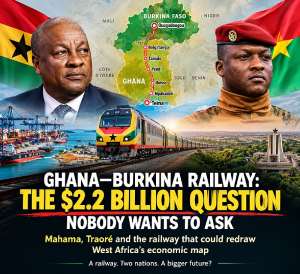
A railway stretching from the Atlantic coast of Ghana to the heart of landlocked Burkina Faso sounds, at first, like another grand African infrastructure announcement.
But this one is different.
Because beneath the steel tracks, bridges, stations and locomotives lies a much bigger contest: Who controls the movement of goods between the Gulf of Guinea and the Sahel? Who controls the economic gateway? Who finances the infrastructure? Who carries the debt? And, perhaps most importantly, who ultimately benefits?
The proposed Ghana–Burkina Faso Railway Interconnectivity Project is designed to connect Ghana's Port of Tema to Ouagadougou, with the Ghanaian alignment passing through places including Mpakadan, Hohoe, Yendi, Tamale, Bolgatanga and Paga before crossing into Burkina Faso. Earlier official plans envisaged about 1,000–1,200 kilometres, depending on the final route and project definition.
And here is the first uncomfortable truth:
The railway is not actually starting from zero.
Ghana has already constructed the 97.7-kilometre Tema–Mpakadan standard-gauge section, a first major piece of the larger corridor. That section cost approximately US$447 million and was financed through a buyer's credit arrangement involving India's Exim Bank.
So the real question is no longer:
"Will Ghana and Burkina Faso build a railway?"
The real question is:
"Who will pay for the remaining railway and on what terms?"
TWO COUNTRIES, ONE CORRIDOR BUT TWO VERY DIFFERENT INTERESTS
Ghana and Burkina Faso are neighbours separated by roughly 600 kilometres of border, but their economic circumstances are dramatically different.
Ghana has an Atlantic coastline and one of the region's major ports at Tema.
Burkina Faso is landlocked.
That geographical fact has enormous economic consequences.
For Burkina Faso, access to an efficient seaport is not simply about convenience. It is about national economic survival.
For Ghana, connecting Tema to Burkina Faso means transforming Ghana from simply a coastal economy into a gateway economy for the Sahel.
The World Bank has previously identified the Tema–Ouagadougou corridor as strategically important to Ghana's trade while noting the high transport and logistics challenges facing landlocked Burkina Faso.
This means both countries need the railway.
But they don't necessarily need it for exactly the same reason.
Burkina Faso wants access.
Ghana wants the business generated by that access.
And that distinction matters.
BEFORE MAHAMA AND TRAORÉ: THE IDEA WAS ALREADY ALIVE
The railway conversation predates both leaders.
Official Ghanaian documents show that the Ghana–Burkina Faso Railway Interconnectivity Project was already being developed through a Joint Committee of Experts.
The project was divided into feasibility studies, procurement of a private-sector partner, technical analysis and construction.
Burkina Faso's transport authorities also described the project as a modern railway connecting Tema to Ouagadougou, with the private sector expected to finance, construct and operate the line under a concession arrangement before eventually transferring it to the states.
The proposed railway was designed as a standard-gauge line, with earlier technical specifications envisaging passenger trains capable of up to 160 km/h and freight trains around 120 km/h.
The Burkina Faso section was planned to include ten stations, while the broader corridor was expected to have dozens of stations.
So when social media says:
"Traoré and Mahama are now building Africa's longest railway"
that needs qualification.
They did not invent the project.
They inherited a project that had spent years trapped between feasibility studies, financing questions, procurement problems and political transitions.
And that may actually be the biggest story.
THEN CAME MAHAMA AND TRAORÉ
On January 7, 2025, Captain Ibrahim Traoré travelled to Accra for President John Dramani Mahama's inauguration.
The meeting that followed was politically significant.
Burkina Faso's government reported that Mahama and Traoré discussed strategic sectors and expressed their determination to strengthen bilateral cooperation.
Mahama told Traoré that he was honoured by his presence and described the two countries' relationship as entering a new phase.
Then, in March 2025, Mahama travelled to Ouagadougou.
The discussions went beyond railway infrastructure.
Security, terrorism, trade, energy and broader Ghana–Burkina relations were on the table.
Mahama emphasised the need for the two countries to cooperate against terrorism and increase economic and agricultural trade.
And this is where the railway becomes much more interesting.
Because a railway connecting Tema to Ouagadougou is not merely a transport project.
It is economic diplomacy made of steel.
WHAT DID TRAORÉ ACTUALLY SAY TO MAHAMA?
This is where responsible journalism must separate fact from internet mythology.
There are numerous videos and social-media posts claiming that Traoré and Mahama personally announced a new deal to construct the "longest railway line in Africa."
But publicly available official records do not establish that the two presidents signed a brand-new multi-billion-dollar railway construction contract during their 2025 meetings.
What the official record establishes is more measured.
The two leaders discussed strengthening economic cooperation.
The railway interconnection was already part of the bilateral framework.
And Burkina Faso's official government records specifically identify an existing cooperation agreement concerning railway interconnection.
So we should resist turning political symbolism into a construction contract.
A handshake is not financing.
A railway agreement is not a financial close.
A feasibility study is not construction.
And a presidential announcement is certainly not the same thing as money sitting in a project account.
That distinction is critical.
HOW MUCH WILL THIS RAILWAY COST?
Here comes one of the most important questions.
There is no single, newly published final financing figure that can responsibly be described today as the definitive cost of completing the entire Ghana–Ouagadougou railway.
However, earlier project documentation and infrastructure assessments have put the broader Ghana–Burkina railway project at approximately US$2.2 billion in one major project estimate, while other route and scope assumptions have produced different figures.
That means anyone announcing a precise final price without explaining:
- the route;
- the final engineering design;
- land acquisition;
- bridges;
- stations;
- signalling;
- rolling stock;
- border infrastructure;
- inflation;
- financing costs;
- security costs;
- and the PPP structure
is giving the public a number without giving the public the calculation.
And that is dangerous.
SO HOW MUCH IS GHANA CONTRIBUTING?
This is where the public deserves far more transparency.
Ghana has already made a substantial infrastructure commitment through the Tema–Mpakadan section.
That 97.7-kilometre line cost about US$447 million, financed through India's Exim Bank buyer's credit.
But that does not mean Ghana has contributed US$447 million in cash from its own internally generated funds.
It means Ghana assumed obligations under an externally financed credit structure.
That distinction matters.
And it raises a bigger question:
How much additional debt will Ghana assume to complete its remaining portion of the corridor?
That figure needs to be publicly disclosed.
AND HOW MUCH IS BURKINA FASO CONTRIBUTING?
Here is another uncomfortable question.
Where is the publicly available document showing Burkina Faso's exact cash contribution to the railway construction?
The project structure has historically envisaged the two states making land available for the railway while a private partner would potentially finance, construct and operate the infrastructure under a concession. Burkina Faso's official transport documentation also refers to land provision and compensation obligations associated with the right-of-way.
Burkina Faso has also invested US$70 million in the Tema Inland Container Depot, demonstrating a significant interest in the Ghana corridor.
But that investment should not automatically be described as Burkina Faso's "railway contribution."
They are different investments.
Therefore:
Until both governments publish a financing matrix, the public should not pretend that Ghana and Burkina Faso are contributing equal amounts of money.
There is currently no credible public evidence establishing a simple 50:50 cash contribution for the entire railway.
WHO IS REALLY PAYING?
This may be the most important question of all.
The original project architecture was heavily oriented toward a Public-Private Partnership.
Burkina Faso's transport ministry said the selected private partner would be expected to construct, operate and eventually transfer the railway under a concession.
That means the ultimate financial structure could involve:
Ghanaian government contribution
+ Burkina Faso government contribution
+ private capital
+ commercial financing
+ development finance
+ possible concessional loans
+ grants/technical assistance.
This is radically different from saying:
"Ghana and Burkina Faso are jointly paying US$2.2 billion."
They may not be.
And the public deserves to know exactly who is assuming which risk.
WHAT ABOUT FOREIGN AID?
Yes but we must distinguish foreign aid, loans and project-specific grants.
India has played a major financing role in Ghana's railway development.
The Tema–Mpakadan project was financed through approximately US$447 million in buyer's credit from India's Exim Bank, consisting of an earlier US$398.33 million facility and an additional US$48.84 million for the extension to Mpakadan.
That is financing not a conventional grant.
And in 2026, the European Union provided approximately €20 million (about US$21.6 million) in grant support for signalling/ETCS-related upgrades on the Tema–Mpakadan line.
Again, that grant should not be confused with funding the entire Ghana–Burkina railway.
The public therefore needs to ask:
What are the interest rates?
What are the repayment periods?
Are there grace periods?
Is Ghana guaranteeing the loans?
Are contracts tied to foreign companies?
What procurement conditions accompany the financing?
What happens if projected freight volumes fail to materialise?
Those questions are not anti-development.
They are pro-development questions.
WHY BURKINA FASO WANTS THIS RAILWAY
For Ouagadougou, the attraction is obvious.
A reliable rail corridor to Tema could give Burkina Faso another route to international markets.
Instead of depending heavily on road transport, the country could move larger quantities of:
- gold and minerals;
- cotton;
- agricultural products;
- livestock-related goods;
- industrial inputs;
- fuel and other commodities.
It could also reduce dependence on existing corridors leading toward Abidjan and other coastal gateways.
And that is where the railway becomes geopolitical.
Because Burkina Faso is not merely looking for a railway.
It is looking for options.
WHY GHANA WANTS IT
Ghana's interest is equally powerful.
If Tema becomes a major maritime gateway for Burkina Faso and potentially Mali and Niger—Ghana could capture more:
port fees + logistics activity + warehousing + customs services + trucking + rail freight + manufacturing + finance + insurance + industrial investment.
A successful railway could turn Tema into something much bigger than a Ghanaian port.
It could become a Sahelian gateway.
That could generate thousands of direct and indirect jobs.
But it also creates competition.
Togo's Lomé port, Côte d'Ivoire's Abidjan corridor and Benin's Cotonou corridor will not simply surrender regional transit business.
The railway therefore creates a quiet economic battle for the Sahel.
THE GOOD NEWS
The benefits could be enormous.
1. Lower transport costs
Rail can move bulk cargo more efficiently than trucks over long distances.
2. Less pressure on Ghana's roads
Heavy freight traffic damages roads.
Moving more cargo onto rail could reduce maintenance pressure.
3. Stronger Tema Port
More Burkinabè transit cargo could strengthen Ghana's maritime logistics industry.
4. Industrialisation
Railway stations can become economic centres.
Warehouses, factories, agro-processing plants and logistics parks can emerge around them.
5. Jobs
Construction alone could create significant employment, followed by permanent jobs in operations, maintenance, logistics and manufacturing.
6. Regional integration
The railway could physically connect two economies that are already connected by trade, culture and geography.
BUT HERE COMES THE DARK SIDE
Infrastructure does not automatically produce prosperity.
Africa has built impressive roads, ports and railways that have struggled to generate expected economic returns.
The first danger is debt.
If governments borrow billions to build a railway that does not attract enough freight, who pays?
The taxpayer.
The second danger is cost overruns.
A US$2.2 billion estimate can become substantially more expensive once construction delays, inflation, land compensation, currency movements and financing costs enter the equation.
The third danger is security.
Burkina Faso is facing a severe security crisis involving jihadist armed groups.
Building and protecting hundreds of kilometres of railway in an insecure environment is not a normal engineering challenge.
It is a national-security challenge.
The fourth danger is political instability.
What happens if governments change?
What happens if Ghana changes its policy?
What happens if Burkina Faso's political direction changes?
What happens if the PPP operator becomes financially distressed?
What happens if the railway becomes politically important but commercially unprofitable?
AND HERE IS THE QUESTION NOBODY WANTS TO ASK
WHAT IF THE RAILWAY IS BUILT BUT THE CARGO DOES NOT COME?
This is the elephant in the room.
A railway cannot survive on presidential speeches.
It needs cargo.
Lots of it.
Every day.
For decades.
It needs miners, farmers, manufacturers, importers, exporters and logistics companies to actually use it.
That means governments must publish realistic freight forecasts.
Not political projections.
Not optimistic speeches.
Audited commercial projections.
ANOTHER QUESTION: WHO WILL CONTROL THE RAILWAY?
Suppose a private company finances and operates the railway.
Who controls the tariffs?
Who controls access?
Can Ghanaian companies use it freely?
Can Burkinabè companies use it freely?
Who gets priority when there is limited capacity?
Will foreign mining companies receive preferential freight arrangements?
Will small Ghanaian and Burkinabè businesses have affordable access?
Could the railway become a corridor designed primarily for exporting minerals rather than transforming local economies?
These questions must be answered before the first major contract is signed.
THE MINING QUESTION
And here is perhaps the most uncomfortable question.
Is this railway being built to industrialise Ghana and Burkina Faso or mainly to move commodities faster to the sea?
The difference is enormous.
If the railway merely transports raw minerals from the Sahel and Ghana's interior to Tema for export, Africa may simply be building a faster extraction pipeline.
But if railway stations become industrial hubs where minerals are processed, agricultural products are packaged, manufactured goods are produced and businesses grow, then the project becomes transformational.
The railway should not merely move Africa's wealth out.
It should help create wealth along the route.
WHAT ARE PEOPLE SAYING?
Public reactions have generally reflected two competing emotions.
On one side, there is excitement.
Ghanaians have previously praised visible progress on the Tema–Mpakadan railway, particularly because of the potential benefits for transportation and development.
Among supporters of deeper Ghana–Burkina integration, the railway is seen as a symbol of African self-reliance and regional economic integration.
In Burkina Faso, the attraction is even more straightforward:
a landlocked country wants reliable access to the sea.
But there is also scepticism.
Some observers question whether governments facing fiscal and security pressures can realistically deliver a project of this scale.
Others question whether foreign financing could create another debt burden.
And some critics fear that political rhetoric is moving faster than engineering, procurement and financing.
All of those concerns are legitimate.
THE SECURITY QUESTION IS MASSIVE
The railway would pass through territory where security cannot be treated as an afterthought.
Ghana itself has a direct security interest in preventing instability from spilling southward.
Burkina Faso's government has made fighting terrorism a central national priority.
Mahama himself has repeatedly stressed cooperation with Burkina Faso against terrorism.
So the railway could produce a surprising strategic benefit:
economic integration could become part of the security architecture of the region.
But there is a contradiction.
A railway cannot be secure simply because two presidents signed an agreement.
Tracks can be sabotaged.
Bridges can be attacked.
Signals can be vandalised.
Workers can be threatened.
Freight can be targeted.
Therefore, the security budget must be part of the railway's economics from day one.
THE MAHAMA-TRAORÉ RELATIONSHIP IS BIGGER THAN RAIL
Something else is happening.
Mahama's engagement with Traoré represents Ghana's attempt to maintain relations with the Sahel despite the political rupture between Burkina Faso and ECOWAS.
Burkina Faso, Mali and Niger withdrew from ECOWAS in January 2025 and have pursued a different regional political path through the Alliance of Sahel States.
Mahama has taken a pragmatic approach, arguing that Ghana must engage its neighbours regardless of political differences.
That makes the railway more than an infrastructure project.
It is also diplomacy.
It is Ghana saying:
We may disagree politically, but we share a border, trade routes, security challenges and economic interests.
That may be one of Mahama's most strategically important decisions.
BUT GHANA MUST NOT BE NAIVE
Friendship between presidents is not a substitute for contracts.
Pan-Africanism is not a financing model.
Political solidarity cannot repay a loan.
Ghana must therefore negotiate from economic strength.
The government must publish:
1. The final project cost.
2. Ghana's exact financial commitment.
3. Burkina Faso's exact financial commitment.
4. Private-sector contributions.
5. All loans and their interest rates.
6. All grants and their conditions.
7. The concession agreement.
8. The projected freight volumes.
9. The expected annual revenue.
10. The debt-repayment structure.
11. The ownership structure after the concession.
12. The risk-sharing arrangements.
That is what transparency looks like.
AND BURKINA FASO MUST ASK ITS OWN HARD QUESTIONS
Ouagadougou should ask:
Who owns the railway?
Who sets the freight tariffs?
Who controls the terminals?
How much will Burkinabè exporters pay?
Will Burkina Faso have guaranteed access to Tema?
What happens during political disputes?
What happens if Ghana changes its port tariffs?
Can the railway transport Burkina Faso's minerals without locking the country into another form of dependency?
And perhaps the most important:
Does the railway give Burkina Faso genuine economic sovereignty or merely give it another route to export raw materials?
THE BIGGEST OPPORTUNITY
If Ghana and Burkina Faso get this right, the railway could become something much bigger than a railway.
Imagine:
Tema Port
↓
Rail freight
↓
Northern Ghana industrial hubs
↓
Paga border
↓
Ouagadougou
↓
Future connections toward Mali and Niger
That could create an economic corridor connecting the Atlantic Ocean directly to the Sahel.
It could support:
agriculture + mining + manufacturing + logistics + ports + tourism + regional trade.
And eventually, the railway could become part of a broader West African transport network.
THE BIGGEST RISK
But if the project is badly financed, poorly managed or politically captured, the same railway could become:
another expensive African monument.
Steel tracks.
Beautiful stations.
Presidential ceremonies.
And empty trains.
That is the nightmare.
THE FINAL QUESTION
President Mahama and Captain Traoré have an opportunity that previous administrations did not fully realise.
But history will not judge them by the speeches.
It will judge them by whether the railway:
moves cargo, creates jobs, reduces transport costs, increases trade, strengthens regional security and produces enough economic value to justify its cost.
The railway has already survived governments, feasibility studies, procurement exercises, delays and political transitions.
Now it faces its biggest test:
MONEY.
Where will the billions come from?
SECURITY.
How will the tracks be protected?
GOVERNANCE.
Who will control the railway?
ECONOMICS.
Will the cargo be sufficient?
SOVEREIGNTY.
Who ultimately benefits?
And perhaps the most uncomfortable question of all:
ARE GHANA AND BURKINA FASO BUILDING A RAILWAY TO CONNECT TWO COUNTRIES OR BUILDING A NEW ECONOMIC POWER CORRIDOR THAT COULD CHANGE WHO CONTROLS WEST AFRICA'S GATEWAY TO THE SAHEL?
That is the question worth watching.
Because if Tema becomes Ouagadougou's preferred gateway to the Atlantic, the map of West African trade could change without a single border being redrawn.
By:
Patrick Belebang Yagsori
+233240292413
[email protected]

 "Fix SHS placement bottlenecks for BECE graduates" — Patricia Appiagyei tells go...
 Dr Ayew Afriye secures police enquiry bail for Efya Royal
 Free SHS cannot be blamed for basic education underfunding — Kwasi Kwarteng
 Over 4million fake baby diapers seized nationwide
 National Service personnel to demonstrate over delayed refunds, unpaid allowance...
 Even a dog would win Karaga seat from Dr. Amin Adam for NDC in 2028 — Former MP
 UK stranded Barosky to receive psychological, financial support after his repatr...
 Mahama dragged to Supreme Court over Council of State vacancy
 Ghana loses over 12,000 lives, US$1.9bn annually to air pollution — EPA
 Transport Minister admits Tema Port container congestion, promises infrastructur...

