




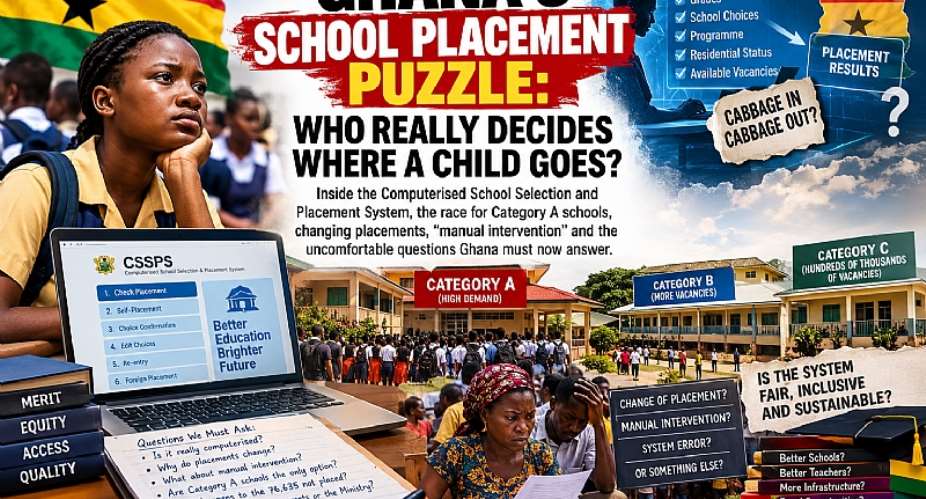
Every year, thousands of Ghanaian parents hold their breath after the Basic Education Certificate Examination (BECE).
Then the placement results arrive.
For some families, there is celebration. For others, confusion. For some, anger.
A child who performed well may not get the school the family expected. Another may reportedly see a particular school on the system and later discover a different placement. Parents queue at resolution centres demanding answers. Some ask the question that refuses to disappear:
If the system is computerised, how can a computer make a mistake or how can a placement change after it has supposedly been generated by a computer?
And perhaps the bigger question is this:
Is Ghana's Computerised School Selection and Placement System (CSSPS) actually selecting students according to merit and preference or has it become a sophisticated system managing a much deeper problem: unequal schools, unequal demand and unequal opportunities?
The 2026 exercise has brought that question back into the national conversation with extraordinary force.
FROM HUMAN HANDS TO COMPUTER ALGORITHMS
Ghana did not always place students through computers.
Before CSSPS, placement into secondary schools was largely manual. School heads and education officials participated in regional selection exercises after BECE results were released. Research on the system describes the old arrangement as labour-intensive and vulnerable to errors, delays and allegations of preferential treatment.
The transition was formally launched in September 2005.
Contemporary reporting at the time described CSSPS as a response to the administrative cost and frustrations associated with the manual system. The stated ambition was striking: selection should be based on candidates' scores and merit rather than personal connections or "protocol."
The philosophy was simple:
Let the computer match the child.
The idea was revolutionary.
But twenty-one years later, perhaps Ghana needs to ask:
Did we computerise the placement problem or did we actually solve it?
WHAT EXACTLY DOES THE COMPUTER DO?
This is where public understanding becomes important.
The CSSPS is not simply a machine randomly distributing students among schools.
According to GES documentation, the system uses the candidate's BECE performance, school/programme choices and available vacancies. The placement process uses the aggregate derived from four core subjects English Language, Mathematics, Integrated Science and Social Studies and the two best elective results. Schools also declare available vacancies, which are fed into the system.
The current CSSPS describes itself as a platform matching students based on academic performance, programme preferences and available vacancies.
In simplified terms:
Student's performance + choices + programme + residential preference + school capacity = placement outcome.
But there is another crucial factor:
Demand.
A student may be academically qualified for secondary education but still fail to obtain a particular school because too many candidates with competitive results selected that school and the available spaces were exhausted.
That distinction is fundamental.
Qualifying for SHS is not the same thing as qualifying for a particular SHS.
THE 2026 NUMBERS SHOULD MAKE EVERY GHANAIAN STOP AND THINK
The figures released for the 2026 placement exercise are enormous.
According to the Ghana News Agency's report on the Ministry of Education's briefing:
623,072 candidates sat the 2026 BECE.
604,567 qualified for placement.
527,932 have been automatically placed.
That represents approximately 87.3% of qualified candidates.
76,635 qualified candidates were not automatically placed.
313,283 candidates selected Category A schools as their first choice.
Yet Category A schools declared only 76,417 vacancies.
Category B schools declared 250,366 vacancies.
Category C schools declared 468,652 vacancies.
The numbers reveal something more uncomfortable than a simple "computer placement problem."
There were far more declared vacancies outside Category A than in Category A.
So the country faces a strange paradox:
Ghana does not appear to have simply run out of secondary-school places. Ghana has run out of places in the schools that many families most want.
The Ministry has described this as a mismatch between where vacancies exist and where candidates prefer to attend.
And that opens a much bigger national debate.
THE CATEGORY A QUESTION: ARE WE CREATING FIRST-CLASS AND SECOND-CLASS EDUCATION?
Consider the numbers.
313,283 candidates chose Category A schools first.
Available Category A vacancies:
76,417.
That means the number of first-choice Category A applicants was more than four times the declared Category A vacancies.
Meanwhile, Category C schools declared 468,652 vacancies.
So here is the question nobody should be afraid to ask:
Why do hundreds of thousands of parents and students believe that the "best" future is concentrated in a relatively small group of schools?
Is it because those schools genuinely provide substantially better education?
Is it because of their historical reputation?
Is it because of infrastructure?
Is it because of teachers?
Is it because of discipline?
Is it because of university admission outcomes?
Or has Ghana unintentionally created a hierarchy in which the category of a school has become a proxy for the quality of a child's future?
And if Category C schools have hundreds of thousands of vacancies, why are parents reluctant to choose them?
IS CSSPS REALLY "GARBAGE IN, GARBAGE OUT"?
The expression "garbage in, garbage out" is particularly relevant to computerised systems.
A computer can process information extraordinarily quickly.
But it cannot magically correct bad or incomplete information.
If the candidate's school choices are incorrectly captured, if programme choices are wrong, if residential status is wrong, if vacancies supplied by schools are inaccurate, or if candidate information contains errors, the output can be wrong even though the computer has functioned exactly as programmed.
Interestingly, GES has previously provided a school-choice verification mechanism precisely because incorrect information forwarded for placement could cause problems.
So perhaps the right question is not:
"Did the computer make the mistake?"
But:
"Who entered the information, who verified it, who authorised it, and what audit trail exists when the final placement differs from what the candidate submitted?"
That is a much harder question.
BUT CAN A COMPUTER CHANGE A STUDENT'S SCHOOL?
This is one of the most sensitive issues.
The current CSSPS portal states that automatic placement is final, while self-placement is available only to candidates who were not automatically placed.
Yet parents continue to report situations involving unexpected schools, programmes, residential status or alleged changes.
In 2025, parents reported complaints involving students who were not placed, students placed in schools they said they had not chosen, and cases where day/boarding status differed from what they expected.
This does not automatically prove that the computer changed anybody's placement unlawfully.
There are several possible explanations:
the original choice may have been incorrectly captured;
the candidate may have been placed through another valid choice;
the candidate may have misunderstood the selection form;
programme or residential capacity may have affected the result;
a correction may have occurred during an authorised resolution process;
or there may genuinely have been an administrative or technical error.
But this leads to a question that deserves a straight answer from the authorities:
If a placement changes after the original result appears, does the system maintain a complete, independently auditable digital history showing who initiated the change, when it occurred, why it occurred and who authorised it?
That is what a truly transparent digital system should be able to demonstrate.
SO IS THERE STILL "MANUAL PLACEMENT"?
This requires careful distinction.
The GES has previously described three placement modes: automatic placement, self-placement and manual placement. Its published guidance says automatic placement is performed by the system without manual intervention.
But the current public CSSPS portal presents the user-facing process around:
Check Placement → Self-Placement → Choice Confirmation → Edit Choices → Re-entry → Foreign Placement.
Therefore, it would be wrong to conclude simply that "everything is manual" because resolution centres exist.
Resolution centres are not necessarily places where officials manually decide who deserves a particular school.
The more important unanswered question is:
At what precise points can authorised human beings intervene in the database after automatic placement, and what controls prevent unauthorised alteration?
That is a legitimate accountability question not an accusation.
HOW DOES A STUDENT'S GRADE ACTUALLY AFFECT PLACEMENT?
The higher the student's performance, the stronger the candidate's position in competitive placement.
But Ghana does not simply have one national number saying:
"Aggregate 10 = School X."
The Ministry has previously clarified that placement depends on factors including candidate performance, chosen school, programme demand and available spaces.
The GES placement guidance describes automatic placement as being conducted by merit in descending order. The system considers the candidate's aggregate against the merit required for the programme and residential option, and if space is unavailable, it proceeds to the next relevant choice.
That means two students with similar results can potentially end up in different schools because:
their choices are different.
And this is where school selection becomes critical.
CHOOSING A SCHOOL IS NOT JUST FILLING A FORM
Parents sometimes approach school selection emotionally:
"My child must attend this school."
But CSSPS is not designed around parental desire alone.
Candidates select schools in ranked order, programmes and residential status, subject to the rules for the relevant placement year.
The official CSSPS guidance currently allows candidates to review choices, while placement options are constrained by school categories, programme availability, vacancies and other selection rules.
Therefore:
Choice No. 1 is a preference not a guarantee.
This is perhaps one of the most misunderstood aspects of the system.
If 5,000 qualified candidates choose a school with 1,000 relevant spaces, 4,000 candidates cannot all be placed there simply because they selected it first.
That is mathematics, not discrimination.
But mathematics alone cannot answer another question:
Why have we allowed the quality gap between schools to become so wide that parents are willing to fight desperately for a place in a handful of institutions?
THE 2026 PLACEMENT CRISIS MAY ACTUALLY BE AN EDUCATION QUALITY CRISIS
This may be the most important issue of all.
Ghana can continue modifying CSSPS every year.
It can add more choices.
It can improve the portal.
It can establish more resolution centres.
It can introduce online enrolment.
But if parents continue believing that only certain schools can guarantee their children's future, the placement crisis will return every year.
The research literature has already identified a major problem: computerisation improved transparency and reduced human errors, but it did not necessarily eliminate parents' strong preference for traditionally endowed schools.
That is the deeper problem.
CSSPS cannot manufacture equality between schools.
AND WHAT ABOUT DISCIPLINE?
Here another uncomfortable question arises.
Some parents say they prefer certain schools because of academic excellence.
Others cite discipline.
But if Ghana is experiencing an enormous concentration of demand in a limited number of schools, we should ask:
What exactly are parents buying when they fight for Category A schools?
Better teaching?
Better discipline?
Better facilities?
Better leadership?
Better peer influence?
Better examination preparation?
Or simply a prestigious school name?
And if discipline and academic outcomes are the reasons, why can't the Ministry systematically replicate the successful practices of high-demand schools in less-demanded institutions?
IS GHANA PRODUCING ENOUGH TEACHERS OR ENOUGH GOOD TEACHERS?
This question must be separated from the placement figures.
The fact that 604,567 candidates qualified for placement does not prove that Ghana lacks teachers.
Neither does the number of unplaced candidates prove that teachers are not being employed.
Those would be unsupported conclusions.
But the placement crisis gives us an opportunity to ask a legitimate policy question:
As enrolment expands, is Ghana expanding teachers, classrooms, laboratories, dormitories, sanitation facilities, libraries, ICT infrastructure and school leadership at the same pace?
Because Free SHS and increased access are meaningless if expansion produces overcrowded classrooms and unequal learning conditions.
The real measure of education policy cannot simply be:
"How many children entered SHS?"
It must also be:
"What quality of education did they receive after entering?"
WHAT HAPPENS TO THE 76,635 NOT AUTOMATICALLY PLACED?
This is where the 2026 figures deserve careful interpretation.
Of the 604,567 candidates who qualified for placement, 527,932 were automatically placed.
That leaves 76,635 who were not automatically placed.
But that does not mean 76,635 children have been permanently denied secondary education.
The Ministry has opened self-placement for eligible candidates who were not matched with their original choices.
The Ministry has also said candidates who obtained a grade 9 in English and/or Mathematics can access self-placement under the stated arrangements.
Separately, 3,372 candidates whose results were unavailable were not placed at this stage and are expected to receive an opportunity to resit the examination.
So the critical question is:
How many of the 76,635 will ultimately obtain a school of their choice, how many will accept an alternative school, and how many will fail to transition into secondary education at all?
That final number matters enormously.
Because "not automatically placed" is not the same thing as "not educated."
But the Ministry must publish the final outcome.
AND HERE IS THE QUESTION ABOUT "INCLUSION"
Ghana increasingly talks about inclusive education.
But can a placement system truly be called inclusive if access to particular schools depends heavily on:
examination performance;
parental knowledge;
school choices;
geography;
programme availability;
residential capacity;
and the ability to navigate a complicated digital system?
What happens to a child whose parents are unfamiliar with computers?
What happens to a child from a poor household?
What happens to a child whose parents cannot travel to a resolution centre?
What happens to a child with disability?
What happens to a child in a remote community where information about schools is limited?
And perhaps the most uncomfortable question:
Does digital placement democratise opportunity or does it simply digitise existing inequalities?
THE NEW ONLINE ENROLMENT: A STEP FORWARD
There is at least one significant development in the 2026 exercise.
The CSSPS has been upgraded with an online admission and enrolment facility, allowing parents and guardians to complete relevant processes and download admission documents without necessarily travelling to individual schools.
This could significantly reduce:
transport costs + queues + paperwork + middlemen + unnecessary travel.
But technology creates another responsibility:
Can every parent access and understand the technology?
A digital system is only inclusive if the people it serves can actually use it.
THE BIGGEST QUESTION: IS CSSPS SUSTAINABLE?
The answer may be:
Yes but not in its current form without deeper reforms.
CSSPS has clear advantages.
It has replaced a cumbersome manual system.
It has increased speed.
It has reduced opportunities for some forms of human manipulation.
It has created an electronic record of choices and placements.
It can process hundreds of thousands of candidates.
And academic research has found improvements in transparency, fairness and efficiency compared with the manual system, while also identifying continuing technical and stakeholder-satisfaction problems.
But technology cannot solve structural inequality.
If Category A schools remain overwhelmingly attractive while Category C schools have enormous unused capacity, the fundamental problem remains.
THE QUESTIONS GES AND THE MINISTRY MUST ANSWER
Perhaps the national debate should now move beyond:
"Why didn't my child get School X?"
The bigger questions are:
1. What exactly determines a candidate's placement priority?
2. Can the Ministry publish the algorithmic principles governing automatic placement in sufficient detail for independent scrutiny?
3. When a placement changes, is there an immutable audit trail showing who changed it and why?
4. How many placements were altered after automatic placement in the 2026 exercise?
5. How many complaints were received and how many were upheld?
6. How many students were placed outside their submitted choices, and in how many cases was this caused by an error rather than exhaustion of capacity?
7. Why did 313,283 candidates select Category A schools when only 76,417 vacancies were declared there?
8. What makes Category A schools so attractive?
9. Why are Category C schools carrying 468,652 declared vacancies while parents continue fighting over Category A places?
10. What percentage of the national education budget is effectively being used to equalise the quality gap between school categories?
11. Are teachers, laboratories, classrooms, dormitories and instructional materials distributed according to need?
12. How many candidates ultimately fail to secure secondary-school placement after self-placement closes?
13. What happens to those students?
14. Does Ghana have enough classrooms and qualified teachers for the next five to ten years of BECE cohorts?
15. Should Ghana continue allowing school prestige to determine educational opportunity?
16. Should there be a stronger national effort to equalise the quality of all public SHSs so that Category C does not become synonymous with "second choice"?
17. Is CSSPS selecting students or is it merely rationing scarce spaces in popular schools?
18. And finally: if every Ghanaian child deserves quality education, why should the quality of that education depend so heavily on which school the computer assigns them to?
THE REAL PROBLEM MAY NOT BE THE COMPUTER
This is perhaps the most important conclusion.
It is easy to blame the computer.
It is harder to confront the system behind the computer.
The computer did not create Category A, B and C.
The computer did not create unequal infrastructure.
The computer did not create parental obsession with certain school names.
The computer did not create differences in school reputation.
The computer did not create overcrowding.
The computer did not create the enormous demand for a limited number of institutions.
The computer merely processes the rules and information humans give it.
That is why the debate must move beyond:
"Was the placement computerised?"
The more important question is:
"What kind of education system have we built that requires 313,283 children to compete for just 76,417 Category A spaces while hundreds of thousands of vacancies remain elsewhere?"
That is the question Ghana must confront.
Because if the answer is simply to improve the computer, we may be treating the symptom while leaving the disease untouched.
THE FINAL QUESTION GHANA SHOULD NOT RUN AWAY FROM
CSSPS was introduced more than two decades ago to make school placement more transparent, merit-based and efficient.
It has undoubtedly transformed the old manual system.
But after twenty-one years, Ghana should be brave enough to conduct a fundamental review.
Not merely:
"Is the computer working?"
But:
"Is the education system working?"
If a child with good grades cannot access a preferred school because thousands of other children with good grades also want it, the problem is not necessarily the computer.
If parents reject hundreds of thousands of available vacancies because they believe only a small group of schools offer a meaningful future, the problem is not necessarily the computer.
And if Ghana continues producing schools that parents desperately want and schools that parents desperately avoid, then the real national challenge is not computerised placement.
It is educational inequality.
CSSPS can distribute opportunity.
Only education policy can equalise it.
And until Ghana is prepared to confront that distinction, every September will bring the same question:
Who placed my child there and why?
But perhaps the question we should now be asking is much bigger:
Why have we built an education system in which where a child is placed can feel more important than the education that child receives?
That is the debate Ghana cannot afford to postpone.
By:
Patrick Belebang Yagsori
+233240292413
[email protected]

 Contractors risk blacklisting over delayed projects — Works Minister
 Ghana to introduce biometric SIM verification before end of 2026 — Sam George
 Gomoa Chiefs to collect revenue in disputed areas in Effutu after clash
 S.Africa again seeks to halt US auction of Mandela items
 UAE leader warned Netanyahu of Hamas attack days before October 7, says report
 Houthi attacks disrupt Saudi oil facilities and wound more than 70
 Place all 54,985 affected BECE candidates in schools and publish final outcome —...
 NPP needs honest reflection, better organisation to reconnect with voters — NAPO
 Illegal retail business will not be tolerated — Trade Minister tells foreign inv...
 Vehicle bursts into flames on Accra-Kumasi Highway at Akyem Asafo

