




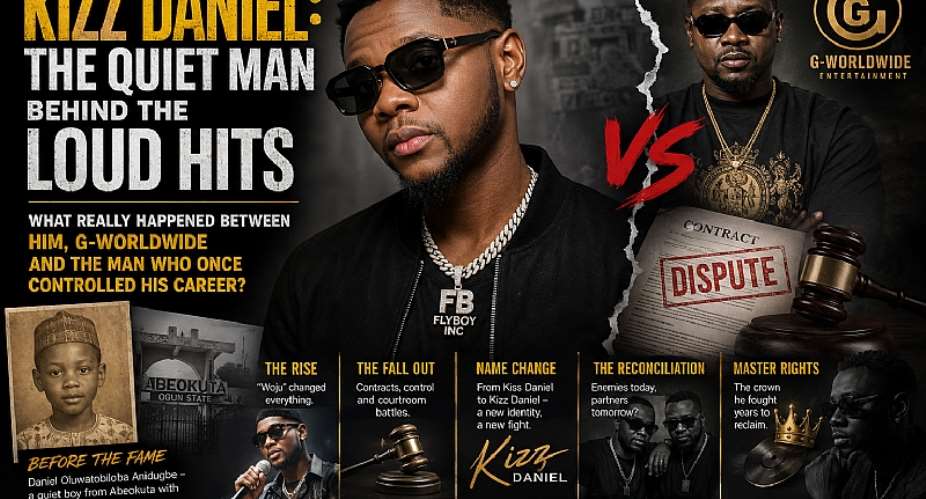
Before the world knew him as Kizz Daniel, he was Daniel Oluwatobiloba Anidugbe — a quiet boy from Abeokuta, Ogun State, whose journey from a relatively private family life to the centre of Nigeria’s Afrobeats industry would eventually become one of the most fascinating stories of independence, conflict, reconciliation and reinvention in African music.
But perhaps the most interesting question today is not how Kizz Daniel became successful.
It is:
What happened to the young man behind “Kiss Daniel” and why does he appear so remarkably calm while the industry around him keeps generating questions?
FROM ABEOKUTA TO AFROBEATS: BEFORE THE FAME
Daniel Oluwatobiloba Anidugbe was born on May 1, 1994, in Abeokuta, Ogun State. He studied Water Resources Management at the Federal University of Agriculture, Abeokuta, while simultaneously pursuing music. He eventually signed with G-Worldwide Entertainment in 2013.
The boy who would become Kizz Daniel did not initially present himself as the stereotypical loud, flamboyant superstar.
In fact, his own descriptions of his upbringing point in the opposite direction.
In an interview, Daniel described his mother as calm and his late father, Kola Anidugbe, as the stylish music-loving personality in the family. His father was an artist and lecturer at the Federal College of Education, Osiele, Abeokuta, and reportedly supported Daniel's earliest musical ambitions.
His father even financed his first studio recording.
The message was simple: try music but if it fails, go for your master's degree.
That decision would change everything.
THEN CAME “WOJU” AND THE BOY DISAPPEARED INTO THE BRAND
G-Worldwide gave the young artiste a platform.
Then came “Woju.”
The song transformed Daniel from an ambitious university graduate into one of the most recognizable new voices in Nigerian pop music.
His debut album, New Era, followed in 2016 and contained songs including “Woju,” “Laye” and “Mama.” The project helped establish him as a serious commercial force.
But success created a new problem.
Who owned what?
The music?
The recordings?
The name?
The future?
And, perhaps most importantly:
Who actually controlled Daniel's career?
THE G-WORLDWIDE WAR: WAS IT REALLY ABOUT MONEY?
This is where the story becomes uncomfortable.
In 2017, Daniel's relationship with G-Worldwide collapsed publicly.
G-Worldwide maintained that he had signed a seven-year recording and artiste-management agreement in 2013 and accused him of breaching the arrangement by setting up Flyboy Inc., appointing another manager, negotiating bookings and continuing to use the name “Kiss Daniel.”
Daniel, on the other hand, disputed the allegations and maintained that he had properly terminated his relationship with the label.
The disagreement moved beyond social media.
It went to court.
And the battle wasn't simply about money.
It was also about identity and ownership.
G-Worldwide claimed rights relating to the stage name “Kiss Daniel” and recordings made during the contractual relationship. The dispute subsequently became a major example of the dangers of poorly understood or heavily contested artist-label agreements.
Then came one of the strangest developments in the saga.
Daniel changed his name.
Kiss Daniel became Kizz Daniel.
BUT HERE IS THE QUESTION MANY PEOPLE DON'T ASK
If the relationship was completely toxic...
why did the story eventually end with the two men working together again?
That is where the Kizz Daniel story becomes far more complicated than the usual “artist versus record-label boss” narrative.
Because in 2023, the same Emperor Geezy who had once been at the centre of the dispute was brought into Kizz Daniel's business structure.
Kizz Daniel publicly explained that he had stepped down as CEO of Flyboy Inc. and brought Emperor Geezy into the company.
The explanation was astonishing.
Kizz Daniel said Geezy was somebody he trusted with the brand.
Even more surprisingly, Daniel revealed that during their period of public conflict, Geezy had continued privately advising him.
According to Daniel, the former boss would send him messages telling him when he was making mistakes and encouraging him to make better decisions.
So what were we really watching?
A bitter business war?
A disagreement between two ambitious men?
A contract dispute?
A fight over ownership?
Or simply two people who understood each other better privately than the public ever knew?
FROM COURTROOM ENEMIES TO BUSINESS PARTNERS
This may be the most extraordinary chapter of the entire story.
The man who once represented the old system became part of the new system.
Emperor Geezy reportedly became involved with Flyboy through a partnership intended to allow Kizz Daniel to concentrate more heavily on music while Geezy handled important business responsibilities. Kizz Daniel described him as someone who genuinely wanted the brand to grow.
That development destroys the easy narrative that one man simply “defeated” the other.
Perhaps neither man truly won.
Perhaps both men learned something.
Or perhaps they eventually discovered that business disputes and personal relationships do not always have to end in permanent hatred.
AND THEN CAME THE MASTER RIGHTS
In June 2025, Kizz Daniel announced that he had regained the master rights to his debut album, New Era.
Think about what that means.
The album that introduced “Kiss Daniel” to Africa was originally released under G-Worldwide.
Years later, the artiste who had fought his former label over control of his career publicly celebrated getting his masters back.
That is not just a music-business development.
It is the closing of a chapter that once appeared impossible to close.
But it raises another question:
How much of Kizz Daniel's career was lost, delayed or complicated because of that original battle?
And how much of it did he gain because the battle forced him to become more independent?
WHY IS KIZZ DANIEL SO QUIET?
This is where public perception becomes dangerous.
Some people interpret a quiet personality as arrogance.
Others interpret it as confidence.
Some call it pride.
But Kizz Daniel himself has rejected the idea that his reserved personality means he is arrogant.
In a detailed interview, he explained that he is naturally private and reserved and that people sometimes mistake his quietness for snobbishness. He said he could stay home for an entire week without going out.
So perhaps the mystery isn't:
“Why doesn't Kizz Daniel talk?”
Perhaps it is:
“Why do we expect every successful person to explain themselves constantly?”
His silence may not be fear.
It may be temperament.
It may be discipline.
It may also be a lesson learned from an industry where one sentence can become tomorrow's headline.
BUT SILENCE HAS A PRICE
The problem with being quiet is that other people start telling your story for you.
When an artist doesn't explain himself, fans fill the vacuum.
When he doesn't respond, bloggers interpret.
When he doesn't fight publicly, people assume he is hiding something.
And when he remains calm?
People ask:
“What does he know that we don't know?”
That may explain why Kizz Daniel remains such an interesting figure.
He has experienced legal battles, name changes, managerial changes, personal loss, international success and public controversy yet he rarely behaves like someone desperate to win every argument publicly.
WHAT ABOUT HIS PERFORMANCE?
Here, the conversation needs balance.
Kizz Daniel's live-performance history has not been without controversy.
The 2022 Tanzania incident became one of the biggest examples. He was arrested after failing to perform at a scheduled concert, with the promoter alleging that the singer refused to perform because he did not have his gold chain. That account was widely reported at the time.
But there have also been major performances and successful international appearances.
His performance of “Buga” at the 2022 FIFA Fan Festival in Qatar put him before a massive international audience.
His touring career has continued, including a major global tour announced in 2025, while his music continued to generate major streaming and chart attention.
So is his performance declining?
The evidence does not support declaring that as a fact.
What can be said is that expectations have changed.
The young man who once needed to prove he belonged is now an established star.
And established stars are judged differently.
WHAT ARE THE FANS SAYING?
There appears to be a fascinating contradiction.
Some fans see Kizz Daniel as one of Afrobeats' most underrated hitmakers an artiste who can disappear, return with a record and still command attention.
Others question whether the consistency of his earlier era has been matched by his more recent work.
That debate is legitimate.
But the numbers and industry recognition make it difficult to argue that he has simply disappeared.
“Twe Twe,” for example, became one of Nigeria's most-streamed songs in the first half of 2024, according to reporting citing Turntable Charts.
And in 2026, Kizz Daniel was still receiving major industry recognition, including a nomination for Best Headies Collaboration for “Lost” with Fola.
So perhaps the real question isn't:
“Is Kizz Daniel finished?”
It is:
“Has the audience's definition of Kizz Daniel's peak simply become impossible for Kizz Daniel himself to satisfy?”
WHO ARE HIS PARENTS AND WHAT WOULD HIS FATHER THINK OF HIM TODAY?
His father, Kola Anidugbe, died in 2015, at precisely the period when Daniel was beginning to break into mainstream music.
Daniel has repeatedly spoken about how deeply connected he was to his father.
He described his father as his best friend and credited him with supporting his earliest musical ambitions.
His father reportedly paid for his first studio session.
He encouraged him.
He believed in him.
And then he died before seeing the full magnitude of what his son would become.
That is perhaps the saddest unanswered question in this entire story:
If Kola Anidugbe were alive today, would he recognize the quiet university student he once financed or would he be surprised by the man the music industry created?
We cannot answer that.
His father is no longer here to tell us.
And that is precisely why we should not invent answers on his behalf.
As for his mother, Kizz Daniel has described her as calm, but there is no reliable public record establishing a detailed recent statement from her about her son's current career that would justify putting words into her mouth.
That silence should be respected.
AND WHAT ABOUT THE MONEY?
This is another question that deserves serious treatment.
The G-Worldwide dispute involved allegations concerning contractual obligations, intellectual property, recordings and financial claims. In the later legal battle, G-Worldwide reportedly sought damages of about ₦500 million.
But reducing the entire dispute to:
“They were fighting over money.”
would be too simplistic.
Because ownership in entertainment isn't just about today's cash.
It can determine:
Who owns the recordings.
Who controls the artist's name.
Who receives future royalties.
Who controls licensing.
Who negotiates performances.
Who owns intellectual property.
Who controls the artist's business direction.
In other words:
The real currency may have been control.
And that makes the eventual master-rights development even more significant.
THE BIGGEST IRONY OF THE KIZZ DANIEL STORY
The biggest irony is that the man who once fought desperately to escape his former boss eventually brought that same former boss into his own empire.
That is not the ending most people expected.
And perhaps that is why the Kizz Daniel story deserves more serious analysis than gossip.
Because it demonstrates something uncomfortable about power:
Sometimes you fight somebody because you don't want them controlling your future only to discover years later that you can work with them once you control your own destiny.
THE QUESTIONS WE SHOULD REALLY BE ASKING
Forget the gossip for a moment.
Forget the Instagram arguments.
Forget the old “Kiss versus Kizz” jokes.
There are bigger questions.
1. Was Kizz Daniel's greatest battle actually against G-Worldwide or against the idea that somebody else could define his career?
2. If Emperor Geezy was truly the enemy, why did Kizz Daniel later trust him with Flyboy?
3. Was the original dispute primarily about money, intellectual property, contractual obligations or control?
4. How much did Kizz Daniel learn from the legal battle that changed the way he manages his career today?
5. Did leaving G-Worldwide make him more successful, or did G-Worldwide provide the foundation that made his later independence possible?
6. Can an artist become so successful that fans stop judging the music objectively because of the superstar's reputation?
7. When Kizz Daniel stays quiet, is he demonstrating emotional maturity or is he missing opportunities to control the public narrative?
8. Are fans genuinely disappointed with his performances, or are they comparing him unfairly with artists whose performance styles are naturally more energetic?
9. What would his late father, who financed his first recording, say about the man his son has become?
10. And perhaps the most uncomfortable question:
If Kizz Daniel had never fought G-Worldwide, would we know the Kizz Daniel we know today?
THE MAN WHO CHANGED HIS NAME MAY HAVE CHANGED MUCH MORE THAN HIS NAME
Daniel Oluwatobiloba Anidugbe began as a young man from Abeokuta.
He became Kiss Daniel.
He fought for independence.
He became Kizz Daniel.
He built Flyboy.
He survived controversy.
He reconciled with the man who once stood on the opposite side of the courtroom.
He regained the masters to the album that launched his career.
And he continues to make music, tour and compete for relevance in an Afrobeats industry that has become dramatically more global than when he first released “Woju.”
Perhaps that is the real story.
Kizz Daniel is not simply the quiet man who refuses to explain himself.
He is a case study in what happens when a young artiste discovers that fame is easy compared with ownership.
The boy from Abeokuta wanted to make music.
The industry taught him about contracts.
The courtroom taught him about control.
Fame taught him about perception.
Fatherhood taught him about responsibility.
And reconciliation may have taught him the hardest lesson of all:
Not every person who once stood against you must remain your enemy forever.
But one question remains hanging over the entire Kizz Daniel story:
When the music finally stops, will history remember him mainly as the hitmaker who gave Africa “Woju” and “Buga” or as the quiet young man who fought to take ownership of the name, the music and the destiny that the world came to know as KIZZ DANIEL?
That is a question only time can answer.
By:
Patrick Belebang Yagsori
+233240292413
[email protected]

 CUTS Raises Cartel Concerns Over Cement Manufacturers’ Uniform GH¢12 Surcharge
 I have not been invited by OSP over fake GH¢70,000 memo — Patricia Appiagyei
 Vetting committee has never taken bribes or gifts from nominees — Bernard Ahiafo...
 Chief Justice Baffoe-Bonnie clarifies controversial remarks
 Dunkwa-Ayanfuri road construction to commence in 2027 – Finance Minister
 PRESEC, St. Augustine’s College and Accra Academy set for NSMQ grand finale on S...
 Appiagyei denies alleged GH¢70,000 vetting payment in memo
 Lawyer challenges GRA’s power to grant passenger baggage tax exemptions
 Agbogbloshie waste heap is as high as 10-storey building – Mahama Ayariga
 'After getting the gold, you will get thirsty' – Kwaku Bonsam explains why galam...

