




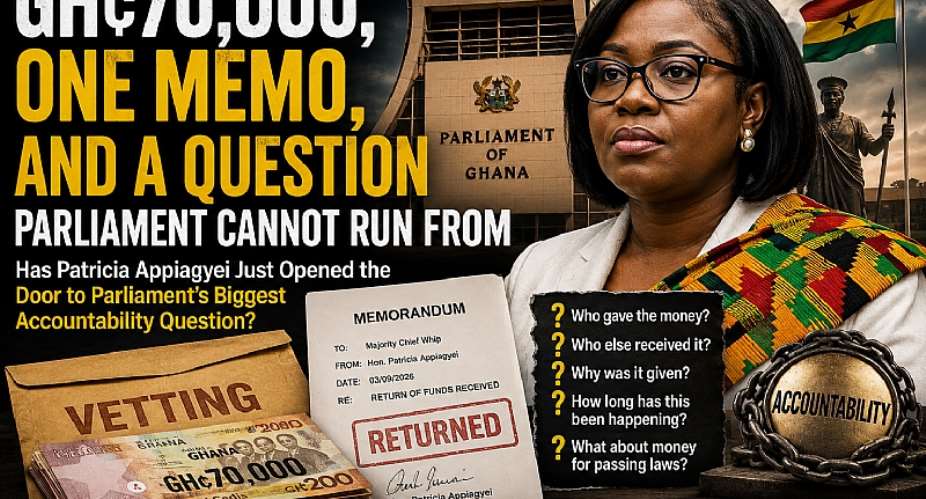
Ghana's Parliament has suddenly been confronted with a question far bigger than GH¢70,000.
The question is not simply why Deputy Minority Leader and Asokwa MP, Patricia Appiagyei, returned GH¢70,000 reportedly allocated to her in connection with the work of Parliament's Appointments Committee.
The bigger question is this:
Why was the money given to members of Parliament in the first place, where did it come from, who authorised it, who else received it, and what exactly was it intended to pay for?
Those questions deserve answers.
And they deserve answers not from political parties defending their own side, but from Parliament itself.
According to reports published on September 4, 2026, Appiagyei returned GH¢70,000 after receiving it as an advance from the Majority Chief Whip. She said she did not know the original source of the money and did not want to personally benefit financially from a parliamentary process involving the vetting of Majority Leader Mahama Ayariga and Deputy Majority Leader Zanetor Agyemang Rawlings. She also linked her decision to the Minority Caucus's protest and non-participation in the vetting of three Supreme Court nominees.
Her decision deserves recognition.
But it also creates a much larger accountability problem.
THE GH¢70,000 QUESTION
The first question Parliament must answer is brutally simple:
What was the GH¢70,000?
Was it a legitimate parliamentary allowance?
Was it an administrative advance?
Was it money intended for logistics?
Was it a gift?
Was it money collected from nominees?
Was it money contributed by members of a political caucus?
Or was it something else?
At present, the public does not have sufficient evidence to conclusively answer those questions.
Even the reports on Appiagyei's memorandum make an important distinction: she says she did not know the source of the money. There is no established evidence in the public reporting that the GH¢70,000 came directly from the nominees she was expected to vet.
That distinction matters.
Because calling the money a bribe as an established fact would go beyond the evidence currently available.
But calling for an investigation is entirely justified.
WAS PATRICIA APPIAGYEI THE ONLY ONE WHO RECEIVED IT?
This is perhaps the most important immediate question.
If GH¢70,000 was allocated to Patricia Appiagyei, how many other members received an equivalent amount?
Did every member of the relevant committee receive it?
Did only some members receive it?
Were members of both the Majority and Minority Caucuses allocated money?
Did parliamentary leadership know about it?
Was there a written authorisation?
Was it recorded in Parliament's financial accounts?
Who requested the money?
Who released it?
Who determined the amount?
And, most importantly:
If other MPs received the same money, what did they do with theirs?
Available reports confirm that Minority Leader Alexander Afenyo-Markin also returned his share, according to Appiagyei's memorandum. But the public reporting available today does not establish a complete list of every person who received the allocation or who has returned it.
That information should not remain a political secret.
Parliament owes it to the Ghanaian taxpayer to publish the facts.
AND WHAT ABOUT THE MONEY OF THE PAST?
Here the controversy becomes even more uncomfortable.
Ghana's Fourth Republic began in 1992. Parliament has operated continuously under the constitutional order since then.
But there is currently no credible evidence establishing that members of Parliament have routinely received inducement money from nominees for vetting from 1992 to today.
That claim must therefore be investigated rather than presented as fact.
However, Parliament cannot simply dismiss the question because historical evidence has not yet been produced.
If today's GH¢70,000 arrangement raises questions, Parliament should be able to tell Ghanaians:
Have similar payments ever been made before?
If yes, since when?
Under what authority?
How much?
To whom?
For what purpose?
Were the payments recorded?
Were they parliamentary allowances or money from nominees?
And if they were legitimate allowances, why were they connected to particular vetting exercises?
The answers could finally separate parliamentary administrative expenditure from alleged inducements.
GHANA HAS BEEN HERE BEFORE
This is not the first time Parliament's Appointments Committee has faced bribery allegations.
In 2017, a major controversy erupted after allegations surrounding the vetting of then Energy Minister-designate Boakye Agyarko.
Mahama Ayariga alleged that GH¢3,000 had been given to Minority members of the Appointments Committee, allegedly to influence their position on Agyarko's approval. Parliament subsequently established a five-member ad hoc committee chaired by Joe Ghartey to investigate the matter.
Interestingly, contemporary reports stated that some Minority MPs said they initially believed money handed to them was a sitting allowance, but returned it after being told it was allegedly connected to the bribery allegation.
The Joe Ghartey Committee ultimately reported that it found no evidence supporting the allegation that Agyarko had bribed the committee, and Parliament's subsequent proceedings dealt with Mahama Ayariga's conduct in making the allegation.
That history is important.
It means the GH¢70,000 controversy is not emerging in an institutional vacuum.
It comes after Parliament has previously had to investigate allegations involving money and the Appointments Committee.
And that is precisely why the current issue deserves an independent examination.
BUT IS THIS A PARLIAMENTARY PROBLEM OR A PARTY PROBLEM?
This is where Ghana must be careful.
The issue cannot be reduced to NPP versus NDC.
Parliament belongs to Ghana.
If the Majority is involved, investigate.
If the Minority is involved, investigate.
If former MPs are implicated, investigate.
If current MPs are implicated, investigate.
If parliamentary officials are involved, investigate.
There should be no political immunity for corruption allegations.
The temptation will be for one side to use this controversy as a weapon against the other.
That would miss the point completely.
The real question is whether Ghana's parliamentary processes have adequate safeguards against financial influence.
DOES PARLIAMENT TAKE MONEY BEFORE LAWS ARE PASSED?
This is perhaps the most explosive allegation surrounding the wider debate.
There have been public claims and suspicions that money is sometimes paid to influence parliamentary decisions, including claims that money must be paid before certain legislation can pass.
But there is no credible evidence establishing as a general fact that Parliament requires payment before passing laws.
That allegation should therefore not be treated as proven.
However, it is serious enough that Parliament should welcome scrutiny rather than fear it.
Under Article 106 of Ghana's Constitution, Parliament's law-making power is exercised through bills passed by Parliament and assented to by the President. Bills are subject to constitutional procedures, including committee consideration.
There is no constitutional provision saying citizens, businesses or interest groups must pay MPs personally for legislation to become law.
If anyone has evidence of such payments, that evidence should immediately be handed to the appropriate anti-corruption authorities.
Because if legislation can literally be bought, then Ghana does not merely have a corruption problem.
Ghana has a constitutional crisis.
THE SPECIAL PROSECUTOR SHOULD LOOK AT THIS
The Office of the Special Prosecutor has a clear mandate to investigate corruption and corruption-related offences involving public officials and politically exposed persons. Its mandate includes alleged bribery and the corrupt use of public office for private gain.
And there is already precedent for the OSP examining allegations involving Parliament.
The OSP previously investigated an alleged attempt by a wealthy businessman to bribe members of the NPP parliamentary majority caucus in 2022. The OSP eventually closed that investigation because a key witness declined to disclose the identity of the alleged suspect, while noting that the matter could be reopened if circumstances or additional facts warranted it.
That history makes the current controversy even more significant.
The question should not be whether the OSP should automatically declare anybody guilty.
It should be:
Can the source, destination and purpose of the GH¢70,000 be independently established?
If the money was legitimate, the investigation should clear it.
If it was improper but not criminal, Parliament should correct the system.
If evidence of corruption emerges, the law should take its course.
That is how institutions become stronger.
WHAT ARE THE OTHER MEMBERS SAYING?
The public needs to hear from every person who received the money.
Not through party propaganda.
Not through anonymous sources.
Not through social-media battles.
But through clear statements.
Did you receive GH¢70,000?
Who gave it to you?
Who authorised it?
Where did it come from?
Why was it given?
Did you return it?
If you kept it, under what parliamentary rule did you keep it?
These are not unreasonable questions.
They are basic accountability questions.
AND WHAT ABOUT THE EXECUTIVE?
The Executive cannot simply watch Parliament burn under the weight of allegations and pretend it has nothing to do with the matter.
Government has a responsibility to protect the integrity of Ghana's democratic institutions.
But the Executive must also be careful.
Parliament is constitutionally distinct from the Executive.
Therefore, government should not dictate the outcome of an investigation.
Instead, the appropriate response would be to support lawful, independent scrutiny and ensure that anti-corruption institutions have the resources and independence required to do their work.
THE MOST UNCOMFORTABLE QUESTION
Perhaps the question Parliament should ask itself is one that Parliament may not want to ask:
If GH¢70,000 can be allocated to an MP in connection with a vetting process and the MP herself says she does not know its source, how many other financial arrangements exist around parliamentary committees that the public knows nothing about?
That is the real issue.
Transparency should not begin only after a controversy erupts.
WHY RETURNING THE MONEY MATTERS
Patricia Appiagyei's decision to return the money does not prove that the money was a bribe.
But it demonstrates something important:
A public official can recognise a potential conflict and refuse the benefit.
That is a positive principle.
Her decision should therefore not be used merely to attack Parliament.
It should become an opportunity to reform Parliament.
The same standard should apply to everyone.
If other MPs received the money, they should be asked to explain it.
If they legitimately received it as an authorised parliamentary allowance, Parliament should publish the documentation.
If others returned it, tell the public.
If others kept it, explain why.
PARLIAMENT HAS AN OPPORTUNITY
Ghanaian democracy does not need a Parliament that is afraid of difficult questions.
It needs a Parliament willing to answer them.
The Appointments Committee should publish the financial arrangements surrounding the relevant vetting exercises.
Parliament should clarify whether members received GH¢70,000 or other sums.
The source and purpose of the money should be established.
The Auditor-General should be able to examine any public funds involved.
And where there is credible evidence of corruption, the appropriate anti-corruption institutions should investigate.
ACEPA Executive Director Dr Rasheed Dramani has already described the development as an opportunity to confront broader concerns about inducements associated with parliamentary vetting and has called for scrutiny of whether such practices are pervasive.
That is exactly where the national conversation should go.
Not partisan shouting.
Evidence.
GHANA DESERVES TO KNOW
The public does not need Parliament to tell it that everything is fine.
The public needs Parliament to show that everything is fine.
There is a fundamental difference.
Show the records.
Show the authorisation.
Show the source.
Show the recipients.
Show the purpose.
Show whether the practice has happened before.
And if there are allegations stretching beyond vetting into the passage of legislation, produce the evidence and investigate them.
Because the most dangerous conclusion Ghana could reach would be that Parliament takes money to perform the constitutional duties for which MPs are already paid.
But the second-most-dangerous conclusion would be to accuse Parliament of doing so without evidence.
Both possibilities demand the same response:
INVESTIGATE.
The GH¢70,000 may eventually prove to be nothing more than a legitimate parliamentary advance.
It may reveal an administrative practice that needs reform.
Or it may uncover something much darker.
Until the facts are established, nobody should be convicted in the court of public opinion.
But Parliament should also understand this:
When a lawmaker returns money and publicly says she does not know its source, the burden of transparency becomes bigger than the envelope.
Ghana is watching.
And Parliament should be ready to answer.
The question is no longer simply, “Why did she return GH¢70,000?”
The bigger question is:
WHO ELSE RECEIVED IT AND WHY?
And after that:
HOW LONG HAS THIS BEEN HAPPENING?
Those are questions Ghana's Parliament cannot afford to leave unanswered.
By:
Patrick Belebang Yagsori
+233240292413
[email protected]
 UN backs effort to drop Mercator map and show size of Africa more accurately
 CUTS Raises Cartel Concerns Over Cement Manufacturers’ Uniform GH¢12 Surcharge
 I have not been invited by OSP over fake GH¢70,000 memo — Patricia Appiagyei
 Vetting committee has never taken bribes or gifts from nominees — Bernard Ahiafo...
 Chief Justice Baffoe-Bonnie clarifies controversial remarks
 Dunkwa-Ayanfuri road construction to commence in 2027 – Finance Minister
 PRESEC, St. Augustine’s College and Accra Academy set for NSMQ grand finale on S...
 Appiagyei denies alleged GH¢70,000 vetting payment in memo
 Lawyer challenges GRA’s power to grant passenger baggage tax exemptions
 Agbogbloshie waste heap is as high as 10-storey building – Mahama Ayariga

