




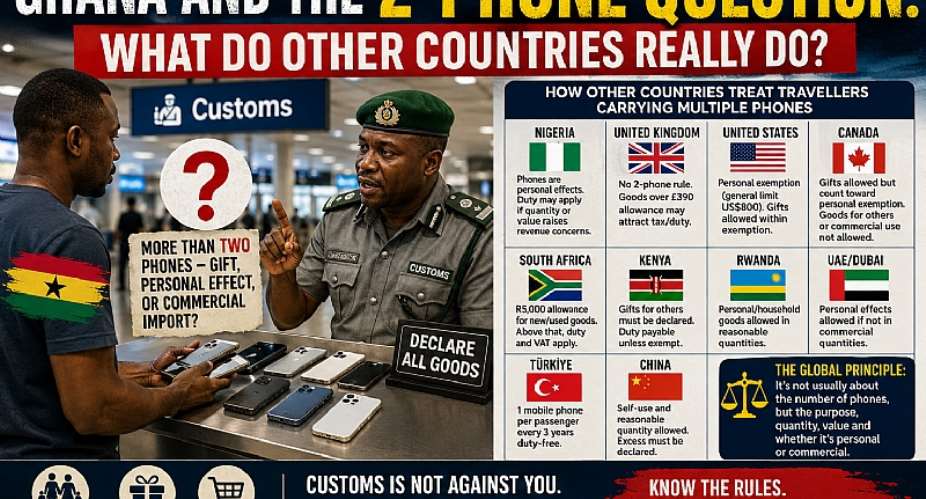
Is Ghana creating a new customs principle or simply enforcing an existing distinction between personal effects and imports? A global comparison raises uncomfortable questions.
A Ghanaian traveller returns home from abroad carrying several mobile phones.
One is for himself.
Another is for his wife.
Another is for his mother.
Another is for his brother.
Perhaps another is for a sister who cannot afford to buy one in Ghana.
At what point do those phones stop being family gifts and become commercial imports?
That question has suddenly become bigger than the phones themselves.
It is now a question about taxation, common sense, customs discretion and whether Ghana's treatment of passengers is consistent with international practice.
The controversy erupted after comments attributed to the Commissioner of the Customs Division of the Ghana Revenue Authority (GRA), Aaron Kanor, suggested that travellers bringing more than two mobile phones could have the additional phones treated as commercial imports.
The comments triggered understandable public concern.
But then came an important clarification.
On September 3, 2026, the GRA stated that there is no automatic rule requiring a traveller carrying more than two phones to pay customs duty. The Authority said the number of phones, by itself, does not determine whether duty is payable. Instead, Customs considers factors including whether the phones are used or new, whether they are commercially packaged, the quantity and similarity of the devices, and whether circumstances indicate sale, distribution or another commercial purpose.
That clarification changes the debate considerably.
But it also raises a bigger question:
How do other countries deal with passengers carrying multiple phones especially phones intended for family members?
The answer is revealing.
GHANA: THE NUMBER TWO IS NOT SUPPOSED TO BE THE LAW
The first thing that must be established is that Ghana's latest official clarification does not create a simple rule saying:
Two phones are free. The third phone is taxable.
The GRA has expressly rejected that interpretation.
Its position is that Customs must determine whether the items are genuinely personal effects or whether they amount to goods being imported for another person, sale, distribution or commercial purposes.
A traveller could therefore legitimately carry more than one phone for personal reasons for example, a personal phone and a work phone, or a replacement handset.
The problem arises when someone arrives with several brand-new, similarly packaged phones.
At that point, Customs may reasonably ask:
Why are you carrying six identical new phones?
That is a legitimate customs question.
But there is another question Customs must also be prepared to answer:
Does carrying several phones for relatives automatically make those phones commercial goods?
According to the GRA's September 3 clarification, no. The number alone is not decisive.
And that distinction matters enormously.
NIGERIA: NO SIMPLE TWO-PHONE RULE
Nigeria provides an interesting comparison.
The Nigeria Customs Service Act 2023 expressly identifies cellular telephones among travellers' personal effects.
However, the law also gives Customs the power to require declaration where personal effects exceed prescribed value or quantity limits, or where they are considered capable of causing revenue loss.
In other words, Nigeria recognises mobile phones as personal effects while maintaining the ability to intervene when quantity or circumstances suggest something beyond ordinary personal use.
There is no simple statutory principle in the provision examined that says:
"You may carry two phones but the third is automatically commercial."
That is an important distinction.
UNITED KINGDOM: VALUE, NOT A TWO-PHONE COUNT
The United Kingdom takes a substantially different approach.
UK rules for travellers entering Great Britain provide a general allowance of £390 for other goods, including electrical goods. If a traveller exceeds the allowance, tax and duty may become payable.
More importantly, the UK distinguishes between personal goods and commercial goods.
There are no personal allowances for goods brought in to sell or use in a business; commercial goods must be declared.
Notice the principle:
It is not:
Phone 1 = free.
Phone 2 = free.
Phone 3 = tax.
Instead, the system focuses on the nature and value of the goods and whether they are personal or commercial.
That is a fundamentally different approach from a simple numerical threshold.
UNITED STATES: EVEN GIFTS CAN FIT WITHIN THE PERSONAL EXEMPTION
The United States also provides an instructive comparison.
U.S. Customs and Border Protection says the personal exemption is generally US$800, although different circumstances can produce different exemption amounts.
Crucially, goods can qualify when they are intended for personal or household use or to be given as gifts.
This is an important point in the Ghana discussion.
The American framework demonstrates that a traveller carrying something for another person does not automatically turn that item into a commercial import.
The context matters.
The value matters.
The purpose matters.
And the traveller's overall circumstances matter.
CANADA: GIFTS ARE RECOGNISED BUT THERE ARE LIMITS
Canada provides perhaps an even clearer example.
The Canada Border Services Agency allows travellers to bring certain goods within personal exemptions based on how long they have been outside Canada.
For example, after an absence of more than 48 hours, a Canadian resident can generally claim up to CAN$800 in goods.
But there is a crucial limitation:
Goods brought in for another person or for commercial use do not qualify for the personal exemption.
Canada therefore demonstrates something important:
A country can legitimately distinguish between personal belongings and goods being imported for somebody else.
But it does not necessarily need a crude "two phones" rule to make that distinction.
SOUTH AFRICA: VALUE AND PERSONAL EFFECTS
South Africa similarly operates largely through traveller allowances and the distinction between personal effects and taxable goods.
The system is not built around a universal rule that says the third mobile phone automatically becomes taxable.
Instead, customs treatment depends on the applicable traveller allowance, the nature of the goods and whether they qualify as personal effects.
That model again raises an important policy question for Ghana:
Should customs enforcement focus on the number of phones or on whether the phones are genuinely personal/family goods or commercial merchandise?
KENYA: HERE IS WHERE THE GHANA DEBATE GETS INTERESTING
Kenya has a particularly relevant rule.
Kenya Revenue Authority guidance states that passengers receive concessions for goods intended for personal and/or household use, while used personal effects receive exemptions.
But Kenya also makes clear that goods brought for somebody else including gifts can be subject to customs treatment.
Its guidance states that duty is payable on donations or gifts at the applicable rate unless the goods qualify for an exemption.
This means Ghana is not unusual in recognising that gifts carried across a border can have customs consequences.
But again, the Kenyan model is not simply:
"More than two phones = commercial."
The nature, value and exemption applicable to the goods remain important.
RWANDA: "REASONABLE QUANTITY" IS THE KEY
Rwanda's customs framework is especially revealing.
The Rwanda Revenue Authority says passenger goods may qualify as personal effects when they are the passenger's property, accompany the passenger, are intended for personal or household use, and are in such kinds and quantities as the customs officer may allow.
But Rwanda expressly excludes trade goods or goods for sale or disposal to other persons from that particular personal-effects exemption.
It also provides a general exemption for certain goods up to US$500 per traveller, subject to the stated conditions.
Again, the principle is familiar:
Personal use = one category.
Commercial/distribution = another category.
But there is no universal "two phones" formula.
DUBAI/UAE: EVEN MOBILE PHONES ARE LISTED AS PERSONAL EFFECTS
Dubai offers perhaps one of the most interesting comparisons.
Dubai Customs lists mobile telephones among personal belongings that passengers may bring in without customs duty.
But there is a condition.
The baggage and gifts must be of a personal nature and not in commercial quantities.
That is almost exactly the distinction at the centre of Ghana's current debate.
Dubai does not simply say:
"Every traveller gets two phones."
Instead, it asks whether the quantity is reasonable and whether the goods are personal or commercial.
Dubai's current customs guidance, updated September 3, 2026, also states that certain personal effects and used household items may qualify for exemption, while new items under specified circumstances may be subject to duty.
TÜRKİYE: THE COUNTRY THAT REALLY DOES HAVE A PHONE-SPECIFIC LIMIT
And then there is Türkiye.
This is where the argument becomes particularly interesting.
Türkiye has a genuinely restrictive mobile-phone rule.
Its customs/telecommunications framework limits the duty-free entry and registration of mobile phones to one phone per passenger within a three-calendar-year period, subject to the applicable conditions.
That is a real phone-specific restriction.
So, yes, there is at least one major example where a country has a very specific numerical rule relating to mobile phones.
But Türkiye is actually stricter than the two-phone idea being debated in Ghana.
The lesson, however, is not that Ghana should copy Türkiye.
The lesson is that if Ghana wants to impose a specific numerical limit, that limit should be clearly established in law and communicated transparently to travellers.
CHINA: "SELF-USE AND REASONABLE QUANTITY"
China's customs framework provides another useful comparison.
Chinese customs law states that luggage and articles carried by individuals entering or leaving the country should be limited to self-use and reasonable quantities and are subject to customs supervision. Travellers are also required to truthfully declare their goods.
This is another model based on a principle rather than simply counting phones.
The phrase worth paying attention to is:
"Self-use, reasonable quantity."
That concept gives customs authorities room to identify commercial quantities while still recognising ordinary personal travel.
WHAT DOES THE GLOBAL COMPARISON ACTUALLY TELL US?
After looking across these countries, one fact becomes difficult to ignore:
There is no universal international rule that says a traveller may carry only two mobile phones.
Different countries use different systems.
Some focus on:
- Value;
- Personal exemptions;
- Gifts;
- Personal effects;
- Quantity;
- Whether goods are new or used;
- Commercial packaging;
- Intended use;
- Commercial versus personal purposes;
- And whether the goods are being brought in for somebody else.
Türkiye is an exception because it has a very specific phone-related restriction.
But even there, the limit is based on a formal regulatory framework not an informal numerical threshold at the airport.
THE REAL GHANAIAN QUESTION IS NOT "HOW MANY PHONES?"
It is:
WHAT IS THE PURPOSE OF THE PHONES?
Imagine two passengers.
Passenger A
Travels home with five different phones.
One is his current phone.
One is an old phone he has been using as a spare.
One is a replacement.
One belongs to his wife.
One is a birthday gift for his mother.
None is commercially packaged for resale.
Should five automatically mean commercial importation?
Not necessarily.
Now consider Passenger B.
He arrives with ten brand-new iPhones.
All are identical.
All are sealed.
He has no convincing explanation.
He has receipts showing multiple purchases.
He appears to be bringing them into Ghana for resale.
That looks very different.
The number is relevant but it is not the entire story.
THE DANGER OF CUSTOMS BY "COUNTING"
This is where Ghana must tread carefully.
If the law says one thing but travellers believe another because of comments at an airport, confusion is inevitable.
Imagine a Ghanaian abroad buying phones for:
- mother;
- father;
- wife;
- husband;
- children;
- siblings.
Are these people suddenly customers of a commercial importer?
Not necessarily.
They may simply be family members receiving gifts.
And that distinction should not be left to rumours, social media videos or conflicting interpretations.
The GRA's latest statement is therefore welcome because it makes clear that the number of phones alone does not determine whether duty is payable.
But clarification is only the beginning.
GHANA NEEDS A CLEARER PASSENGER POLICY
If Customs genuinely wants to prevent people from disguising commercial imports as personal baggage, the solution should be transparent.
Ghana could clearly publish:
1. What qualifies as a personal mobile phone.
2. What qualifies as a family gift.
3. What quantity is considered reasonable.
4. What value threshold applies.
5. When a traveller must use the red channel.
6. How Customs determines commercial intent.
7. How duty is calculated.
8. How a traveller can challenge an assessment.
That would protect government revenue and protect travellers from arbitrary treatment.
REVENUE COLLECTION MUST NOT BECOME REVENUE CONFUSION
There is nothing wrong with Ghana collecting legitimate customs revenue.
Indeed, Customs has an important responsibility to prevent commercial importers from disguising merchandise as passenger baggage.
But enforcement must also be predictable.
A Ghanaian living abroad should not have to wonder:
"If I buy phones for my family, will Customs consider me a trader?"
Nor should a Customs officer have to make a decision based primarily on an uncertain number communicated informally.
The best customs systems do something simple:
They establish clear rules and apply them consistently.
SO, IS GHANA UNIQUE?
No.
Countries around the world scrutinise goods carried by travellers.
Countries also tax or restrict goods that exceed personal allowances, appear commercial, or are brought in for others.
Kenya does it.
Canada does it.
The United Kingdom does it.
The United States does it.
Rwanda does it.
The UAE does it.
China does it.
Nigeria does it.
And Türkiye has an especially strict phone-specific regime.
But Ghana should not be portrayed as having a simple international-standard "two-phone rule."
The GRA itself has now said that is not the rule.
THE FINAL QUESTION: TAX THE PHONE OR IDENTIFY THE IMPORT?
This controversy has accidentally opened a much bigger conversation about Ghana's customs philosophy.
If someone brings seven brand-new phones into Ghana to sell, Customs should be able to intervene.
If someone brings seven phones for seven family members, the circumstances deserve examination but seven should not automatically equal commercial importation simply because seven is greater than two.
The difference is crucial.
Because the objective of customs should not merely be to count goods.
It should be to determine what those goods are, why they are being brought into the country, who they belong to, and whether the law requires duty to be paid.
That is how Ghana can protect revenue without turning an ordinary act of family generosity into a customs controversy.
The "2-phone question" therefore has a surprisingly simple answer:
The world does not operate under one universal two-phone rule.
Some countries use value.
Some use quantity.
Some recognise gifts.
Some restrict commercial quantities.
Some, like Türkiye, impose a specific phone limit.
And Ghana's own revenue authority has now clarified that more than two phones does not automatically mean customs duty.
So the debate should move beyond:
"How many phones can I carry?"
The more important question is:
"What exactly does Ghana's law consider a personal gift, and what exactly makes a traveller a commercial importer?"
Until that question is answered in language ordinary travellers can understand, the two-phone controversy is unlikely to disappear.
By:
Patrick Belebang Yagsori
+233240292413
[email protected]

 I have not been invited by OSP over fake GH¢70,000 memo — Patricia Appiagyei
 Vetting committee has never taken bribes or gifts from nominees — Bernard Ahiafo...
 Chief Justice Baffoe-Bonnie clarifies controversial remarks
 Dunkwa-Ayanfuri road construction to commence in 2027 – Finance Minister
 PRESEC, St. Augustine’s College and Accra Academy set for NSMQ grand finale on S...
 Appiagyei denies alleged GH¢70,000 vetting payment in memo
 Lawyer challenges GRA’s power to grant passenger baggage tax exemptions
 Agbogbloshie waste heap is as high as 10-storey building – Mahama Ayariga
 'How did we get here, to be told to go to Rwanda to learn cleanliness?' – Mahama...
 'After getting the gold, you will get thirsty' – Kwaku Bonsam explains why galam...

