




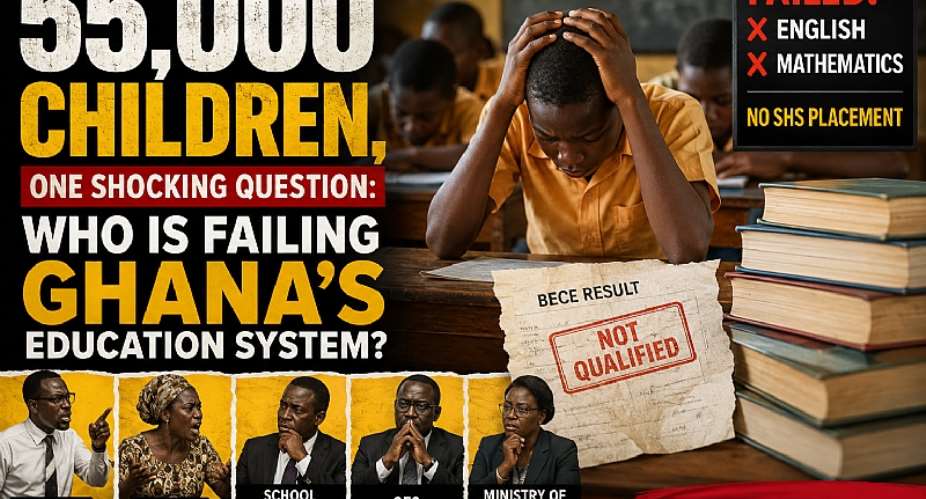
When thousands of BECE candidates cannot proceed to SHS because of English and Mathematics, Ghana must stop asking only whether the children failed and start asking whether the system failed them.
Ghana is confronting an uncomfortable education reality.
About 55,000 candidates who sat the 2026 Basic Education Certificate Examination (BECE) will not qualify for placement into second-cycle institutions because they failed either English Language or Mathematics, according to the Coordinator of the Computerised School Selection and Placement System (CSSPS), Sherif Sulemana.
Approximately 620,000 candidates wrote the examination, while about 565,000 qualified for placement. The qualification rule is straightforward: a candidate who fails either English Language or Mathematics is disqualified from placement, regardless of the candidate's overall aggregate.
Fifty-five thousand is not merely a statistic.
It is 55,000 young people.
Fifty-five thousand families asking what went wrong.
Fifty-five thousand children standing at a frightening crossroads in their educational journey.
And perhaps the most uncomfortable question is this:
If tens of thousands of children are failing the two subjects that form the foundation of almost every other subject, who exactly should Ghana hold accountable?
Should we blame the students?
Should we blame parents?
Should we blame teachers?
Should we blame headteachers?
Should we blame school authorities?
Should we blame the Ghana Education Service (GES)?
Should we blame the Ministry of Education?
Or should we finally admit that the problem is bigger than any single group?
GHANA HAS BEEN BUILDING AN EDUCATION SYSTEM FOR MORE THAN 70 YEARS
The current crisis cannot be understood without understanding Ghana's long educational journey.
Ghana's modern education expansion accelerated dramatically with the 1951 Accelerated Development Plan for Education, which sought to expand access to primary education and dramatically increase the number of trained teachers and schools.
The 1961 Education Act reinforced the commitment to free and compulsory basic education.
Then came the major 1987 education reforms, which restructured pre-tertiary education and introduced the JSS/SSS structure that eventually evolved into today's JHS/SHS system. The reforms also replaced the former Common Entrance examination with the BECE.
In the 1990s, Ghana introduced Free Compulsory Universal Basic Education (FCUBE), extending the free and compulsory principle to basic education.
And in 2017, Ghana introduced Free Senior High School (Free SHS), dramatically expanding access to secondary education.
The Ministry of Education itself was established in 1957 with responsibility for formulating and coordinating education policies, setting standards and monitoring implementation, while GES has responsibility for managing and supervising pre-tertiary education.
So Ghana cannot say education is a new national experiment.
We have had generations of reforms.
We have had curriculum reforms.
We have had teacher-training reforms.
We have had free basic education.
We have had Free SHS.
We have had technology initiatives.
We have had new assessment systems.
We have had new policies.
Yet here we are.
Thousands of children are still reaching the end of basic education without the required command of English and Mathematics.
That demands more than another policy document.
It demands an investigation.
BUT HERE IS THE QUESTION NOBODY WANTS TO ASK
What happens inside the classroom for nine years before a child reaches BECE and still cannot pass English or Mathematics?
A child does not suddenly become academically weak on examination day.
The problem may have been developing for years.
Perhaps the child struggled in Primary 4.
Perhaps the child could not read fluently in Primary 6.
Perhaps Mathematics fundamentals were never properly mastered.
Perhaps the teacher knew but the intervention never happened.
Perhaps the school promoted the child from one class to another despite serious learning gaps.
Perhaps the parents did not monitor the child's progress.
Perhaps the class was overcrowded.
Perhaps the teacher lacked the resources or training needed.
Perhaps the child was absent too often.
Perhaps the child simply refused to learn.
Perhaps it was a combination of all these factors.
But one question must be answered:
Where was the early-warning system?
If a child is repeatedly failing Mathematics tests from Primary 4 to JHS 3, why are we waiting until BECE to discover the problem?
If a child cannot read and understand a simple passage properly, why are we waiting for WAEC to expose the weakness?
ARE WE TEACHING CHILDREN OR SIMPLY MOVING THEM FROM CLASS TO CLASS?
This may be one of the most uncomfortable questions Ghana's education authorities must confront.
Can a student be promoted academically without mastering the foundational skills required for the next level?
A school can produce beautiful statistics showing attendance.
A headteacher can submit impressive administrative reports.
A teacher can complete lesson plans.
A district can organise monitoring exercises.
GES can issue directives.
The Ministry can announce new reforms.
But ultimately, the question is brutally simple:
Can the child read, write, calculate, reason and communicate?
GES's own mission recognises that discipline is important for creating an environment conducive to teaching and learning, and its student code states that discipline directly affects academic achievement and citizenship.
So why aren't we measuring educational success more aggressively by what children can actually do?
AND THEN THERE IS THE ELEPHANT IN THE CLASSROOM: DISCIPLINE
For generations, the Ghanaian classroom operated on a simple understanding:
The teacher was an authority figure.
Not because teachers were perfect.
Not because every traditional disciplinary method was acceptable.
But because society understood that learning requires structure, boundaries and consequences.
Today, that relationship appears increasingly complicated.
Ghana's GES formally banned corporal punishment in schools in 2017 and subsequently introduced a Positive Discipline Toolkit to provide alternatives to physical punishment.
The principle of protecting children from violence is absolutely important.
A teacher should never abuse, humiliate or physically harm a child.
But here is the question Ghana must now answer:
What effective authority has replaced corporal punishment?
Because banning caning is not the same thing as eliminating discipline.
A school can prohibit physical punishment while still maintaining strong, fair and effective consequences for misconduct.
Indeed, GES's current student code prohibits students from bringing unapproved electronic devices, including mobile phones, into school unless authorised.
So the rules exist.
The question is:
Are the rules being enforced?
THE MOBILE PHONE PROBLEM: WHO GAVE THE CHILD THE PHONE?
The mobile phone has become one of the most complicated challenges facing schools.
In 2025, Parliament's Select Committee on Education called on SHS heads to strictly enforce the GES policy and code of conduct concerning mobile phones and other indiscipline issues. School authorities reportedly identified phones as a major distraction and challenge.
But let us ask another question.
Who bought the phone?
The child?
Or the parent?
If a parent purchases an expensive smartphone for a 14-year-old, allows unrestricted access to TikTok, Facebook, WhatsApp, YouTube and other platforms, and then complains that the child is no longer concentrating in school, who is responsible?
And when the teacher confiscates the phone because school rules prohibit it, why should the parent rush to school to attack the teacher?
The issue is not technology.
Technology can improve education.
The issue is uncontrolled technology in the hands of children who have not yet developed the maturity to manage it.
WHEN PARENTS BECOME THEIR CHILDREN'S LAWYERS AGAINST TEACHERS
Parents have an important responsibility to protect their children.
But protection must not become interference with legitimate school discipline.
There is a growing concern whenever parents automatically believe their child over the teacher.
What happens when a parent tells a child:
"If any teacher touches you, call me."
What message does that child receive?
What happens when the child knows that the parent will come to school to confront the teacher?
What authority remains with the teacher?
And what happens when teachers become afraid to correct students because they fear complaints, transfers, investigations or confrontation?
These are uncomfortable questions but they must be asked.
A teacher cannot educate effectively if the teacher is afraid of the child.
At the same time, teachers must understand that authority is not a licence for abuse.
The solution cannot be either extreme.
It must be firm, lawful, professional and accountable discipline.
WHEN STUDENTS ATTACK TEACHERS, GHANA SHOULD WORRY
This is no longer merely theoretical.
In June 2026, students at Bawku Senior High School reportedly attacked teachers and vandalised school property after authorities enforced examination rules against alleged malpractice.
Two teachers were assaulted, and school property was damaged. GES condemned the incident and said those responsible could face legal and disciplinary action.
The incident is disturbing for another reason.
What happens to a country when a student believes violence is an acceptable response to authority?
What happens when refusing to allow cheating becomes a reason to attack an invigilator?
What happens when a teacher enforcing examination rules becomes the enemy?
And what kind of graduate are we producing if dishonesty is defended with violence?
This is not simply a school discipline issue.
It is a national character issue.
GES CANNOT SIMPLY CONDEMN THE FIRE AFTER THE HOUSE BURNS
GES has acknowledged that indiscipline is a serious issue.
In June 2026, the Service announced that it had constituted a committee to review its student discipline code amid concerns about rising indiscipline in schools. GES also rejected claims that it had abolished punishment for misconduct or class repetition.
That is welcome.
But Ghanaians deserve more than committees.
What exactly has failed?
Which schools have the highest rates of serious indiscipline?
How many teachers have been assaulted?
How many headteachers have been threatened?
How many students have been suspended or expelled?
How many parents have been sanctioned for interfering with school administration?
How many schools have effective counselling and behavioural intervention programmes?
How many teachers have been trained in positive discipline?
How many schools actually enforce the mobile-phone policy?
And most importantly:
What measurable improvement has resulted?
MINISTRY OF EDUCATION: WHERE IS THE NATIONAL ACCOUNTABILITY FRAMEWORK?
The Ministry of Education has a responsibility that goes beyond announcing policies.
The Ministry's own mandate includes policy formulation, standards and monitoring.
Therefore, when 55,000 children cannot qualify for SHS because they failed English or Mathematics, the Ministry should not merely explain the placement rules.
Ghanaians deserve a deeper explanation.
Why are so many children reaching the end of basic education without mastering two foundational subjects?
What are the national trends?
Which regions are worst affected?
Which districts are worst affected?
What are the teacher-pupil ratios in those areas?
What percentage of JHS students receive remedial support?
How often are struggling pupils identified?
How many schools conduct serious intervention programmes before BECE?
And perhaps the biggest question:
What does the Ministry consider an acceptable failure rate?
Because if 55,000 children failing these core subjects is considered merely an examination statistic, we have misunderstood the purpose of education.
BUT LET US NOT LET THE CHILDREN OFF THE HOOK
There is another uncomfortable truth.
Not every failure is the teacher's fault.
Not every failure is GES's fault.
Not every failure is the Ministry's fault.
Some students simply do not study.
Some deliberately ignore teachers.
Some spend hours on social media.
Some refuse to do homework.
Some cheat.
Some skip classes.
Some are more interested in entertainment than education.
And some children, despite every intervention, struggle academically.
We must therefore reject the lazy argument that every failed student proves the teacher failed.
But we must equally reject the opposite argument that every failed student is simply lazy.
Education is too complicated for either explanation.
WHAT ABOUT THE TEACHERS?
Teachers deserve serious scrutiny too.
Are all teachers teaching effectively?
Absolutely not.
There are teachers who are dedicated, innovative and hardworking.
There are also teachers who may not be giving students the attention they deserve.
There are teachers who may rely too heavily on rote learning.
There are teachers who may not adequately identify struggling learners.
There are teachers who may be absent or disengaged.
There are also teachers working under extremely difficult circumstances.
GES has been pushing teachers to develop learner plans tailored to their students' needs and aligned with the Standards-Based Curriculum.
But the question remains:
Is implementation being monitored closely enough to know whether those learner plans are actually improving learning?
A policy on paper cannot teach a child.
A teacher does.
And a teacher needs training, resources, supervision, motivation and accountability.
WHAT ABOUT HEADTEACHERS?
The headteacher is not merely an administrator.
The headteacher is supposed to be the instructional and disciplinary leader of the school.
So we must ask:
Are headteachers adequately trained in instructional leadership?
Do they know which teachers are struggling?
Do they know which pupils cannot read?
Do they know which classes are consistently underperforming in Mathematics?
Do they intervene early?
Do they support teachers when discipline becomes difficult?
And when a teacher legitimately disciplines a student within the rules, does the school leadership stand behind the teacher or immediately distance itself to avoid controversy?
AND WHAT ABOUT PARENTS?
Parents cannot demand world-class education while outsourcing every responsibility to teachers.
Parents must ask their children:
What did you learn today?
Not simply:
"Did the teacher teach?"
They must check homework.
Monitor phones.
Control social-media use.
Attend PTA meetings.
Talk to teachers.
Take absenteeism seriously.
Teach respect.
Teach responsibility.
And, perhaps most importantly, stop automatically defending children when they are clearly wrong.
A child who is never corrected at home may eventually become a child who cannot accept correction anywhere.
WHAT ARE GHANAIANS SAYING NOW?
Across homes, classrooms and social media, the debate is likely to produce two competing arguments.
One side will say:
"The teachers have failed."
Another will say:
"The children are not serious."
Others will say:
"Parents have destroyed discipline."
Others will point directly at GES.
Others will blame the Ministry.
But perhaps the most truthful answer is:
Everybody has a piece of this responsibility.
And that is precisely why the solution cannot be another isolated directive.
FREE SHS SOLVED ACCESS BUT HAS GHANA SOLVED LEARNING?
This distinction is critical.
Free SHS was created partly to remove financial barriers to secondary education. Government data and subsequent research show that the policy dramatically increased secondary-school participation.
That is a major achievement.
But access and quality are not the same thing.
Getting a child into school is one challenge.
Making sure the child can read, calculate, reason, communicate and solve problems is another.
Ghana must therefore move from:
"How many children are in school?"
to:
"How much are children actually learning?"
Because a child sitting in a classroom for nine years without acquiring foundational skills is technically being educated but something has gone terribly wrong.
THE REAL NATIONAL EMERGENCY MAY NOT BE THE 55,000
The 55,000 should worry us.
But perhaps an even bigger concern is the number of children who passed narrowly, progressed to SHS and are still carrying serious learning gaps.
What about them?
How many enter SHS unable to write a coherent paragraph?
How many struggle with fractions?
How many cannot confidently explain what they have read?
How many memorise notes without understanding them?
How many reach SHS and suddenly discover that nobody has fixed the weaknesses accumulated during basic school?
Are we measuring the symptom instead of diagnosing the disease?
GHANA NEEDS A NATIONAL LEARNING AUDIT NOT ANOTHER TALKING SHOP
This moment should be used to conduct a serious national investigation into basic education.
Not a political investigation.
Not an exercise to punish teachers.
Not an exercise to embarrass parents.
A genuine education audit.
Every district should know:
- How many pupils cannot read at the expected level.
- How many struggle with basic Mathematics.
- Which schools consistently underperform.
- Which teachers need professional support.
- Which schools have serious attendance problems.
- Where classroom overcrowding is affecting learning.
- Where textbooks and learning materials are inadequate.
- Where discipline has deteriorated.
- Where parents are disengaged.
- Where technology is becoming a distraction.
- Where remedial programmes are working and where they are not.
Then intervene before BECE.
AND HERE ARE THE QUESTIONS GES AND THE MINISTRY MUST ANSWER
1. Why are tens of thousands of children reaching JHS completion without mastering English and Mathematics?
2. How many of these students had been identified as academically weak before writing BECE?
3. If they had been identified, what intervention was provided?
4. How many basic schools have functional remedial programmes?
5. How are headteachers held accountable for persistent academic underperformance?
6. How are teachers whose students consistently perform poorly supported or assessed?
7. How are parents being held accountable for chronic absenteeism, lack of supervision and indiscipline?
8. Has the ban on corporal punishment been matched with sufficiently effective alternative disciplinary mechanisms?
9. How many teachers have been assaulted by students in recent years?
10. What protection and institutional support do teachers receive when attacked?
11. How many students have been sanctioned for serious violence against teachers?
12. What is GES doing about students bringing mobile phones to schools despite the existing rules?
13. What responsibility do parents bear when they knowingly provide prohibited devices to their children?
14. Why should a teacher enforcing a legitimate school rule become vulnerable to parental retaliation?
15. Are school authorities empowered to enforce discipline without fear of administrative victimisation?
16. How many teachers have faced disciplinary consequences after attempting to enforce school rules and were those actions justified?
17. Is GES measuring learning outcomes strongly enough, or are we measuring administrative compliance more than actual learning?
18. What is the Ministry's target for reducing foundational learning failure over the next three years?
19. Who will be held responsible if the same crisis occurs again next year?
20. And perhaps the biggest question of all: WHO IS ACTUALLY ACCOUNTABLE WHEN A CHILD FAILS?
THE FUTURE OF GHANA IS SITTING IN THESE CLASSROOMS
The children failing Mathematics today could become tomorrow's engineers.
Those struggling with English could become tomorrow's lawyers, journalists, teachers, administrators and politicians.
Those refusing to respect authority today could become tomorrow's managers, directors and national leaders.
And those learning that violence can defeat accountability could carry that mentality into workplaces, institutions and politics.
That is why this conversation cannot end with:
"They failed English and Mathematics."
The deeper question is:
Why did we allow them to reach this point?
Ghana has spent decades expanding educational access.
We have built schools.
We have trained teachers.
We have introduced reforms.
We have introduced Free SHS.
We have developed curricula.
We have created codes of conduct.
We have banned corporal punishment.
We have introduced technology.
Yet the fundamental question remains:
Are Ghanaian children actually learning?
Because education is not successful simply because children enter classrooms.
It is successful when they leave those classrooms with knowledge, discipline, confidence, critical thinking, character and skills.
THIS IS NOT ABOUT BLAMING TEACHERS. IT IS ABOUT DEMANDING ACCOUNTABILITY FROM EVERYONE.
Teachers must teach.
Students must learn.
Parents must parent.
Headteachers must lead.
GES must supervise.
The Ministry must formulate effective policy and enforce standards.
WAEC must assess fairly.
Communities must support schools.
And government must provide the resources necessary for quality education.
No single group can carry the blame.
But neither should any group escape accountability.
The 55,000 children should therefore not become another political talking point.
They should become a national wake-up call.
Because if Ghana waits until these children fail WASSCE, struggle to enter university, remain unemployable or become frustrated young adults before we start asking questions, then we will have waited too long.
The real examination is no longer just the BECE.
The real examination is whether Ghana itself is educating the next generation well enough to lead the country.
And that examination is being written every day in our homes, in our classrooms, in our schools, in the offices of GES and inside the Ministry of Education.
The question is: will Ghana pass?
By:
Patrick Belebang Yagsori
+233240292413
[email protected]

 About 55,000 BECE candidates disqualified from SHS placement
 Foreign Affairs Ministry reaffirms ban on middlemen in attestation services
 Zenator assumes office as Environment, Science And Technology Minister
 2026 BECE: Only 17% of candidates record aggregates between 6 and 18
 'Can your salary buy a Land Cruiser?' – Eric Carbonu challenges journalist over ...
 Private SHSs have vacancies for all 54,985 BECE candidates denied placement — GN...
 Binduri: Farmers along Kubore stretch urged to remain calm over Bagre Dam spilla...
 Travellers bringing more than two phones to Ghana may pay customs duties – GRA
 The Supreme Court Rejected The Attorney-General’s Case On The Unconstitutionalit...
 Sophia Akuffo calls for limits on Supreme Court interlocutory appeals to avoid u...

