




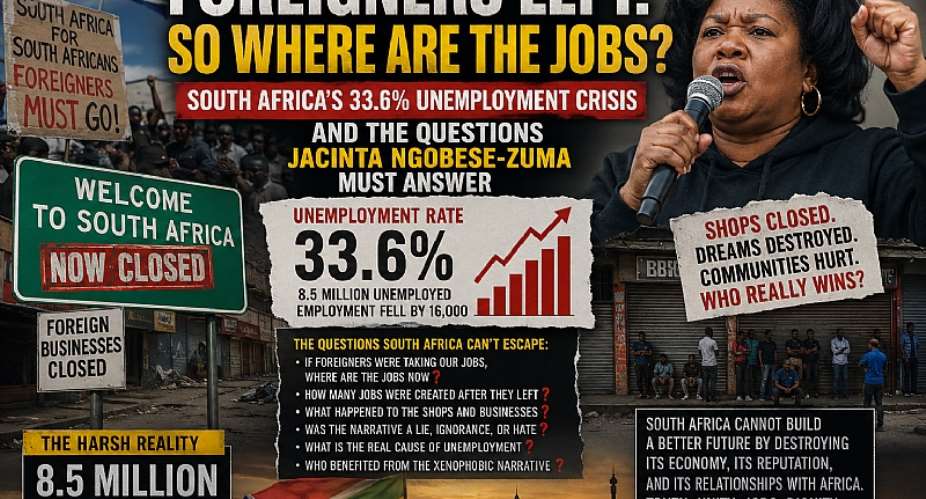
It was repeated in communities, on social media, at political gatherings and on the streets: foreign Africans were taking South Africans’ jobs.
They were allegedly taking businesses.
They were allegedly taking spaza shops.
They were allegedly overwhelming hospitals and schools.
They were allegedly responsible for crime.
And, above all, they were allegedly standing between unemployed South Africans and the jobs they desperately needed.
That narrative became powerful enough to produce street movements demanding that foreigners leave.
One of the most prominent recent faces of that campaign is Jacinta Ngobese-Zuma, founder and leader of March and March.
But South Africa now faces an uncomfortable question:
If foreigners were the reason South Africans could not find jobs, what happens when foreigners are pushed out and unemployment still rises?
The latest answer from the country's own statistics agency is devastating.
South Africa's official unemployment rate rose from 32.7% in the first quarter of 2026 to 33.6% in the second quarter. The number of unemployed people increased by 345,000 to 8.5 million, while the number of employed people actually fell by 16,000 to 16.7 million.
So here is the question that deserves to be shouted from Johannesburg to Durban, Pretoria to Cape Town:
WHERE ARE THE JOBS THAT WERE SUPPOSED TO APPEAR AFTER THE FOREIGNERS WERE BLAMED?
The uncomfortable history South Africa cannot erase
South Africa's xenophobia crisis did not begin with Jacinta Ngobese-Zuma.
The country experienced devastating anti-foreigner violence in 2008, when attacks against migrants spread through townships and informal settlements. Similar waves of hostility occurred in subsequent years, including major attacks and boycotts against foreign-owned businesses.
By 2022, Operation Dudula had emerged as a prominent anti-immigrant movement, claiming that undocumented foreigners were responsible for problems ranging from unemployment to crime.
Then came March and March.
The movement, founded by Jacinta Ngobese-Zuma, emerged in 2025 and subsequently became one of the most visible voices demanding tougher immigration enforcement. Its leadership says it is targeting undocumented immigrants rather than foreigners generally and insists that its campaign is about sovereignty, jobs, public services and border control rather than xenophobia.
But critics have pointed out that rhetoric directed at migrants can easily become broader than the distinction between documented and undocumented foreigners.
GroundUp has argued that the movement's rhetoric draws on longstanding xenophobic narratives and can dehumanise Africans from other countries.
And that is where the debate becomes serious.
Because South Africa absolutely has the right to enforce its immigration laws.
But enforcing immigration law is not the same thing as convincing citizens that another African nationality is responsible for an economy that cannot generate enough jobs.
THE GREAT JOBS TEST
This is perhaps the most important question of the entire debate.
Suppose the argument is:
Foreigners are taking our jobs.
Then logically:
Foreigners leave → vacancies appear → South Africans take those vacancies → unemployment falls.
But what does the latest data show?
The unemployment rate is 33.6%.
There are 8.5 million unemployed people.
Employment actually declined by 16,000 during the second quarter of 2026.
Where, therefore, is the evidence that removing foreigners has solved South Africa's unemployment problem?
There is an even bigger problem with the argument.
South Africa's government itself has now acknowledged that illegal immigration is not the cause of all the country's economic problems.
President Cyril Ramaphosa said in June 2026 that the solution requires faster economic growth, investment, industrial expansion, infrastructure development and the creation of millions of jobs.
That statement should force an enormous rethink.
Because if the government itself says illegal immigration is not the cause of all the economic problems, why were unemployed South Africans repeatedly encouraged to look sideways at another African rather than upward at the economic system?
THE NUMBERS DON'T SUPPORT THE SIMPLE “FOREIGNERS STOLE THE JOBS” STORY
This is where evidence becomes more uncomfortable.
A World Bank study examining South Africa between 1996 and 2011 found that immigrants had a positive impact on employment and wages for locals, with the study estimating that each immigrant worker generated approximately two jobs for citizens. It also found that immigrants and locals often performed complementary rather than identical work.
That does not mean every immigrant is legally employed.
It does not mean undocumented employment is acceptable.
It does not mean South Africans should ignore illegal immigration.
It means something more important:
Migration and unemployment are not the same problem.
The IMF reached a similarly nuanced conclusion in research covering South Africa and other African countries: the effect of immigration depends substantially on whether immigrant and local workers have complementary or competing skills.
So perhaps South Africa has been asking the wrong question.
Instead of:
“How many foreigners have jobs?”
Perhaps the more important question is:
“Why is the South African economy not creating enough jobs for everybody who needs one?”
THE APARTHEID ELEPHANT IN THE ROOM
South Africa inherited one of the most unequal economic structures in the world.
Apartheid did not simply separate people residentially.
It distorted education.
It distorted land ownership.
It distorted access to capital.
It distorted industrial development.
It distorted labour markets.
And its consequences did not disappear in 1994.
The World Bank has repeatedly identified South Africa's historical exclusion, low economic growth, structural labour-market problems, skills mismatches and unequal access to economic opportunities as major contributors to persistent unemployment.
Another World Bank analysis describes South Africa's unemployment as fundamentally structural and points to weak labour demand, economic restructuring, skills-biased technological change and the country's historical geography among the underlying problems.
More recently, the World Bank has warned that South Africa's economy does not create jobs quickly enough, while the country continues to experience low growth and severe inequality.
So why blame the Nigerian trader?
Why the Zimbabwean worker?
Why the Malawian gardener?
Why the Ghanaian professional?
Why the Mozambican construction worker?
Why the Congolese entrepreneur?
Why the foreign-owned spaza shop?
Why not confront the deeper economic architecture?
BUT WHAT ABOUT FOREIGNERS RUNNING SPaza SHOPS?
This is where South Africans have a legitimate argument that should not be dismissed.
Some communities genuinely believe foreign-owned informal businesses have squeezed South African entrepreneurs out of markets.
President Ramaphosa himself acknowledged that many communities feel excluded from opportunities in their own neighbourhoods and said government must promote fair competition and support local enterprise.
But here comes another uncomfortable question:
If a foreigner can arrive with limited resources, open a shop, work fourteen hours a day, establish supply chains, survive fierce competition and build a profitable business why isn't the question also:
Why couldn't South Africa create an environment where its own young people could do exactly the same?
That question is much harder.
Because it moves responsibility from the immigrant to the economic system.
AND WHAT HAPPENED TO THE BUSINESSES AFTER FOREIGNERS LEFT?
This is perhaps the most revealing test of all.
If foreign-owned shops were simply “stealing” economic opportunities, removing their owners should automatically create a massive wave of South African entrepreneurship.
But entrepreneurship doesn't work like that.
A shop is not simply a building with products inside it.
It requires:
capital;
credit;
suppliers;
business knowledge;
working capital;
customers;
distribution networks;
long working hours;
risk tolerance;
management;
and often years of experience.
Therefore, forcing a foreign trader out does not automatically manufacture a South African entrepreneur.
And if the shop closes rather than being taken over successfully, the community may actually lose a source of goods, employment and economic activity.
Recent reporting has warned that anti-migrant mobilisation has already created economic disruption in sectors including retail, agriculture, construction and transport. Reuters reported economists' concerns that migrant workers contribute substantially to the economy and that their sudden departure could hurt sectors dependent on migrant labour.
So the question becomes:
Did South Africa remove competitors or did it sometimes remove economic participants?
JACINTA NGOBESE-ZUMA: THE QUESTION IS NO LONGER WHETHER YOU CAN MARCH
Jacinta has every democratic right to protest peacefully.
She has every right to demand stronger borders.
She has every right to demand enforcement of immigration law.
She has every right to ask government why undocumented people are able to work illegally.
Those are legitimate questions.
But leadership comes with another responsibility:
What happens when the argument you used to mobilise people does not produce the outcome you promised?
Jacinta has said her movement was motivated by concerns about unemployment, undocumented immigration and pressure on public services.
So here are the questions she and every March and March supporter should now answer:
Where are the jobs?
If foreigners were taking the jobs, how many jobs have actually been recovered for South Africans?
How many unemployed South Africans have been employed because of March and March's campaign?
How many foreign-owned businesses that disappeared have been successfully taken over by South African entrepreneurs?
How many new South African businesses have been created because foreigners were pushed out?
How much has unemployment fallen because of the campaign?
And perhaps the most uncomfortable question:
If unemployment rises after the campaign, who takes responsibility for the economic narrative that was sold to frustrated South Africans?
WAS JACINTA LYING TO SOUTH AFRICA?
That question must be approached carefully.
There is no credible evidence available to establish that Jacinta deliberately lied to South Africans or that a secret organisation instructed her to manufacture xenophobia.
Claims that unidentified groups were “behind” her actions should not be presented as fact without evidence.
But that does not mean the claims made by the movement should escape scrutiny.
There is a profound difference between saying:
“Jacinta deliberately deceived everyone.”
and asking:
“Were the claims made by the movement supported by sufficient evidence?”
That second question is entirely legitimate.
And it is arguably the question South Africa should now be asking.
THE GOVERNMENT HAS AN ANSWER BUT IS IT BIG ENOUGH?
To its credit, the South African government is not pretending that unemployment does not exist.
The government says it has created or supported millions of work and livelihood opportunities through programmes including the Presidential Employment Stimulus, Expanded Public Works Programme, Social Employment Fund and Presidential Youth Employment Intervention.
The Presidential Youth Employment Intervention's Jobs Boost Outcomes Fund pilot, for example, had secured 7,044 job placements by March 2026, with thousands of those jobs verified as sustained.
Government is also pursuing structural reforms through Operation Vulindlela, targeting electricity, logistics, telecommunications, water, investment and other constraints to economic growth.
And in August 2026, the Government-Business Partnership launched its third phase with an ambition to contribute toward one million additional jobs by 2030, while acknowledging that 8.5 million people were unemployed and that economic growth remained too weak.
But here is the brutal reality:
Work opportunities are not the same thing as permanent jobs.
South Africa needs an economy capable of continuously creating productive employment not merely programmes that temporarily absorb unemployed people.
THE GOVERNMENT'S MOST IMPORTANT ADMISSION
Perhaps the most important statement came from President Ramaphosa himself.
He acknowledged that illegal immigration is not the cause of all South Africa's economic challenges and identified faster economic growth, investment, industrial expansion, infrastructure and millions of jobs as the answer.
That is a significant admission.
Because it means South Africa cannot deport its way out of a 33.6% unemployment rate.
It cannot police its way into prosperity.
It cannot blame neighbouring countries into economic growth.
And it cannot make unemployment disappear by changing the nationality of the unemployed person's competitor.
SO WHAT ARE SOUTH AFRICANS SUPPOSED TO BELIEVE NOW?
This is where the political and moral damage becomes serious.
Imagine being a Ghanaian, Nigerian, Zimbabwean, Malawian, Mozambican or Congolese citizen who was told:
“You are taking our jobs.”
You watched your friend's shop attacked.
You watched Africans being insulted.
You watched people being threatened because of their nationality.
You watched political movements demand mass deportations.
Then you look at South Africa's latest unemployment figure.
33.6%.
And you ask:
“So it was me?”
“Or was there a much bigger problem?”
South Africa's own government has now intensified action against employers who exploit undocumented workers, strengthened immigration enforcement and promised tighter controls. As of June 2026, government reported thousands of immigration-law arrests and said it was targeting employers who illegally employ undocumented migrants.
That is how the issue should have been handled from the beginning:
LAW ENFORCEMENT not MOB JUSTICE.
AND AFRICA IS WATCHING
This is not merely a South African domestic problem.
South Africa is one of Africa's major economic powers.
Its companies operate across the continent.
Its banks operate across borders.
Its retailers operate across borders.
Its telecommunications companies operate across borders.
Its citizens travel, work and conduct business throughout Africa.
So what happens when countries whose citizens were mistreated in South Africa remember those experiences?
What happens when South Africa later needs their markets?
What happens when South African companies need African governments to facilitate investment?
What happens when Pretoria asks Ghana, Nigeria, Zimbabwe, Zambia, Mozambique, Malawi or other African countries for closer economic cooperation?
Can economic diplomacy survive when ordinary Africans believe South Africa treated them as enemies?
The consequences are already becoming economic.
Reuters reported that anti-migrant protests and the departure of foreign workers risk economic repercussions and affect regional economies that depend on South Africa, including through remittances.
South Africa itself has acknowledged that its future is inseparable from Africa and that migration cannot be solved by enforcement alone.
THE GREAT CONTRADICTION
Here is perhaps the biggest irony of all.
South Africa says:
“Foreigners are taking our jobs.”
Yet South Africa is simultaneously asking investors to come and create jobs.
It wants international companies.
It wants skilled migrants.
It wants tourists.
It wants foreign investment.
It wants African markets.
It wants regional integration through the African Continental Free Trade Area.
It wants South African companies to expand throughout Africa.
And it wants neighbouring countries to cooperate on migration.
The contradiction is obvious:
How can South Africa tell Africans, “Come and invest with us,” while some of its citizens are telling Africans, “Get out”?
The country's own government has recognised this contradiction. Its economic strategy explicitly identifies tourism, agriculture, services, green manufacturing and other sectors as areas with significant potential for job creation, while also emphasising African trade integration.
THE QUESTION SOUTH AFRICA CANNOT RUN AWAY FROM
Perhaps South Africa's greatest mistake was not enforcing its immigration laws.
Every country has the right to control its borders.
The mistake would be allowing legitimate concerns about illegal immigration to become a convenient explanation for structural economic failure.
Because once politicians and activists convince desperate people that the person next door is responsible for their poverty, the political reward can be immediate.
But the economic consequences can be disastrous.
And when the foreigners disappear and the unemployment remains?
The scapegoat is gone.
But the problem remains.
SO, JACINTA, WHAT NOW?
March.
Protest.
Demand.
Challenge government.
Demand legal immigration.
Demand border security.
Demand action against employers who exploit undocumented workers.
All of that can happen within the law.
But now comes the harder part.
Build.
Build businesses.
Build industries.
Build factories.
Build technology companies.
Build agricultural value chains.
Build export industries.
Build vocational skills.
Build affordable finance for young entrepreneurs.
Build logistics.
Build energy security.
Build education.
Build an economy capable of absorbing hundreds of thousands of new workers every year.
Because South Africa's Government Business Partnership says roughly 300,000 new work-seekers enter the labour force every year.
No campaign against foreigners can solve that mathematical problem.
Only economic growth can.
THE FINAL QUESTION
South Africa once gave Africa Nelson Mandela.
It gave Africa a powerful symbol of reconciliation.
It helped champion African liberation.
It became a major economic gateway into the continent.
But today, South Africa faces a reputational crisis of its own making.
If it wants Africa to trust it again, it must demonstrate that Pan-Africanism is not something reserved for diplomatic speeches.
It must show that an African from Zimbabwe, Ghana, Nigeria, Malawi, Mozambique, Lesotho, Zambia or the Democratic Republic of Congo can live, work and trade legally without being treated as an enemy.
And it must tell its own unemployed young people the truth:
Your biggest enemy may not be the African standing beside you.
It may be an economy that simply isn't creating enough opportunities.
That truth is harder to sell than xenophobia.
But it is the truth South Africa desperately needs.
Because at 33.6% unemployment and 8.5 million people without work, the country has reached the point where the scapegoat theory deserves to be tested against reality.
And reality is asking one devastating question:
IF THE FOREIGNERS WERE TAKING ALL THE JOBS WHY ARE SOUTH AFRICANS STILL UNEMPLOYED?
By:
Patrick Belebang Yagsori
+233240292413
[email protected]

 About 55,000 BECE candidates disqualified from SHS placement
 Foreign Affairs Ministry reaffirms ban on middlemen in attestation services
 Zenator assumes office as Environment, Science And Technology Minister
 2026 BECE: Only 17% of candidates record aggregates between 6 and 18
 'Can your salary buy a Land Cruiser?' – Eric Carbonu challenges journalist over ...
 Private SHSs have vacancies for all 54,985 BECE candidates denied placement — GN...
 Binduri: Farmers along Kubore stretch urged to remain calm over Bagre Dam spilla...
 Travellers bringing more than two phones to Ghana may pay customs duties – GRA
 The Supreme Court Rejected The Attorney-General’s Case On The Unconstitutionalit...
 Sophia Akuffo calls for limits on Supreme Court interlocutory appeals to avoid u...

