




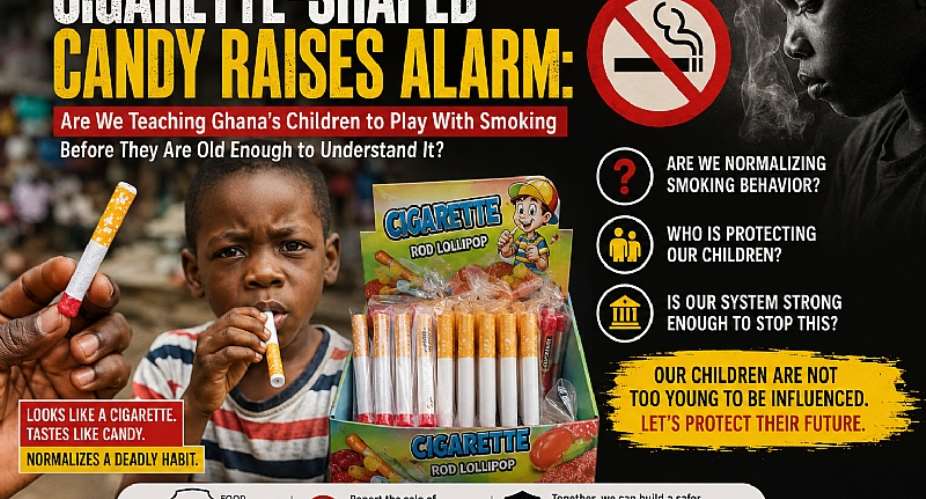
A child walks into a shop.
He sees something colourful. Something sweet. Something designed to look like a cigarette.
He does not see lung cancer.
He does not see addiction.
He does not see premature death.
He sees candy.
And perhaps that is precisely where the danger begins.
The recent seizure of “Cigarette Rod Lollipop,” a cigarette-shaped confectionery being sold in Accra, has opened a much bigger conversation than simply whether one particular sweet is safe to eat.
It raises uncomfortable questions about what Ghana allows onto its shelves, how products get through its borders, the responsibility of traders and importers, the influence of product design on children, and whether Ghana is protecting its children aggressively enough from products that can normalise harmful adult behaviours.
The Food and Drugs Authority (FDA), working with National Security, seized quantities of the product in Accra's Central Business District during an operation over the weekend. A key suspect was arrested and investigations into the importation, distribution and sale of the product are ongoing.
But the seizure should not be the end of the conversation.
It should be the beginning.
The candy that looks like a cigarette
According to the FDA, the product is not registered with the Authority. That means its composition has not been verified by the regulator.
That alone is serious.
Under Section 97(1) of Ghana's Public Health Act, 2012 (Act 851), food products must be registered before they are manufactured, imported, distributed or sold.
But there is another issue that arguably makes this product even more disturbing.
It looks like a cigarette.
The FDA has warned that children holding and using such a product could potentially be introduced to smoking behaviour and that the product could undermine efforts to discourage tobacco use among young people.
That warning deserves serious public attention.
Because children learn through imitation.
A child may not understand the chemistry of nicotine, the consequences of addiction or the connection between smoking and disease.
But a child understands pretend.
Children pretend to drive cars.
They pretend to cook.
They pretend to be doctors.
They pretend to be police officers.
So what happens when a child is handed something that looks exactly like a cigarette and is told:
“It is just candy.”
Why would anyone manufacture candy that looks like a cigarette?
This is perhaps the question that deserves far more attention.
What is the commercial logic behind producing confectionery in the shape of a product that governments and health organisations have spent decades trying to keep away from children?
Was the design chosen simply because it is unusual?
Was it intended to make the product more attractive?
Was it designed to imitate adult behaviour?
Or was it simply a marketing gimmick designed to make children curious?
The manufacturer of the specific Cigarette Rod Lollipop seized in Ghana has not, in the reports reviewed for this article, publicly explained why the product was designed in a cigarette-like form or why it was marketed for the Ghanaian market.
And that silence creates another question:
Should manufacturers of products that imitate harmful substances be required to explain why they are targeting children with such imagery?
Historically, concerns about “candy cigarettes” have existed for decades. Research and policy debates have examined whether cigarette-shaped confectionery could normalise smoking behaviour, and various countries have restricted or banned such products.
The issue is therefore not entirely new.
What is new is Ghana's encounter with this particular product and the question of whether Ghana has learnt enough from other countries.
What about the traders?
There is another uncomfortable part of this story.
How did these sweets get onto the shelves in the first place?
And why were people willing to sell them?
The FDA's enforcement action followed public complaints and social-media reports about the product being sold in the market.
One suspect has been arrested, but the investigation is still determining the wider importation and distribution chain.
It would therefore be unfair to accuse every trader of knowingly putting children in danger.
Many market women and retailers may simply buy products from wholesalers and sell them for profit without understanding their regulatory status or the wider public-health implications.
But that raises another question:
At what point does “I didn't know” stop being a defence?
If a trader sees a sweet deliberately designed to look like a cigarette, shouldn't that immediately trigger questions?
Where was it manufactured?
Who imported it?
Is it registered?
Is it approved for sale in Ghana?
What exactly is inside it?
And most importantly:
Is this something we should be putting into the hands of children?
Profit is important.
Livelihoods are important.
But children's safety must be more important than a few cedis of profit.
And what are parents supposed to do?
Imagine being a parent who spends years telling a child:
“Smoking is dangerous. Don't smoke.”
Then one afternoon, the same child comes home happily holding a colourful candy shaped like a cigarette.
The child puts it in the mouth.
The child pretends to smoke.
The child laughs.
The parents may laugh too.
But should we?
Perhaps we need to ask ourselves a harder question:
Are we sometimes normalising the very behaviour we later spend millions trying to prevent?
The World Health Organization has repeatedly warned that tobacco and nicotine industries use attractive designs, flavours, packaging and marketing strategies to appeal to younger generations. WHO says nicotine is highly addictive and particularly harmful to children, adolescents and young adults whose brains are still developing.
The cigarette-shaped candy does not contain nicotine simply because it resembles a cigarette.
But symbolism matters.
A cigarette can be transformed from something dangerous into something playful.
From something forbidden into something funny.
From something adults smoke into something children pretend to smoke.
And that is precisely the concern.
Ghana's own law appears to recognise the danger of imitation
Interestingly, Ghana's legal framework is not completely silent on this issue.
The Public Health Act, 2012 contains provisions prohibiting the sale, display or advertising of a non-tobacco product or service containing imagery or other material commonly identified with tobacco products.
More significantly, Section 62 states that a person shall not package, label or offer for sale a product that looks like or is likely to be identified or associated with tobacco or a tobacco product.
That is an extraordinary provision when considered alongside the current controversy.
It means this debate is not merely about whether parents think a candy looks inappropriate.
There is a public-health and legal question.
So how did it get here?
This may be the most important question of all.
Ghana's FDA says it has zero tolerance for unregistered imported products and operates at ports of entry to control regulated goods. The Authority says importers are required to register products before importation, and that unregistered regulated products brought into Ghana commercially may be confiscated or re-exported.
The Ghana Revenue Authority also requires appropriate permits from regulatory agencies, including the FDA and Ghana Standards Authority where applicable, as part of import-clearance procedures.
So if an unregistered food product eventually appears openly in a major market in Accra, the public deserves to know:
Where exactly did the system fail?
Was it imported through an official port?
Was it smuggled through an unofficial route?
Was it misdeclared?
Was it overlooked during inspection?
Was it brought in as another category of commodity?
Did someone fail to check?
Or did enforcement simply happen too late after the product had already reached children?
These are not accusations.
They are questions that a serious investigation should answer.
Ghana has systems. But are the systems working early enough?
This is where the controversy becomes bigger than one sweet.
The FDA says it has regulatory responsibility at Ghana's various ports of entry and specifically states that it is responsible for identifying unregistered imported regulated products. It also says it can confiscate or dispose of unregistered commercial quantities.
So perhaps Ghana does not necessarily lack laws.
Perhaps the deeper problem is enforcement, coordination, intelligence and interception before products reach the market.
Why should regulators discover questionable products only after they become popular enough for consumers to complain?
Why should social media expose a product before regulators do?
Why should a parent see something in Makola before the system designed to protect consumers sees it?
Shouldn't the border be the first line of defence not the market?
Other countries have gone further
Ghana is certainly not the only country to recognise the danger of products that resemble tobacco.
Australia provides an interesting comparison.
In New South Wales, for example, legislation prohibits the sale of confectionery, food, toys or other products that resemble tobacco products or are packaged to resemble them. Victoria also has powers concerning products that resemble tobacco products or are likely to encourage children or young people to smoke.
Pakistan has similarly reported a prohibition on manufacturing or offering sweets, snacks or toys in the form of cigarettes.
Historically, cigarette-shaped confectionery has also been restricted or banned in several countries, including Australia, Canada, Finland, Norway and the United Kingdom, although the precise legal approaches differ by jurisdiction.
The lesson is not that Ghana must copy every foreign law.
The lesson is that other countries have recognised that product design itself can become a public-health issue.
But here is the uncomfortable Ghanaian question
Why does Ghana sometimes appear to become extremely serious about enforcement only after a questionable product has already reached the public?
Why do we so often debate the commodity after it has entered the market instead of asking how it crossed the border?
Why are consumers sometimes the ones discovering products that regulators should have intercepted?
And why does enforcement sometimes become controversial when authorities finally act?
When regulators move into a market and seize goods, some people complain that authorities are destroying people's livelihoods.
But when authorities do not act, the same society may accuse them of sleeping on the job.
Which one do we actually want?
A regulator that allows everything?
Or a regulator that enforces the law even when enforcement is inconvenient?
The better question is perhaps:
Can Ghana enforce its laws firmly while giving traders enough information and education to know what they should never sell in the first place?
What should the FDA do now?
The seizure and arrest are important, but they should not be the final chapter.
The FDA should consider going beyond the immediate enforcement action.
1. Find the entire supply chain
Who manufactured it?
Who imported it?
Who cleared it?
Who distributed it?
How many cartons entered Ghana?
Where were they distributed?
Which markets received them?
How many children may already have purchased them?
2. Tell the public what was found
If laboratory testing is conducted, consumers deserve to know what the product contains.
Was it simply ordinary confectionery?
Were there undeclared substances?
Were the ingredients safe?
Were the labelling requirements met?
3. Investigate the import route
If the product was imported, Ghana needs to know how an unregistered food product got this far.
The FDA says it maintains controls at ports and has zero tolerance for unregistered imports.
This case is therefore an opportunity to test that system.
4. Inspect other markets
If one cigarette-shaped candy reached Makola, could similar products be sitting in other markets?
What about schools?
Street vendors?
Small provision shops?
Online sellers?
What about other products that imitate cigarettes, vapes, alcohol or other adult products?
5. Strengthen public reporting
The FDA has already asked the public to report sellers of the product and has offered confidential rewards for information leading to the arrest of importers or others behind its distribution.
That approach should be strengthened.
Parents and consumers can become an additional layer of surveillance.
And what should parents do?
Parents should not wait for government alone.
Ask your children what they are buying.
Look at unusual sweets.
Teach children that not everything colourful or edible-looking is necessarily safe or appropriate.
And when you see a questionable product, report it.
Because the first warning system may sometimes be a parent standing in a shop saying:
“What exactly is this?”
The question nobody wants to ask
Perhaps the biggest question is not:
“Is cigarette candy dangerous?”
The bigger question is:
Why are we allowing children to rehearse adult addictions in the name of play?
Today it is a cigarette-shaped candy.
Tomorrow, what?
A vape-shaped sweet?
An alcohol-shaped lollipop?
A cannabis-themed confectionery?
Where do we draw the line?
And who draws it?
The manufacturer?
The importer?
The trader?
The FDA?
The government?
Or the parent?
Ghana cannot regulate only after the damage is visible
The FDA's action should be commended because the product was seized and a suspect arrested.
But enforcement after a product has reached consumers is only one part of effective regulation.
Prevention is better than confiscation.
Ghana already has a regulatory structure for imported foods. The FDA says imported products must be registered before importation and that it operates at ports to control regulated products.
The GRA's import procedures also require relevant regulatory permits for goods where applicable.
The laws exist.
The institutions exist.
The procedures exist.
So the question becomes:
Are we enforcing them strongly enough, consistently enough and early enough?
Because when an unregistered product reaches a crowded market and becomes available to children, the failure is no longer invisible.
It is sitting on a table.
It is being sold for a few cedis.
It is being held by a child.
And perhaps that is the image Ghana should be most uncomfortable with.
This is bigger than a sweet
A cigarette-shaped candy may seem harmless to an adult.
But children do not experience the world the way adults do.
They learn through symbols.
They imitate what they see.
They normalise what they repeatedly encounter.
And public health is partly about preventing harmful behaviours before they become habits.
The WHO's current tobacco-control messaging specifically warns that industries increasingly use attractive products, flavours, packaging and marketing techniques to reach younger generations.
So perhaps Ghana's cigarette-shaped candy controversy should force us to look beyond the candy.
It should force us to examine the entire pipeline from manufacturer to importer, from border to wholesaler, from wholesaler to trader, and from trader to child.
And then we should ask ourselves:
Who was watching?
Who approved it?
Who imported it?
Who cleared it?
Who distributed it?
Who sold it?
Who bought it?
And most importantly:
Who was supposed to protect the child?
The FDA has now stepped in.
The real test is whether the Authority can trace the product back to its source, close the loopholes that allowed it to reach Ghanaian consumers, prevent similar products from entering the country and make sure that enforcement is not merely a reaction to social-media outrage.
Because Ghana's children should not have to become the early-warning system for failures in consumer protection.
A sweet should be a sweet.
A cigarette should never be a child's toy.
And if Ghana truly means what its laws say about protecting public health, perhaps the next cigarette-shaped product should never make it from the border to the market in the first place.
By:
Patrick Belebang Yagsori
+233240292413
[email protected]
 ‘Neither East nor West, but forward together’ – Ghana's President renews Nkrumah...
 Ghana records GH¢46.1bn trade surplus in Q1 2026 despite real-term deficit
 Dollarisation of rent: Commissioner accuses BoG of ignoring Rent Control’s call ...
 Gold Coast customers hit streets today over locked-up funds
 Bright Simons explains why SIGA’s GH¢19.8bn SOE profit claim is 'bizarre'
 Election defeat can be life-saver – Former MP
 COCOBOD settles outstanding 2026 DDEP obligations with GH¢2.3bn payment
 OSP has delivered little to Ghanaians despite huge spending – Adomako-Kissi
 My petition seeking removal of Kissi Agyebeng is very strong, it cannot be dismi...
 AI can replace only lazy lawyers – Justice Asante

