




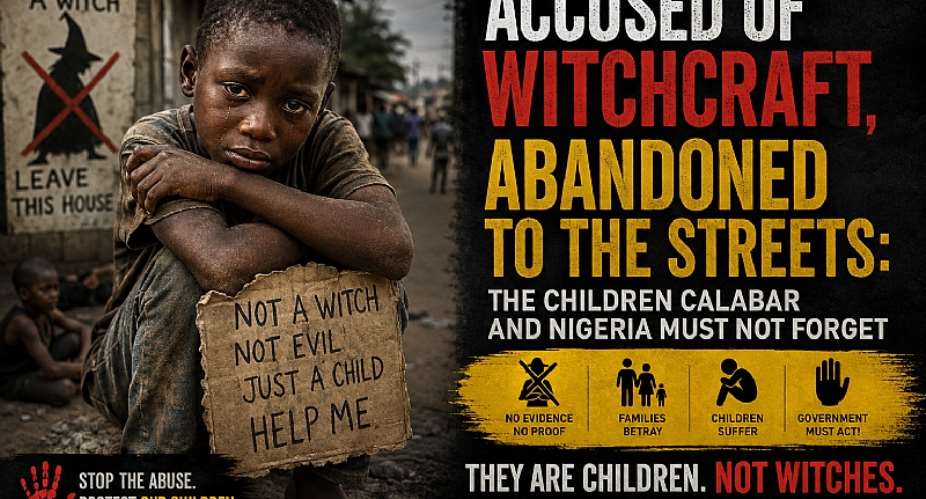
In the streets of Calabar, Cross River State, there is a population of children who should be in classrooms, homes and playgrounds, but instead have been pushed into a life of survival.
Some are known locally as “Skolombo boys” and “Lakasera girls.” Research published in 2025 described more than 1,000 teenagers living on major streets in Calabar and reported that many had been rejected, abandoned or discriminated against after being accused of witchcraft or wizardry.
The most disturbing question is not simply why children are being accused of witchcraft.
It is this:
How did a society become comfortable enough with accusing children of an invisible crime—one that allows them to be beaten, abandoned, excluded from school and left to sleep on the streets—while the system still struggles to stop it?
This is not merely a religious question.
It is a child‑protection crisis, a criminal‑justice question, a poverty question, a governance question and an international human‑rights question.
The accusation that can destroy a child’s life
A child cannot defend himself against an accusation that has no objective test.
There is no forensic laboratory that can establish that a child is a witch. There is no scientifically verifiable evidence that can be presented before a court demonstrating that a child caused illness, poverty, death, accidents or family misfortune through supernatural powers.
Yet the consequences are painfully real.
UNICEF’s research on children accused of witchcraft in Africa documented violence, mistreatment, abandonment and even killing. It also emphasized that the phenomenon is connected not only to beliefs but to social, economic and political factors.
In Calabar, the consequence can be brutally simple:
The child is thrown out.
And once a child is on the street, another crisis begins:
- No stable home
- No regular education
- No reliable healthcare
- Exposure to exploitation
- Exposure to violence
- Exposure to sexual abuse
- Exposure to criminal networks
Eventually, a child who was once a victim can be labelled a criminal because society abandoned him first.
That is the extraordinary contradiction:
We create street children and later complain about street children.
But who is actually accusing these children?
This question deserves far more attention.
Are the accusations coming from parents? Step‑parents? Extended family members? Neighbours? Traditional authorities? Religious leaders? Other children? Or combinations of all of them?
Historical and contemporary research from southern Nigeria indicates that accusations have often originated within families themselves. UNICEF records poverty and ignorance as contributing factors, while Nigerian representatives have acknowledged that accusations can occur in complicated family structures, including polygamous families.
But that raises a deeper question:
Why would a mother, father, uncle or aunt accuse a child they are supposed to protect?
The answer cannot simply be “African culture.” That explanation is too easy—and dangerous.
Research on Calabar’s social history points to multiple factors: poverty, changing family structures, urbanisation, social exclusion and the weakening of traditional communal systems.
Economic hardship can create desperation. Family conflict can create scapegoats. The death of a relative can create someone to blame. A child’s disability or unusual behaviour can be misunderstood. A step‑parent may regard a child as an unwanted burden. A child may become difficult to control during adolescence.
And in environments where supernatural explanations are deeply believed, the accusation becomes a convenient explanation for problems that have entirely different causes.
But there is another uncomfortable possibility:
Sometimes accusation may serve someone’s interests.
If a child is labelled evil, abandoning the child becomes easier to justify. If a family is struggling financially, responsibility can be shifted. If a religious operator claims to possess the power to “deliver” the child, the accusation can create an opportunity for exploitation.
This is precisely why accusations must be investigated—not simply accepted.
The religious dimension cannot be ignored
This issue becomes particularly sensitive when religious actors are involved.
The United Nations Committee on the Rights of the Child has expressed concern about reports of certain churches promoting beliefs in child witchcraft and subjecting children to violent exorcism practices. It called for regulation of religious institutions involved in such practices and prosecution of offenders.
This does not mean religion itself is responsible.
Millions of Nigerians are deeply religious and would never harm a child.
The issue is whether any pastor, traditional healer, parent, community leader or self‑proclaimed spiritualist should be allowed to use supernatural claims as justification for physically or psychologically abusing a child.
A difficult question therefore arises:
At what point does a spiritual declaration stop being a religious belief and become evidence of child abuse?
And another:
If a religious leader identifies a child as a witch and that accusation results in torture, abandonment or death, should the leader be treated merely as a religious figure—or as someone potentially responsible for a criminal act?
Nigeria has laws. So why are children still suffering?
Nigeria ratified the UN Convention on the Rights of the Child and domesticated child‑rights protections through the Child Rights Act. Nigeria also has criminal‑law provisions relevant to witchcraft accusations and ritual attacks. International bodies have repeatedly urged Nigeria to strengthen enforcement.
The problem therefore is not:
“There is no law.”
The more uncomfortable question is:
Where is enforcement?
The African Committee of Experts on the Rights and Welfare of the Child considered a case brought on behalf of children affected by witchcraft accusations in Nigeria. The case concerned alleged abuse, abandonment, exclusion, denial of education and healthcare, and failures by the Nigerian state to prevent, investigate and remedy violations. The Committee’s 2025 decision found violations of several provisions of the African Children’s Charter.
That should have produced a national moment of reckoning.
Instead, the question remains:
How many children must be rescued by NGOs before the Nigerian state treats their protection as a core government responsibility?
Is the Nigerian government powerless or unwilling?
It would be unfair to say nothing has been done.
There are government programmes, laws, social‑welfare structures and partnerships with UNICEF and civil‑society organisations. There are also people doing extraordinary work on the ground.
Basic Rights Counsel Initiative (BRCI) reports providing legal assistance in hundreds of violence‑against‑children cases and securing convictions, including a conviction in a witchcraft‑accusation case in 2022. It has also worked with government agencies and UNICEF‑supported programmes on street children in Calabar.
The Nigerian Red Cross has worked in Cross River through its “Keep the Kids Off the Streets” project, reporting a database of about 3,000 street‑connected children and rehabilitation efforts.
UNICEF has supported child‑protection interventions in Calabar, including an emergency shelter operated by BRCI for girls accused of witchcraft or abandoned to the streets.
And in April 2026, Rights Academy and We The People launched a simplified version of the Cross River Child Rights Law to make child‑protection law more accessible to street‑connected children, parents, community leaders and law enforcement.
So the question is not whether anyone is doing anything.
The question is:
Why are NGOs repeatedly filling gaps that should fundamentally be occupied by the state?
BRCI reports weak state intervention structures and says police and law‑enforcement officers remain reluctant to enforce relevant provisions, sometimes requiring NGOs to provide logistics for government investigations.
If accurate, this represents a profound institutional failure.
Where are the social‑protection agencies?
Nigeria has institutions responsible for children and social welfare.
So where are they when a child is thrown out of a home?
Where is the emergency response? Where is the social worker? Where is the psychological assessment? Where is the legal protection? Where is the family intervention? Where is the prosecution? Where is the long‑term reintegration plan?
UNICEF says violence against children is widespread in Nigeria and that only a fraction of affected children receive help. It identifies community beliefs around witchcraft among the social norms that increase vulnerability.
That should force a fundamental rethink.
Child protection cannot begin after the child has already become a street child. It must begin when the first accusation is made.
And what happens to the children themselves?
Behind every statistic is a human being.
Imagine being eight years old and being told by your family:
“You are a witch.”
Imagine being afraid to sleep in your own home. Imagine being taken somewhere and told you are possessed. Imagine being beaten or subjected to rituals because adults believe something about you that you cannot prove false. Imagine being thrown onto the street. Then imagine growing up believing your parents rejected you because there was something fundamentally wrong with you.
That is psychological violence. And children who survive it may carry the consequences for decades.
Some lose education. Some lose family relationships. Some develop deep mistrust. Some become vulnerable to exploitation. Some become involved in street survival economies. Some eventually come into conflict with the law.
The tragedy is that society may later ask:
“Why are these young people becoming criminals?”
But perhaps we should first ask:
“Who abandoned them when they were still children?”
The vicious cycle: accusation → abandonment → street life → criminalisation
A child is accused. The child is rejected. The child becomes homeless. The child survives through begging, petty work or informal activities. The child encounters violence and exploitation. The child becomes associated with street groups. Society becomes afraid of the child. Police encounter the child as a suspect rather than a victim. The child becomes criminalised. And society congratulates itself for “dealing with the problem.”
But the original problem was not solved.
It was transferred.
A child‑protection failure became a public‑security problem.
The government must answer these questions
Nigeria’s government should not respond to this crisis with another conference, another speech or another awareness campaign without measurable results.
It should answer publicly:
- How many children in Cross River State have been officially identified as victims of witchcraft accusations?
- How many have been rescued from abusive homes?
- How many perpetrators have been arrested?
- How many have been prosecuted?
- How many have been convicted?
- How many religious leaders have been investigated for abusive exorcism practices?
- How many children have been reunited with safe families?
- How many have received psychological care?
- How many have returned to school?
- How much money has the government allocated specifically to this problem?
- How much of that money has reached the children?
- How many trained child‑protection social workers operate in Calabar?
- What happens when a parent reports that another family member has accused a child of witchcraft?
- Which agency has primary responsibility for intervention?
- What happens to a pastor or traditional practitioner who tells a family their child is a witch?
- How many cases have police refused, delayed or failed to investigate?
- How many children remain unidentified because they are living on the streets?
- Where is the national database of children affected by witchcraft accusations?
- Why should NGOs provide resources for functions that belong to government?
- If the state knows children are being abandoned because of witchcraft accusations, why isn’t every credible accusation automatically treated as a child‑protection referral?
These are not unreasonable questions. They are questions of accountability.
Is the state involved?
There is no basis to claim that the Nigerian government as an institution is deliberately participating in witchcraft accusations against children. That allegation would require evidence.
But a different question arises:
Can a state become responsible through failure to act, even when its officials are not the original perpetrators?
International human‑rights principles say governments have duties to protect people from abuse by private actors, investigate violations and provide remedies.
The African Committee’s 2025 decision concerning Nigeria is significant because it addressed alleged state failures to prevent, investigate and remedy violations affecting children accused of witchcraft.
That changes the debate.
The question is no longer simply:
“Who abused the child?”
It becomes:
“What did the state know, when did it know it, and what did it do?”
What does international human‑rights protection mean if children remain unprotected?
This is another uncomfortable question for the international community.
The world has:
- the UN Convention on the Rights of the Child
- the African Charter on the Rights and Welfare of the Child
- the Sustainable Development Goals
- international child‑protection mechanisms
- UN human‑rights institutions
- international NGOs
- humanitarian organisations
- donor agencies
Yet children can still be abandoned in African cities because someone accused them of possessing supernatural powers.
So we must ask:
What is the value of an international treaty if a child cannot feel its protection?
And to international human‑rights organisations:
How many reports must be written before protection becomes measurable action? How many conferences? How many recommendations? How many concluding observations? How many “deep concerns”? How many years of documentation? At what point does international concern become international accountability?
And what about Africa?
Africa must also look in the mirror.
African governments cannot permanently blame colonialism for every contemporary social problem. African communities cannot defend harmful practices simply because they are described as tradition. African religious leaders cannot claim spiritual authority while refusing accountability for the consequences of their declarations. African civil society cannot permanently substitute for government. African leaders cannot demand respect for African sovereignty while failing to protect African children from preventable abuse.
The African Union and African child‑rights institutions must ask:
What kind of African renaissance are we building if some of our most vulnerable children are still being sacrificed to fear, superstition, poverty and social abandonment?
But we must also ask an uncomfortable question about the international media
Why does the world pay enormous attention to spectacular conflicts while children quietly disappear into the streets? Why does a dramatic war attract global headlines while a child expelled from a family because of a supernatural accusation becomes yesterday’s news? Why do international campaigns sometimes become more interested in statistics than individual accountability? And why should the international community wait for another child to be killed before demanding action?
Who can save these children?
There is no single saviour.
The solution must involve the Nigerian government, Cross River State authorities, police, judiciary, social‑protection agencies, schools, religious institutions, traditional leaders, civil society, international organisations and communities.
But the state must lead.
NGOs cannot permanently substitute for government. UNICEF cannot raise every child. The Red Cross cannot police every street. Human‑rights organisations cannot prosecute every perpetrator. Journalists cannot rescue every victim. Ordinary citizens cannot carry the entire responsibility of the Nigerian state.
The government must establish a properly funded child‑protection mechanism capable of identifying, rescuing, investigating and rehabilitating children affected by witchcraft accusations.
Every rescued child should receive:
- immediate protection
- medical assessment
- psychological support
- legal representation
- safe accommodation
- education
- family tracing
- family counselling
- economic support where appropriate
- long‑term reintegration
Most importantly, the child must never be returned to an abusive environment simply because that environment is called “family.”
Family reunification must mean safe reunification—not automatic reunification.
Parents must also be confronted
Parents deserve education and support. But parenthood cannot become immunity from accountability.
If a father throws his child onto the street because a pastor says the child is a witch, we must ask whether that father has committed an offence. If a mother permits her child to be tortured because she believes the child is possessed, we must ask whether love and ignorance can excuse violence. If an uncle hands a child to someone for an abusive “deliverance,” who is responsible? If a religious leader encourages the abuse, who investigates him? And if authorities know about it and do nothing, who investigates the authorities?
The biggest question of all
Perhaps the most important question Nigeria and the world must answer is this:
If there is no evidence that a child possesses supernatural powers, why is the child’s life being treated as evidence against him?
A child cannot be convicted by suspicion. A child cannot be tortured into proving innocence. A child cannot be abandoned because adults cannot explain misfortune. And a child should never have to sleep on the streets because the adults responsible for protecting him chose fear over reason.
Calabar’s children are not witches. They are children.
That distinction must become the foundation of the response.
They are children before they are victims. Children before they are “Skolombo.” Children before they are “Lakasera.” Children before they are street‑connected. Children before they are labelled troublesome. Children before they are treated as criminals. Children before anyone else’s religious, cultural or social explanation of their existence.
The Nigerian government should not wait for another international committee to condemn it. It should not wait for another NGO to expose the problem. It should not wait for another child to die. It should not wait until today’s abandoned child becomes tomorrow’s gang leader, prisoner or victim of trafficking.
The state knows enough. The evidence exists. The laws exist. The institutions exist. The victims exist.
What is missing is not another report.
What is missing is sustained political will, enforcement, accountability and the courage to confront the adults who hide child abuse behind the language of witchcraft.
And the final question must be directed not only at Abuja, but at every governor, legislator, police commander, social worker, pastor, traditional ruler, parent, international organisation and citizen who sees this happening:
When a child is accused without evidence, expelled without due process, abused without protection and abandoned without justice—who exactly is failing that child?
If the answer is everyone, then the real scandal is not that these children were accused of witchcraft.
The real scandal is that an entire protection system can know they exist and still allow them to remain on the streets.
Calabar’s children do not need pity. They need protection. They do not need another sermon. They need justice. They do not need another report. They need action.
And Nigeria must answer the world:
How many children must be destroyed before the state finally decides that protecting a child is not an option, but its constitutional, legal and moral duty?

 GoldBod’s gains must be weighed against full cost to Ghana – Prof. Bokpin
 ‘Afenyo-Markin’s smear campaign against me is about extortion’ – Sammy Gyamfi
 August 22: Cedi sells at GHS12.30 on forex market, GHS11.13 on BoG interbank
 There is a deliberate smear campaign against GoldBod from Minority – Sammy Gyamf...
 ‘If GoldBod wants credit, it must accept blame for losses’ – Dr Owusu Sarkodie
 Akosombo control system to be restored next month – Energy Minister
 ‘Temporary Akosombo system not very robust’ – Energy Minister on recent power ou...
 Mike Ocquaye Jr reacts to Adwoa Safo’s reported return to NPP Dome-Kwabenya race
 Foreign Affairs Ministry urges Tijjaniya pilgrims to Senegal to travel by air ov...
 Bono Police Arrest 36‑Year‑Old in GH¢1.1M Fake Gold Deal; Hunt for Three Others ...

