




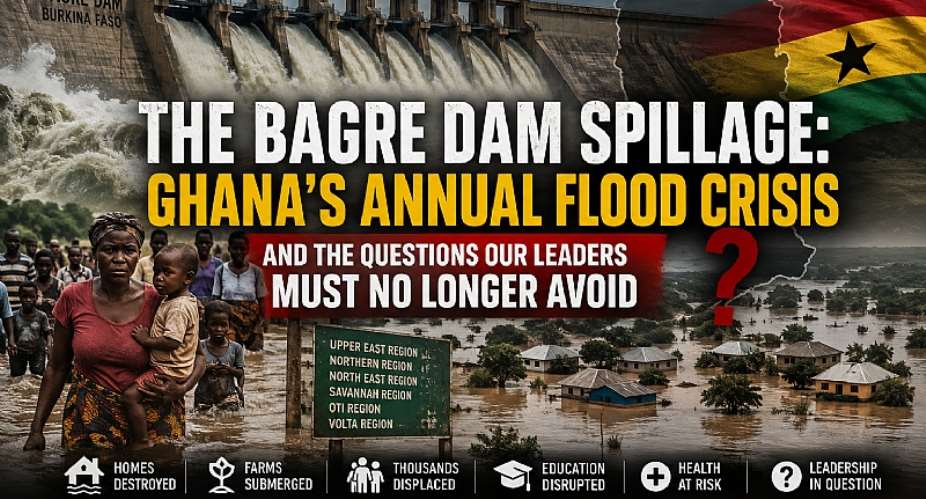
Every year, the headlines return with almost painful predictability:
"Bagre Dam Spillage Imminent."
Communities along Ghana's White Volta begin packing belongings. Farmers anxiously watch the skies. Families prepare for displacement. Schools, clinics, roads, bridges, and farms face destruction once again.
Then the floods come.
Lives are disrupted. Crops disappear beneath muddy waters. Livelihoods vanish overnight. Government officials visit affected communities, announce relief packages, promise long-term solutions, and eventually move on.
Until the next year.
The most disturbing question is no longer whether the Bagre Dam will be spilled.
The real question is:
Why is Ghana still surprised by something that has happened for decades?
A History Written in Water
Bagré Dam was constructed in the late 1980s on the White Volta River primarily for hydroelectric power generation, irrigation, fisheries, and flood management in Burkina Faso.
Like every large reservoir, the dam cannot be allowed to exceed safe water levels. During periods of heavy rainfall, operators must release excess water to protect the structural integrity of the dam.
Failure to do so could threaten the dam itself and create a catastrophe far worse than controlled releases.
In other words, the spillage is not an accident.
It is an engineering necessity.
And Burkina Faso has every sovereign right and responsibility to operate the dam safely.
The problem, therefore, is not that Burkina Faso releases water.
The problem is that Ghana has known this reality for decades and still appears to struggle to reduce its recurring impacts.
Why the Dam Must Be Spilled
Many people mistakenly believe Burkina Faso spills the dam without concern for Ghana.
That is an oversimplification.
Dam operators monitor reservoir levels continuously. When inflows exceed safe storage capacity, controlled releases become necessary to protect the dam and downstream populations from an uncontrolled failure.
Climate change has increased rainfall variability across West Africa, making reservoir management even more challenging.
In many cases, authorities in Burkina Faso notify Ghana before major releases.
The question therefore changes from:
"Why are they spilling the dam?"
to
"Why are we still unprepared after receiving repeated warnings year after year?"
The Human Cost in Ghana
The White Volta flows through northern and eastern Ghana before joining the Volta Lake.
When large volumes of water arrive, communities in regions including the Upper East, North East, Northern, Savannah, Oti and parts of the Volta Region can experience severe flooding.
The consequences are painfully familiar:
Thousands displaced
Homes destroyed
Farms submerged
Livestock lost
Schools closed
Roads washed away
Waterborne diseases increase
Businesses collapse
Children lose months of education
For many farming families, one flood can erase an entire year's income.
Some never fully recover.
Ghana and Burkina Faso Have Tried to Cooperate
The two countries have worked together over the years through technical committees, information sharing and early warning mechanisms to improve communication before major water releases.
The aim has been to give downstream communities time to prepare and evacuate when necessary.
These arrangements have helped improve advance notification, but notification alone does not eliminate the underlying risks.
Warnings save lives.
They do not save farms.
They do not rebuild homes.
They do not replace destroyed schools.
They do not restore lost incomes.
The Question Nobody Wants to Ask
If the Bagre Dam has been spilling for decades...
Why is flood management in Ghana still treated as though it were an unexpected emergency?
Why does every year end with emergency relief instead of permanent solutions?
Why are billions spent reacting to disasters instead of preventing them?
Are We Building a Nation or Managing Annual Crises?
Around the world, countries facing recurring floods have invested in long-term measures such as:
Floodplain management
Stronger drainage systems
Protective embankments
Flood-resilient housing
Better land-use planning
Modern forecasting technology
Relocation of the most vulnerable settlements where necessary
Climate adaptation programmes
Agricultural insurance
Community preparedness
None of these measures eliminates floods entirely.
But they reduce destruction.
So why does Ghana continue to experience similar levels of devastation year after year?
Have We Learned Anything?
There is an old proverb about a bird that promises to build its nest after the rains but forgets once the sun returns.
Are we becoming that bird?
Every flood produces commissions.
Every flood produces speeches.
Every flood produces promises.
Every flood produces relief items.
Then silence.
Until next year.
Development is measured not by how well a country responds to predictable disasters, but by how effectively it prevents avoidable suffering.
Questions Parliament Must Answer
Members of Parliament representing flood-prone constituencies regularly visit affected communities after disasters.
But citizens deserve to know:
How many long-term flood mitigation projects have been completed?
How much funding has been allocated and how much has actually been spent?
What measurable improvements have been achieved?
Why do some communities flood repeatedly despite years of political promises?
Questions for District Assemblies
District Chief Executives, Municipal and District Assemblies are responsible for local planning.
If floods occur almost every year:
Why are people still settling in the highest-risk areas?
Have local development plans adequately reflected known flood risks?
Have drainage systems and evacuation infrastructure kept pace with population growth?
What long-term resilience projects have been delivered?
These are difficult questions but they are legitimate ones.
Where Are Ghana's Experts?
Ghana is home to engineers.
Hydrologists.
Urban planners.
Climate scientists.
Medical specialists.
Economists.
Architects.
Universities.
Research institutions.
If so much expertise exists, why does the country still appear to rely predominantly on emergency response?
Are expert recommendations being implemented or simply filed away?
Beyond Relief: Can Floods Become an Opportunity?
Some countries have transformed recurring floods into opportunities by investing in flood-resilient agriculture, irrigation, wetlands restoration, improved water storage, and infrastructure designed to coexist with seasonal water rather than merely resist it.
Could Ghana expand irrigation using excess seasonal water?
Could flood-resilient farming techniques reduce agricultural losses?
Could better land-use planning protect vulnerable communities while supporting economic development?
Could improved investment today reduce repeated emergency spending tomorrow?
These ideas require careful planning, environmental assessment, financing, and community consultation but they illustrate that recurring natural hazards can also drive innovation if managed strategically.
What Are Ghanaians Saying?
Across affected communities, the frustrations are remarkably consistent.
People ask why they receive warnings every year but continue to lose everything.
Farmers wonder why compensation is often delayed or insufficient.
Parents ask why children repeatedly lose access to education.
Young people question whether they should continue farming land that may disappear beneath floodwaters every rainy season.
Their concerns deserve more than sympathy.
They deserve durable solutions.
Is Ghana Planning for the Future?
Climate scientists warn that extreme weather events may become more frequent in many parts of the world.
If that proves true, then today's flood challenges could become even more demanding in the years ahead.
Preparedness is therefore not optional it is an investment in national resilience.
The Hard Questions That Cannot Be Ignored
If the Bagre Dam has been spilling for decades:
Why do so many communities remain highly vulnerable?
Why are long-term solutions progressing so slowly?
How is disaster-risk funding being prioritised and monitored?
What measurable improvements should citizens expect before the next rainy season?
How will success be evaluated beyond emergency relief distributions?
What lessons have genuinely been learned from previous floods?
These are questions of governance, planning, accountability, and public policy.
They are not questions directed at any one political party alone. They are questions that span successive administrations and multiple levels of government.
Conclusion: The Flood Is Predictable. Our Response Should Be Better.
Nature cannot be negotiated with.
Heavy rains will continue.
Reservoirs will continue to fill.
The Bagre Dam will continue to require careful management.
Those realities are unlikely to change.
What can change is how Ghana prepares.
The measure of national progress is not whether floods occur, but whether citizens remain trapped in the same cycle of loss despite decades of warning.
A predictable disaster should never produce predictable suffering.
Perhaps the greatest challenge before Ghana is not the water flowing from the Bagre Dam.
Perhaps it is whether we finally summon the political will, technical expertise, and sustained investment to ensure that the next generation inherits resilience instead of recurring crisis.
By:
Patrick Belebang Yagsori
+233240292413
[email protected]

 Judiciary must earn public trust, not demand it — Asiedu Nketiah
 Any sod-cutting ceremony at Upper East Airport site this weekend will be 419 — G...
 Mahama must investigate GoldBod over alleged US$1.7bn loss — Abena Osei-Asare
 Attorney General opposes Wontumi’s bail application pending appeal in 20-year se...
 'I will continue to sit until Chief Justice revokes warrant' - High Court judge ...
 August 11: Cedi sells at GHS12.45 on forex market, GHS11.78 on BoG interbank
 Hopeson Adorye eats humble pie, retracts claim linking Ekow Assafuah to Ghana To...
 Legal vacation does not mean lawyers can halt court proceedings – Deputy Attorne...
 Forensic audit reveals how Ghana’s Embassy in the U.S. extorted $19.3 million fr...
 EVIDENCE: How Ghana’s Washington Embassy staff shared money extorted from visa a...

