




For decades, South Africa has been called the Rainbow Nation a country that rose from the ashes of apartheid to become a symbol of freedom, reconciliation, and African unity. Today, however, many Africans are asking a painful question: What happened to the Rainbow Nation?
Why are foreigners being dragged from their homes? Why are shops being attacked? Why are some police officers standing by while innocent people are beaten and harassed? If South Africa is not xenophobic, why are black Africans becoming targets because of their accents, names, or nationality?
These are difficult questions, but they deserve honest answers.
What is Really Happening?
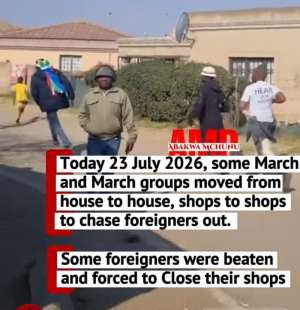
Recent anti-immigration protests escalated in parts of South Africa after groups calling themselves "March and March" and other anti-illegal immigration movements demanded that undocumented migrants leave the country. What began as protests has, in some areas, evolved into vigilante-style operations where protesters go door-to-door looking for foreigners.
Reports from Johannesburg showed protesters breaking doors, searching homes, and handing suspected foreigners over to police officers. Human rights groups have raised concerns that both documented and undocumented migrants are being targeted indiscriminately.
Is This Really About Jobs?
This is perhaps the biggest argument being made by many South Africans.
South Africa has one of the highest unemployment rates in the world, particularly among young people. Many citizens genuinely believe foreigners are taking jobs, operating businesses illegally, depressing wages, and placing pressure on public services.
But economists have repeatedly pointed out that unemployment in South Africa is a far more complicated problem. It is rooted in decades of structural inequality, poor economic growth, educational challenges, electricity shortages, corruption scandals, and insufficient job creation.
If every foreign national left South Africa tomorrow, would unemployment suddenly disappear?
Probably not.
The uncomfortable truth is that unemployment existed long before the recent migration crisis. Foreign nationals did not create South Africa's economic problems, although migration can contribute to pressure in particular sectors and communities.
Are Some South Africans Speaking Out?
Yes.
Many South Africans have strongly condemned the attacks.
Some argue that criminals should be arrested regardless of nationality, but innocent people must never become targets simply because they speak differently or come from another African country.
Others have questioned why protesters are targeting poor migrants instead of holding politicians accountable for unemployment and failed economic policies.
Many South Africans fear that their country's international image is being destroyed by the actions of a minority using violence in the name of patriotism.
What Happened to the Marches?
The marches initially presented themselves as protests against illegal immigration and government failures. Protest leaders demanded stronger border controls and the deportation of undocumented migrants.
However, critics argue that some demonstrations have crossed the line from protest into vigilantism when protesters began conducting their own immigration enforcement operations.
No democratic society can permit citizens to become judges, immigration officers, and executioners simultaneously.
The moment ordinary citizens decide who belongs and who does not belong, democracy itself begins to weaken.
Is the South African Government Walking the Talk?
President Cyril Ramaphosa has repeatedly condemned xenophobia and warned citizens not to take the law into their own hands. The government maintains that South Africa is committed to constitutional values and human rights.
Yet many Africans are asking:
Why are videos showing police officers watching attacks?
Why are homes being searched by protesters?
Why are legal migrants living in fear?
Why are foreign governments evacuating their citizens?
Words matter, but actions matter even more.
When people lose confidence that the government can protect everyone within its borders, questions naturally arise about whether authorities are unable or unwilling to enforce the law equally.
The Economic Cost Nobody is Talking About
South Africa's economy depends significantly on tourism, foreign investment, skilled labour, and regional trade.
When businesses are attacked:
Investors become nervous.
Tourism suffers.
International relationships are damaged.
Skilled workers begin leaving.
Consumer confidence weakens.
Some employers have reportedly dismissed foreign workers out of fear that their businesses could become targets. Others have complained that the uncertainty is disrupting operations and increasing insecurity in communities.
Violence rarely creates jobs. Stability does.
Is South Africa Becoming a Flight Risk for Tourists?
It would be inaccurate to suggest that all tourists are unsafe or unwelcome in South Africa. Millions visit peacefully every year.
However, perception matters.
When international media report that foreigners are being removed from homes and businesses, tourists naturally begin asking difficult questions.
Will I be safe?
Will I be targeted because of my nationality?
Will authorities protect me?
Tourism is built on confidence, and confidence is fragile.
If violence against foreigners becomes normalised, South Africa risks damaging one of its most valuable international assets its reputation.
Is This Xenophobia or Something Else?
Perhaps it is both.
For some people, this is genuinely about unemployment and illegal immigration.
For others, it appears to be xenophobia.
For some politicians and activists, foreigners have become convenient scapegoats for problems that have existed for decades.
The tragedy is that innocent people are often caught in the middle.
An undocumented migrant should face immigration procedures not mob justice.
A documented migrant should never have to prove their humanity because of their accent or nationality.
Africa Must Ask Difficult Questions
South Africa fought against apartheid while receiving enormous support from African nations.
Thousands of Africans sacrificed financially, politically, and diplomatically for South Africa's liberation struggle.
Today, many Africans are asking:
Have we forgotten our shared history?
Can Africans become strangers in Africa?
Who protects the foreigner when the law refuses to act?
Can unemployment justify violence?
What message are we sending to future generations?
No country has an obligation to permit illegal immigration. Every sovereign nation has the right to enforce its immigration laws.
But no nation has the moral right to permit mobs to replace the justice system.
South Africa deserves secure borders.
Foreign nationals deserve human dignity.
Both truths can exist simultaneously.
If South Africa wishes to remain the Rainbow Nation, it must prove that its Constitution protects everyone not only when cameras are watching, but especially when they are not.
Because history has taught us one painful lesson: when we stop seeing our neighbours as human beings, everybody eventually becomes unsafe.
The question Africa must now ask is not simply whether South Africa is xenophobic. The greater question is this:
What kind of South Africa does South Africa itself want to become?
By:
Patrick Belebang Yagsori
+233240292413
[email protected]

 Women's Development Bank has taken too long to be implemented — GUTA Vice Presid...
 'GoldBod's success story will outlive the hate-driven campaign' — Sammy Gyamfi
 Ato Forson dismisses claims of tension with Agric Minister Eric Opoku over GH¢1....
 Ghana's economy will take off after we stabilise it within two years through unr...
 President Mahama raises South Africa xenophobic attacks with Ramaphosa’s Special...
 Google Maps scam: This is why after online payment your food never comes
 GoldBod generated additional $15 billion in foreign exchange inflows — Ato Forso...
 Govt secures US$3.5 billion investment to revive upstream oil and gas sector — F...
 'Free Wontumi and all political prisoners now; we will hold your feet to account...
 NPP disqualifies Oti Regional Youth Organiser aspirant for criticising Bawumia o...

