




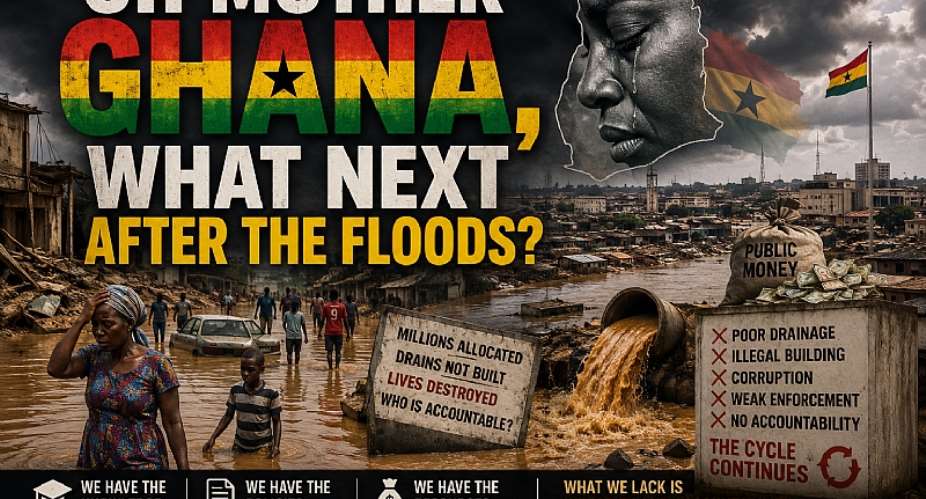
Every year, the story is painfully familiar. Heavy rains fall. Homes are submerged. Businesses are destroyed. Families lose everything they have worked for in a lifetime. Children sleep in classrooms and churches after becoming homeless overnight. Roads become rivers. Vehicles are swept away. We mourn the dead and count our losses.
Then the rains stop.
We return to normal life and begin our annual ritual of forgetting until the next rainy season arrives.
The question every Ghanaian must ask is this: Are floods in Ghana still natural disasters, or have they become man-made disasters created by human greed, incompetence, and collective negligence?
For decades, experts have told us exactly what causes most urban flooding in Ghana. Poor drainage systems. Buildings constructed on waterways. Unregulated urban planning. Indiscriminate dumping of refuse into drains. Weak enforcement of building regulations. Corruption in public infrastructure projects. Climate change has made rainfall more intense, but poor planning has turned rainfall into catastrophe.
So why are we still here?
Ghana is not a poor country in terms of human resources. We have engineers, architects, environmental scientists, urban planners, economists, lawyers, professors, and thousands of highly educated public servants. Our universities graduate some of the brightest minds in Africa every year.
Yet when it rains, our cities behave as though they were designed centuries ago.
One must ask difficult questions.
Why do we only remember drainage systems when floodwaters enter the homes of politicians and wealthy communities?
Why are people allowed to build on waterways until disaster strikes?
Why do governments announce ambitious flood prevention projects every election cycle but fail to deliver sustainable solutions?
How many millions have been allocated over the years for drainage construction and flood control?
Where have those funds gone?
Who has been prosecuted for failing to ensure that public funds intended for infrastructure are used properly?
Why do we continue awarding contracts for drains that cannot survive a single rainy season?
These are not political questions. They are questions of national survival.
The ordinary Ghanaian is not entirely innocent either.
Many of us throw plastic waste into drains and expect floodwaters to show mercy. Some knowingly build in flood-prone areas. Illegal structures spring up on waterways because regulations are either ignored or selectively enforced.
We have become experts at blaming government while refusing to accept our own contribution to the problem.
But individual negligence does not excuse governmental failure.
Governments exist precisely because there are certain problems that citizens cannot solve alone. No individual Ghanaian can build an entire city's drainage system. No market woman can enforce building regulations. No taxi driver can redesign urban planning policies.
That responsibility belongs to leadership.
And leadership is where Ghana continues to disappoint itself.
Perhaps the most painful irony in Ghana today is our justice system's unequal treatment of crime. A poor man who steals cassava or a piece of yam may spend years entangled in the criminal justice system. Yet public officials accused of misappropriating millions of cedis often enjoy endless court adjournments, political protection, or complete silence.
The laws appear fierce when confronting poverty but remarkably gentle when confronting power.
One stolen goat can attract swift justice. One stolen public project can disappear quietly into political debates and press conferences.
How can a nation develop when corruption itself has become a protected institution?
International development partners have supported Ghana over the years with funding for infrastructure development, sanitation, urban resilience, and flood mitigation projects. Successive governments have announced programmes worth millions of dollars aimed at improving drainage systems and sanitation.
Yet many Ghanaians continue to ask a simple question: if the money has been allocated repeatedly over the years, why are the floods becoming more devastating rather than less?
We do not lack policies. We lack political will.
The problem with Ghana is not a shortage of intelligence. It is a shortage of accountability.
We have become like the proverbial hawk that promises to build a house tomorrow. When the rains come, it vows to build immediately after surviving the storm. When the sun shines again, it forgets its promise until the next disaster arrives.
That is Ghana's relationship with flooding.
Every rainy season, we promise ourselves that "never again" will become our national anthem. By the dry season, "never mind" becomes our national policy.
Will this cycle repeat itself next year?
History suggests that it will unless we fundamentally change how we govern ourselves.
Flood prevention cannot be a political slogan. It requires long-term planning that survives changes in government. It requires strict enforcement of building regulations irrespective of political connections. It requires transparent procurement processes for infrastructure projects. It requires annual maintenance of drainage systems. It requires citizens who understand that throwing waste into drains is not merely irresponsible it is potentially deadly.
Above all, it requires leaders who fear history more than they fear losing political power.
The floods are speaking to us as a nation. They are asking whether we intend to build a country or merely inherit one and leave it worse than we found it.
Are we cursed as Africans? Absolutely not.
Africa is not cursed. Bad leadership is.
Degrees do not build nations. Integrity does. PhDs do not prevent floods. Competence does. Political speeches do not save lives. Infrastructure does.
The tragedy of Ghana is not that we lack brilliant minds. The tragedy is that we have failed to transform knowledge into action.
As flood victims count their losses today, another question echoes across the nation:
Who will build the drains? Who will enforce the laws? Who will protect the public purse? Who will ensure that next year's rains do not become next year's tragedy?
The answer cannot always be "the next government" or "the next budget."
The time for emergency reactions has passed. What Ghana needs is emergency thinking.
Because if we do nothing today, the floodwaters will return tomorrow not as visitors, but as permanent residents of our national failure.
The answer will not be found in another speech, another committee, or another promise.
It will be found in what we choose to do before the next rain falls.
By:
Patrick Belebang Yagsori
+233240292413
[email protected]

 'Jailing Camila Alhassan is grave injustice against free speech' – Minority
 Prolonged dry spell threatens farming season in Upper East Region
 Attorney-General says it cannot produce some evidence ordered by court in Adu-Bo...
 Withdraw TikToker Camilla Alhassan’s second prosecution, other pending cases - M...
 Minority Warns Mahama: Don’t Sign Tribunals Bill — It Revives PNDC‑Style Justice
 Ayariga Fires Back: Tribunals Not a Witch‑Hunt — NPP Fears Are Misplaced
 Oforikrom MP Blasts Gov’t: Nkoko Nkitinkiti Is a GH¢200m Failure Feeding Party F...
 Suame MP Explodes: EOCO Has Become a Political Tool — Miracles’ Arrest Was Pure ...
 Herald Editor Cautions EOCO: Stop the Showmanship — High‑Profile Arrests Need Pr...
 UG Lecturer Takes On EOCO: Miracles’ Arrest Shows Weaponised Bail, Lazy Investig...

