




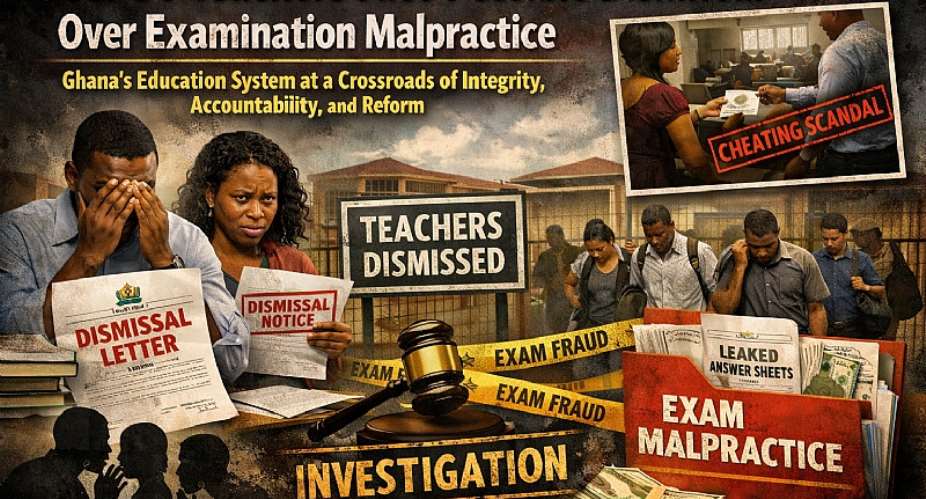
Across Ghana’s education sector, a storm is brewing after reports that more than 50 teachers are set to be dismissed over alleged examination malpractice a development that has reopened national debate on integrity, accountability, and the pressures within the schooling system.
While official investigations are still unfolding, the alleged cases are said to involve misconduct linked to examination conduct regulated by the West African Examinations Council and enforcement oversight by the Ghana Education Service. The details remain sensitive, but the implications are already significant.
What exactly are the teachers alleged to have done?
Although full investigative reports have not been publicly released, examination malpractice cases in Ghana typically involve actions such as:
Assisting candidates during live examinations
Leaking or sharing question papers in advance
Allowing unauthorized materials into examination halls
Colluding with students to alter or exchange answers
Supervisory negligence that enables cheating
If proven, these actions violate core professional standards expected of educators and directly undermine the credibility of national assessments.
Which rules were allegedly broken?
Teachers in Ghana operate under strict professional codes enforced by the Ghana Education Service, including:
The Code of Conduct for Public School Teachers
Examination supervision regulations issued by WAEC
Internal disciplinary policies governing misconduct and professional ethics
Examination malpractice is considered a serious professional offence, often categorized as gross misconduct. Under GES disciplinary frameworks, such offences can lead to sanctions ranging from suspension to outright dismissal.
Does this warrant dismissal?
Legally and institutionally, dismissal is possible but not automatic.
If investigations confirm deliberate involvement or facilitation of cheating, dismissal is generally justified under public service disciplinary procedures. However, if negligence rather than intent is proven, sanctions may vary from warnings to suspension.
The central question remains:
Is this a case of deliberate corruption, or a reflection of systemic pressure and weak supervision structures?
What are the affected teachers saying?
Reports suggest that some of the accused teachers are denying intentional wrongdoing, arguing that:
They were overwhelmed by large class sizes and inadequate invigilation support
Some alleged violations were misunderstandings of examination procedures
In certain cases, they claim they were not directly involved in malpractice activities
Pressure from students, parents, and schools may have contributed to lapses in supervision
However, official disciplinary committees typically rely on evidence from examiners, supervisors, and monitoring reports before reaching conclusions.
Who are the teachers and which schools are involved?
At this stage, names of the teachers and specific schools have not been officially disclosed to the public. Authorities are reportedly still finalizing investigations and disciplinary hearings before releasing detailed findings.
This lack of disclosure is partly due to:
Ongoing administrative proceedings
The need to ensure fair hearings
Protection of institutional reputation pending confirmation of guilt or innocence
A deeper national question
Beyond the disciplinary action lies a more uncomfortable national question:
Why does examination malpractice continue to surface despite repeated sanctions?
Some education observers argue that the problem is not only individual misconduct but also:
High academic pressure on students and teachers
Overloaded examination supervision systems
Weak enforcement in some examination centres
Societal obsession with grades over learning
Conclusion
The potential dismissal of over 50 teachers is not just a disciplinary headline it is a reflection of a deeper struggle within Ghana’s education system to protect academic integrity.
As investigations continue under the oversight of the Ghana Education Service and WAEC, the outcome will likely shape not only careers, but also public trust in the examination system itself.
And the most pressing question remains unresolved:
Is Ghana punishing individuals for a broken system or fixing the system by starting with individuals?
By:
Patrick Belebang Yagsori
+233240292413
[email protected]
 High Court dismisses 'no case' submission in $2million Accra SkyTrain trial, ord...
 World Bank drops climate funding target, raising fears for Africa
 Supreme Court unanimously dismisses challenges to Torkornoo's removal process
 TOR rules out immediate removal of refinery margin citing debt burden
 GES debunks viral claims of flood-damaged WASSCE papers
 Accra floods: 1,000 vehicles damaged at Odawna
 Prove NLA’s GH₵3bn giveaway allegation — Razak Kojo Opoku challenges The Fourth ...
 Illegal miners invade Adansi Asokwa Agenda 111 Hospital site
 Trader loses 15 shops in Odawna disaster
 July 2: Cedi sells at GHS12.30 on forex market, GHS11.36 on BoG interbank
