




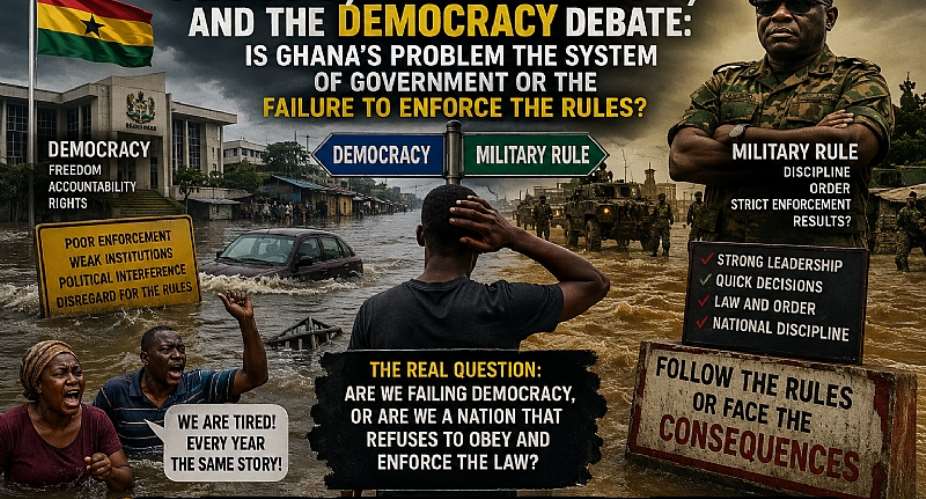
The recent flooding at Tema Community 18, where raging floodwaters reportedly destroyed a factory gate and swept away goods, has once again exposed a painful national reality. Beyond the physical destruction, it has also reignited an old and controversial debate in Ghanaian society: Is democracy failing Ghana, or are Ghanaians failing democracy?
An angry resident, reacting to the destruction, blamed weak enforcement of laws and regulations and argued that Ghana's democratic system has become ineffective in dealing with indiscipline. In his view, only military rule could restore order, discipline, and respect for regulations.
His comments may sound extreme to some, but they reflect a growing frustration among citizens who are tired of annual flooding, poor urban planning, weak law enforcement, and what many perceive as endless discussions without meaningful action.
The question is no longer whether people are angry. The real question is: Why are increasing numbers of Ghanaians beginning to compare democracy with military rule whenever the nation faces a crisis?
Ghana's Historical Journey: Military Rule vs Democracy
Since independence in 1957, Ghana has experienced both military and democratic governments.
The country witnessed military interventions in 1966, 1972, 1979, and 1981, with the latter leading to the establishment of the Provisional National Defence Council (PNDC) under Jerry John Rawlings.
Military governments often justified their interventions by citing corruption, indiscipline, economic mismanagement, and poor governance.
Since 1992, Ghana has enjoyed uninterrupted constitutional democracy, making it one of Africa's most stable democratic nations.
Yet after more than three decades of democratic governance, many citizens continue to question whether democracy has delivered the level of discipline, accountability, and development they expected.
Did Military Rule Bring More Discipline?
Supporters of military governments often point to certain realities:
Swift enforcement of regulations.
Fear of punishment.
Reduced bureaucratic delays.
Immediate implementation of government directives.
Greater public compliance with rules.
Many older Ghanaians still remember periods when unauthorized structures were demolished quickly, sanitation exercises were enforced rigorously, and public officials appeared more fearful of consequences.
But here is the uncomfortable question:
Was that genuine discipline, or was it simply fear?
A society governed by fear may appear orderly on the surface, but does that create sustainable development?
Military governments often restricted freedoms, suspended constitutional rights, censored criticism, and concentrated power in the hands of a few individuals.
If discipline comes at the cost of freedom, accountability, and citizen participation, is that a price a modern nation should pay?
What Democracy Promised
Democracy was expected to provide:
Accountability.
Transparency.
Rule of law.
Citizen participation.
Institutional checks and balances.
Protection of rights and freedoms.
Countries such as Germany, Canada, Sweden, and Netherlands demonstrate that democracy can coexist with discipline, efficiency, and development.
So perhaps the issue is not democracy itself.
Perhaps the issue is how democracy is being practiced.
The Question Nobody Wants to Ask
If developed democracies can enforce laws effectively, why can't Ghana?
Why do buildings continue to appear in waterways?
Why do illegal developments survive for years before authorities act?
Why do politicians often intervene when enforcement agencies attempt to do their jobs?
Why do citizens violate regulations and then expect government protection when disasters occur?
Could Ghana's problem be less about democracy and more about selective enforcement?
What Burkina Faso and Other Military-Led States Did Differently
Many supporters of military governments often point to countries such as Burkina Faso, where military leaders have recently gained popularity.
Supporters argue that military administrations often:
Take faster decisions.
Pursue visible infrastructure projects.
Demonstrate stronger anti-corruption rhetoric.
Project nationalistic leadership.
However, another critical question emerges:
Are these achievements sustainable without strong institutions?
History across Africa shows that many military governments initially enjoyed public support but later struggled with accountability, economic management, and long-term democratic stability.
The real lesson may not be that military rule is superior.
The lesson may be that citizens admire governments that act decisively and enforce rules consistently.
What Successful Democracies Are Doing That Ghana Is Not
Successful democratic nations typically possess:
Strong institutions that operate independently of politics.
Consistent enforcement of laws.
Long-term urban planning.
Effective drainage systems.
Strict building regulations.
Accountability regardless of political affiliation.
In many advanced democracies, a structure built in a waterway would be removed regardless of who owns it.
Can Ghana honestly say the same?
Do Ghanaians Truly Understand Democracy?
This may be one of the most uncomfortable questions of all.
Many citizens demand accountability from leaders.
But do citizens equally hold themselves accountable?
Democracy is often misunderstood as unlimited freedom.
In reality, democracy depends heavily on responsibility.
If citizens litter indiscriminately, build illegally, ignore planning regulations, and resist enforcement actions, can democracy alone solve those problems?
Can a nation become disciplined if its citizens reject discipline?
What Are Ghanaian Youth Saying?
Many young Ghanaians appear divided.
One group believes democracy remains the best option but needs stronger institutions and leadership.
Another group, frustrated by unemployment, corruption, poor infrastructure, and recurring disasters, increasingly expresses admiration for governments perceived as decisive and action-oriented.
This growing frustration should concern policymakers.
When young people begin questioning democratic governance, it signals a crisis of confidence that cannot be ignored.
Is Ghana Lacking Leaders, Thinkers, or Discipline?
Perhaps the most difficult question is this:
Does Ghana suffer from a leadership crisis, a citizenship crisis, or both?
For decades, experts, academics, engineers, urban planners, environmentalists, and policy researchers have produced reports identifying:
Poor drainage systems.
Weak enforcement.
Political interference.
Unplanned urban expansion.
Environmental degradation.
The recommendations are not hidden.
The solutions have been discussed repeatedly.
So why do the same problems persist?
Is the challenge a lack of knowledge?
Or a lack of political will?
Floods: Are We Talking More Than We Are Working?
Every year the pattern appears familiar:
Heavy rains.
Flooding.
Public outrage.
Investigations.
Committees.
Promises.
Media discussions.
Then the rains stop.
Public attention shifts.
The next rainy season arrives.
The cycle begins again.
How many reports have been written?
How many recommendations have been made?
How many have actually been implemented?
Could Ghana's greatest problem be implementation rather than ideas?
What Research Has Suggested for Years
Research and policy studies have consistently emphasized:
Strict enforcement of planning laws.
Protection of waterways.
Expansion of drainage infrastructure.
Improved waste management.
Better urban planning.
Stronger local government capacity.
Public education on environmental responsibility.
These recommendations have existed for years.
The challenge has rarely been identifying solutions.
The challenge has been applying them consistently.
What Are Other Countries Saying About Ghana's Flooding Challenge?
Urban resilience experts worldwide generally agree that flood disasters become worse when:
Drainage systems are blocked.
Wetlands are destroyed.
Construction occurs in flood-prone zones.
Regulations are weakly enforced.
The solutions are well known globally.
The real question is whether Ghana is prepared to implement difficult reforms that may affect powerful interests and require citizens to change long-established habits.
Which System Is Better for Ghana?
The evidence suggests that neither military rule nor democracy automatically guarantees development.
Military rule may produce rapid decisions but risks concentrating power and weakening accountability.
Democracy provides freedom and participation but requires strong institutions and responsible citizenship.
The better question may not be:
"Do we need democracy or military rule?"
The better question may be:
"Can Ghana build a disciplined democracy where laws apply equally to everyone?"
The Way Forward
Ghana's future may depend on five critical actions:
1. Enforce laws consistently without political interference.
2. Strengthen institutions rather than personalities.
3. Invest heavily in drainage and urban planning.
4. Hold both leaders and citizens accountable.
5. Transform national discipline into a cultural value rather than a temporary reaction to disasters.
The floodwaters at Tema Community 18 did more than destroy property. They exposed deeper frustrations about governance, accountability, and national discipline.
As the next rainy season approaches, Ghanaians face a defining choice.
Will the country finally act on decades of recommendations?
Or will the nation once again gather next year to discuss the same floods, ask the same questions, blame the same failures, and promise the same solutions?
That may be the most important question of all.
By:
Patrick Belebang Yagsori
+233240292413
[email protected]
 Mahama announces national security council meeting to tackle flooding
 Flood crisis: 'Identify every blockage in your Assembly for removal' — Mahama o...
 Mahama directs immediate release of GH¢300 million for flood relief, mitigation ...
 Stop redirecting blame to citizens and address flooding crisis — NPP tells Maham...
 Cedi ends June 2026 selling at GHS12.30 on forex market, GHS11.34 on BoG interba...
 ‘Guard Lake Bosomtwe with special task force like River Nile in Egypt’ – KsTU le...
 Dr Osei Adutwum condemns alleged illegal mining around Lake Bosomtwe
 KNUST Planning lecturer urges Bosomtwe residents to lead fight against illegal m...
 Akufo-Addo-Bawumia govt did not ignore Accra flooding crisis — Ahiagbah
 Police arrest four suspected drug peddlers, recover firearm and narcotics in Ash...
