




Humanity stands at a crossroads.
- Artificial Intelligence is reshaping societies.
- Digital networks connect billions of people.
- Quantum technologies, biotechnology, robotics, and advanced computing promise to transform every aspect of life.
Yet, beneath this unprecedented technological acceleration lies a growing crisis. Our technologies have become increasingly powerful, while our relationship with memory, meaning, community, and the natural world has become increasingly fragmented.
- We have mastered the ability to process information, but not necessarily the wisdom to guide its use.
- We have built global communication systems, yet many communities remain disconnected from their ancestral knowledge systems.
- We have created machines capable of learning, while entire cultures struggle to preserve the knowledge accumulated over thousands of years.
The question facing our generation is no longer whether technology will advance. The question is: What kind of civilization will guide that advancement?
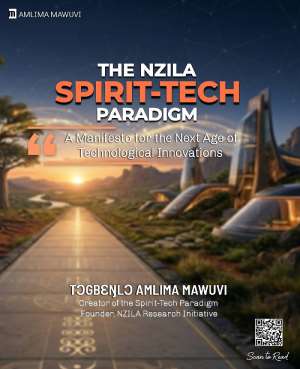
The Nzila Spirit-Tech Paradigm emerges as a response to this challenge. It proposes that, the future of innovation does not lie solely in newer machines, faster processors, or larger data centers - It lies in the conscious reunification of technology, culture, memory, ecology, ethics, and human purpose.
THE GREAT SEPARATION
For centuries, much of the world has operated under a separation between the sacred and the technical.
- Technology became associated with laboratories, industry, and engineering.
- Spiritual and ancestral knowledge became confined to ritual spaces, oral traditions, and cultural memory.
This separation produced remarkable achievements but it also created profound imbalances.
Technological systems increasingly shape human behavior while remaining detached from questions of identity, belonging, responsibility, and long-term harmony. At the same time, many ancestral knowledge systems have been marginalized, misunderstood, or dismissed despite containing sophisticated methods for organizing communities, preserving knowledge, managing resources, and transmitting wisdom across generations.
The Nzila Paradigm argues that this separation is neither natural nor necessary.
Throughout history, our human societies have developed integrated systems that connected knowledge, ethics, environment, symbolism, governance, and technology into coherent frameworks.
The future may require a return to that integration.
TECHNOLOGY IS NOT SEPARATE FROM NATURE
Every modern technology originates from nature.
- Silicon processors emerge from quartz.
- Copper wiring comes from the earth.
- Lithium batteries are refined from natural minerals.
- Optical systems rely on physical laws that existed long before human civilization.
Technology is not the opposite of nature: Technology is nature reorganized through human intention.
This principle forms one of the foundations of Spirit-Tech.
If modern technologies are derived from natural forces and materials, then the study of traditional knowledge systems should not automatically be viewed as separate from the study of technology.
Both are attempts to understand, organize, and apply the forces of existence.
ANCESTRAL SCIENCE
The Nzila Paradigm introduces the concept of Ancestral Science (AS).
Ancestral Science refers to the accumulated knowledge systems developed by communities through long-term observation, experimentation, adaptation, memory preservation, and intergenerational transmission.
These systems include:
- Indigenous ecological knowledge
- Traditional architecture
- Herbal and botanical sciences
- Symbolic communication systems
- Astronomy and calendrical systems
- Memory technologies
- Sacred geometry
- Governance structures
- Language preservation systems
- Community resilience frameworks
Ancestral Science is not defined by age. It is defined by tested knowledge that has survived because it remained useful, meaningful, and adaptable.
VODU AS COMMUNITY PROBLEM-SOLVING SYSTEMS
Within the Spirit-Tech framework, traditional institutions are examined through a systems perspective.
A Vodu is understood as a specialized community problem-solving system, just exactly as the word's meaning in the Eʋe language.
The systems often contain:
- Defined purposes
- Operational protocols
- Ethical constraints
- Symbolic interfaces
- Knowledge repositories
- Social responsibilities
- Mechanisms for accountability
- Methods of transmitting information across generations
Viewed through this lens, ancestral institutions and modern technologies share a common challenge:
How do human beings organize information, energy, relationships, and responsibility in ways that strengthen collective life?
The materials may differ, but the underlying systems challenge remains remarkably similar.
CONSCIOUS TECHNOLOGIES
Spirit-Tech advocates for the development of Conscious Technologies (CTs).
Conscious Technology is technology designed with explicit consideration for:
- Human wellbeing
- Cultural continuity
- Ecological balance
- Ethical responsibility
- Community resilience
- Memory preservation
- Long-term societal impact
The goal is not simply efficiency, the goal is alignment.
Technology should not merely optimize processes. It should strengthen the conditions that allow human communities to flourish.
THE DIGITAL PRESERVATION OF MEMORY
Many of the world's languages, oral histories, cultural practices, and indigenous knowledge systems face extinction within the coming generations. This loss represents not only a cultural tragedy but also the disappearance of valuable human knowledge.
Spirit-Tech therefore recognizes digital preservation as a sacred responsibility.
Artificial Intelligence, data systems, immersive media, language technologies, and digital archives can become powerful tools for protecting and transmitting ancestral memory and knowledge systems.
The future should not erase the past - the future should expand humanity's ability to remember.
ADAGANA AND THE FUTURE OF KNOWLEDGE SYSTEMS
Language is one of humanity's most powerful technologies.
Every language contains unique structures for perceiving reality, transmitting knowledge, and organizing thought.
Within the broader Spirit-Tech vision, initiatives such as the "Adagana OS" represent efforts to explore, preserve, and revitalize ancestral linguistic frameworks while creating new pathways for future learning and innovation.
The preservation of language is not merely cultural work.
- It is technological work.
- It is memory work.
- It is civilization work.
A NEW INNOVATION FRONTIER
The next frontier of innovation will not emerge solely from laboratories. It will emerge from a dialogue:
- between engineers and elders.
- between coders and historians.
- between scientists and indigenous knowledge holders.
- between digital systems and living cultures.
The Nzila Spirit-Tech Paradigm does not call for a rejection of modern science. It calls for an expansion of scientific imagination.
The Paradigm invites humanity to explore how technology can evolve alongside ancestral wisdom, memory, responsibility, and cultural identity.
THE PATH FORWARD
Nzila means the "path".
The path is neither backward nor forward alone. It is a bridge. A bridge between:
- memory and invention.
- ancestry and innovation.
- human consciousness and technological creation.
The future belongs not merely to those who build powerful tools. It belongs to those who understand what those tools are ultimately for.
The Nzila Spirit-Tech Paradigm is an invitation to begin that journey NOW.
The path is open...
A Manifesto By:
AMLIMA MAWUVI
(Creator of the Spirit-Tech Paradigm, and Founder of Nzila Research Initiative)
FOR MORE INFORMATION, COLLABORATION AND SUPPORT
Email: [email protected]
https://wa.me/233206984511
Phone:
+233 20 698 4511
+233 24 394 1199
+233 59 909 9991

 Govt to distribute first batch of 129 vehicles to MMDCEs in 12 regions
 UG Vice-Chancellor calls for oral exams, project-based assessment to deal with A...
 'I will use everything I have to clear my name' – Obuasi SHTS headmaster fights ...
 NPA to strengthen ties with UMaT to drive downstream petroleum sector
 'Report school abuse directly to Education Ministry' – Deputy Minister tells stu...
 'It's a curse on you' – Water Minister badmouths 'malware' workers sabotaging Gh...
 Tap water no longer drinkable near South Africa capital
 96 health facilities under construction in Ashanti Region
 GoldBod reforms create 4,866 direct jobs in less than two years — Sammy Gyamfi


