




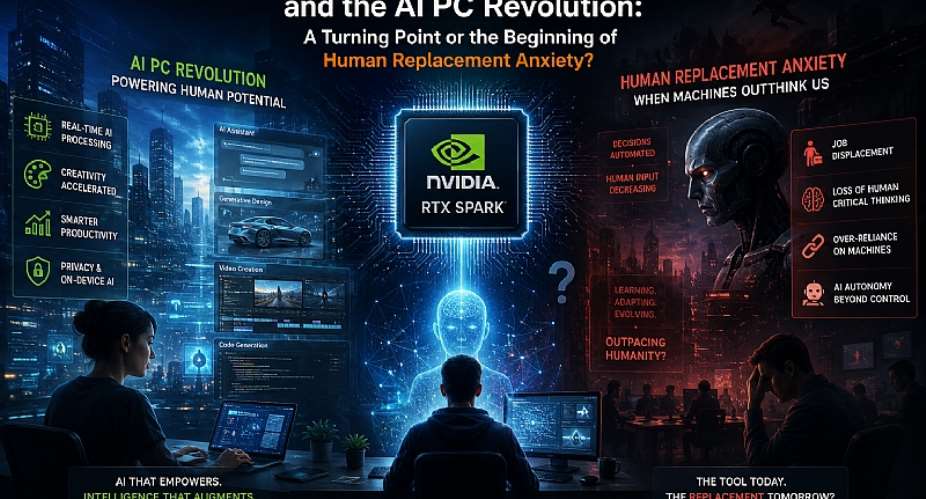
The technology world is once again at a crossroads following reports that NVIDIA is preparing a new wave of hardware referred to in some coverage as the “RTX Spark” chip positioned as part of a broader “AI PC revolution” expected to accelerate personal computing power for artificial intelligence tasks.
While the marketing narrative is bold faster AI processing, on-device intelligence, and a new era of personal computing the deeper question is far more uncomfortable:
Is this truly innovation for humans, or the beginning of systems that will eventually outthink and outpace them?
What Is Being Promised: The “AI PC Revolution”
At the core of NVIDIA’s strategy is a shift from traditional computing toward AI-native PCs machines designed not just to run software, but to think alongside it.
In simple terms, the promises include:
Real-time AI processing on personal computers (not just cloud servers)
Faster generative AI tools (text, video, design, coding)
Smarter operating systems that adapt to user behavior
Reduced dependence on internet-based AI computation
If successful, this could redefine what a “computer” is transforming it from a tool into an active digital assistant or collaborator.
But this raises a deeper concern: when machines begin to anticipate decisions, how much decision-making remains human?
The Critical Questions Nobody Wants to Ask
Behind the excitement, several uncomfortable questions are emerging:
1. Is this innovation or dependency creation?
Are AI PCs empowering humans or gradually making them reliant on systems they no longer fully understand?
2. Who is controlling intelligence?
If intelligence shifts from human cognition to machine acceleration, who sets the limits of that intelligence users, corporations, or the AI itself?
3. What happens to human thinking?
When writing, designing, coding, and even decision-making become automated, does human cognitive skill strengthen or slowly weaken?
4. Are we training systems that will eventually surpass us?
If AI systems learn from human behavior, language, and decision patterns, what stops them from evolving beyond human reasoning altogether?
Effects on Humanity: Progress or Psychological Shift?
The potential impact is not only technical it is deeply psychological and social.
Positive possibilities:
Increased productivity in science, medicine, and engineering
Reduced barriers for education and creativity
Faster problem-solving for global challenges
Enhanced accessibility for people with disabilities
Concerning possibilities:
Decline in independent critical thinking
Job displacement across creative and technical fields
Overreliance on machine judgment
Growing inequality between AI-enabled and non-AI-enabled populations
The most subtle risk is not unemployment but intellectual outsourcing, where humans gradually stop thinking deeply because machines think faster.
Will AI Compete With Humans or Replace Human Roles?
AI is already competing in:
Writing and journalism
Coding and software engineering
Graphic design and animation
Financial forecasting
Customer service systems
However, the next phase AI PCs and local intelligence could extend this competition into everyday life decisions: scheduling, communication, learning, and even emotional responses.
This leads to a difficult question:
If AI performs both physical and cognitive tasks better than humans, what remains uniquely human?
Comparison With Past Technological Revolutions
Previous revolutions industrial machines, electricity, the internet changed what humans do.
AI changes something deeper:
it challenges how humans think.
The Industrial Revolution replaced muscle labor
The Internet revolutionized information access
The AI revolution targets cognition itself
That distinction is why this moment feels fundamentally different.
Why Now? The Timing of the AI Explosion
The acceleration of AI systems is not accidental. It is driven by:
Massive increases in computing power
Availability of large-scale data
Breakthroughs in machine learning models
Corporate competition for AI dominance
Demand for automation across industries
Companies like NVIDIA are positioning themselves at the center of this transformation because AI is no longer just software it is becoming hardware-dependent intelligence.
The Most Disturbing Scenario: When AI Becomes “Better Than Human Thinking”
The most debated question is not whether AI will assist humans but whether it will surpass them in meaningful reasoning.
If future AI systems:
Learn continuously without human input
Improve themselves through feedback loops
Operate faster than human cognitive limits
Then we may face a situation where AI is not just a tool but a parallel intelligence system evolving beside humanity.
At that point, the question shifts from “Can AI think?” to “What happens when AI thinks better than us?”
Conclusion: Revolution or Redefinition of Humanity?
The so-called “AI PC revolution” is more than a hardware upgrade. It is a shift in the relationship between humans and machines.
We are entering an era where:
Intelligence is no longer exclusively human
Decision-making is increasingly shared
Creativity is partially automated
And thinking itself becomes a hybrid process
The uncomfortable truth is this:
The real revolution is not that AI is taking over humans but that humans may be willingly transferring parts of their thinking to machines.
The final question remains unanswered:
If machines eventually think faster, learn better, and decide more efficiently what exactly will define the human role in the world they helped create?
By:
Patrick Belebang Yagsori
+233240292413
[email protected]

 Ridge Hospital seeks relatives of unidentified woman injured in accident
 Kasoa: Firefighters pelted with stones over faulty fire tenders, 15 shops destro...
 Obuasi SHTS headmaster arrested over sexual misconduct allegations – Muntaka
 GoldBod says 76% of gold exported since August refined locally
 15 errors out of 1,964 names of South Africa evacuees due to pressure, we deserv...
 'No disturbances again' — Asiedu Nketiah urges calm over late Ahafo Ano South-We...
 Govt to distribute first batch of 129 vehicles to MMDCEs in 12 regions
 UG Vice-Chancellor calls for oral exams, project-based assessment to deal with A...
 'I will use everything I have to clear my name' – Obuasi SHTS headmaster fights ...
 'It's a curse on you' – Water Minister badmouths 'malware' workers sabotaging Gh...


