




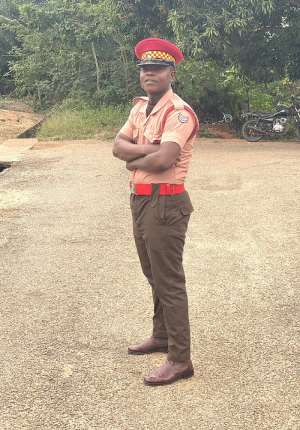
In an era where music often celebrates luxury, fame and street credibility, a unique voice is emerging from within Ghana’s correctional system. Young Paddy know in private life as Simon Padi Narh, a prison officer by profession and a rapper by passion, is using his music as a powerful tool to educate the public particularly the youth about the difficult realities of prison life.
Unlike many artists who rap about prison from imagination or second-hand stories, Young Paddy speaks from daily experience. Working within the prison environment has given him a close view of the consequences of crime, the emotional toll of incarceration, and the regrets of many inmates who wish they could turn back time. Through his lyrics, he transforms these observations into cautionary tales meant to steer young people away from criminal activities.
For Young Paddy, music is more than entertainment. It is a social message, a form of public education, and a warning to young people who may underestimate the consequences of their actions.
The inspiration behind Young Paddy’s music is rooted in what he sees every day in the line of duty. Prison, he says through his music, is not the glamorous image sometimes portrayed in movies or street narratives. Instead, it is a place where freedom disappears and regret becomes a daily companion.
Inside prison walls, many inmates reflect deeply on the mistakes that led them there. Young Paddy’s songs highlight these reflections the pain of separation from family, the stigma that follows imprisonment, and the realization that a single wrong decision can permanently alter the course of one’s life.
Through vivid storytelling in rap, he paints a picture of the emotional and psychological burden inmates carry. In many cases, these inmates were once ordinary young people with dreams and ambitions similar to those of the youth outside the prison walls.
At the heart of Young Paddy’s music is a direct message to young people: never choose the path that leads to prison or never go to prison which is fast becoming a hit song he advices the youth to stay out of trouble.
Across communities in Ghana, the influence of peers, economic hardship, and the temptation of quick money sometimes lure young people into criminal activity. Young Paddy’s songs attempt to counter these pressures by exposing the reality behind the consequences.
His message is simple but powerful , prison is not a place anyone wants to experience.
Many inmates, he suggests through hi s lyrics, believed they were too smart to get caught or that their actions would have no serious consequences. But the reality inside prison tells a different story. Freedom, once lost, is not easily regained, and the cost extends beyond the prison gates to families, careers and reputations.
Ghana has a long tradition of musicians using their craft to address social issues. From political commentary to messages about morality and community values, music has often served as a mirror reflecting society’s challenges.
Young Paddy’s approach fits within this tradition. By combining hip-hop rhythms with social commentary, he delivers messages that are both engaging and thought-provoking.
His music belongs to a growing movement of conscious artists who believe that entertainment should also carry meaning and responsibility.
For many young listeners, music is one of the most influential forms of communication. A message delivered through rhythm and storytelling often resonates more strongly than lectures or formal warnings. Recognizing this, Young Paddy uses rap as a language that young people easily understand.
What makes Young Paddy particularly unique is the intersection between his profession and his art. As a prison officer, his duty is to maintain discipline and contribute to the rehabilitation of inmates. As a rapper, he extends that mission beyond the prison walls by addressing the wider society.
In this way, his music becomes a form of preventive outreach encouraging young people to avoid the choices that lead to incarceration in the first place.
The idea that a prison officer is also a rapper may seem unusual, but it highlights the evolving role of public servants in engaging communities through creative means.
Young Paddy’s message also feeds into a broader national discussion about crime prevention and youth development. Many experts argue that preventing crime requires more than law enforcement; it also requires education, mentorship and positive role models.
Artists who speak openly about the consequences of crime contribute to this preventive effort by influencing attitudes and choices.
By sharing stories from the prison environment, Young Paddy provides a perspective that few people outside the correctional system truly understand.
As his music continues to reach wider audiences, Young Paddy hopes that his message will resonate with young people across the country. His goal is not merely to build a music career but to make a difference one listener at a time.
He believes that if even a handful of young people decide to abandon criminal paths after hearing his music, then his effort will be worthwhile.
In a society where youth face increasing social and economic pressures, voices that encourage discipline, responsibility and lawful living are more important than ever.
Through the fusion of duty and creativity, Young Paddy is proving that music can be more than entertainment. It can be a powerful instrument for awareness, reflection and change.
And for the young people listening to his songs, the message remains clear: the best way to understand prison is never to go there.

 Ridge Hospital seeks relatives of unidentified woman injured in accident
 Kasoa: Firefighters pelted with stones over faulty fire tenders, 15 shops destro...
 Obuasi SHTS headmaster arrested over sexual misconduct allegations – Muntaka
 GoldBod says 76% of gold exported since August refined locally
 15 errors out of 1,964 names of South Africa evacuees due to pressure, we deserv...
 'No disturbances again' — Asiedu Nketiah urges calm over late Ahafo Ano South-We...
 Govt to distribute first batch of 129 vehicles to MMDCEs in 12 regions
 UG Vice-Chancellor calls for oral exams, project-based assessment to deal with A...
 'I will use everything I have to clear my name' – Obuasi SHTS headmaster fights ...
 'It's a curse on you' – Water Minister badmouths 'malware' workers sabotaging Gh...


