




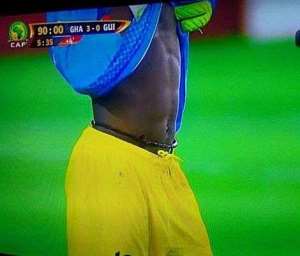
Several footballers have been accused of having used or continue to use special charms which make them perform better—despite the non availability of any sort of evidence to back this assertion.
Commonly accused footballers or those who sought for special charms for protection or to enhance their playing skills are those who come from Africa where superstition is somewhat valued than science.
In yesterday's first quarter finals AFCON game between Ghana and Guinea, Naby-Moussa Yattara who was the goalkeeper of Guinea and conceded 3 goals was handed a red card just when the game was about to end.
And during a jersey swap before making his way off the pitch, a talisman which is mostly associated with African charm was spotted around the waist of a player who was replacing him as the new goalie—fuelling social media talks that he was using juju (charm).
In fact, this case is a clear indication that juju does not work (that is if indeed the player had one) and more importantly, it shows that superstition has no place in our contemporary settings—this is because, how do you account for your side being scored 3 goals and on top your goalkeeper receiving a red card when you have JUJU (charm) by your side? What a useless charm he must have paid for then…
credit: ghanacelebrities

 EOCO has done nothing on cocaine trade despite its mandate – Kofi Tonto
 Gov't to launch new legal frameworks to strengthen social protection, gender equ...
 NPP Vetting Committee got it wrong by clearing Kojo Bamba to contest Vice Chair ...
 'I'm shocked NPP elected an ex-convict as 1st Vice Chairman' – Akwatia MP on Koj...
 East Legon: 'Why do you allow containers everywhere in such an expensive area?' ...
 I gave each NPP delegate GH¢400 for transport - Nana Akomea
 Investors favour 364-day treasury bill as bids hit GH¢474m
 Police probe three children found dead in abandoned vehicle boot at Tamale zoo


