




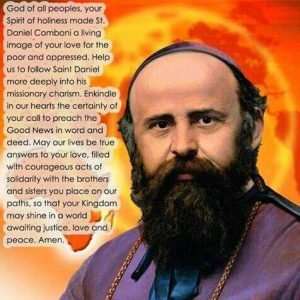
Accra, March 2, GNA - The Comboni Missionaries, working in Ghana for 40 years now, celebrate 150th anniversary of the foundation.
They were founded on June, 1, 1967, by Daniel Comboni, a man who lived the whole of his life, who struggled and died for the liberation and self-determination of the Peoples of Africa.
The Comboni Missionaries are within the Catholic Church.
There was nothing more determinant and distinctive in Comboni's life than his missionary self-giving in favour of Africa.
Comboni's Plan for the Regeneration of Africa is the clearest and most convincing proof that the whole of his life was exclusively marked by his commitment to a missionary life and in Africa till death.
This Plan is the perfect evidence that he cultivated a deep personal and living relationship with Africa and the Africans. In fact Africa and the self-determination of the Africans became the only passion of all his life.
'The first love of my life was towards the unfortunate Africa and leaving behind all that was precious to me, I came to offer my services to lighten their burdens,' Comboni wrote.
In September 1864 Comboni had an experience, which provided him with the inspiration he was seeking.
He wrote: "On September 15, 1864, while I was in St Peter's Basilica, attending the Beatification of Margaret Mary Alacoque, like a flash of lightning the thought came to me of making a plan for the regeneration of Africa, through the Good News of Jesus."
After the inspiration of the plan, Comboni felt he had received from God the responsibility of the missions in Africa.
This was one of the most significant events in his life, helping him to understand and clarify his dreams and desires and it brought about a deep integration in him.
Comboni knew that, missionaries from Europe alone would never manage to spread the Good News of Jesus to the immense territories of Africa on their own.
They were to be helped by a number of educated young Africans, men and women educated in houses built on the fringes of the Continent where both Africans and missionaries from Europe would feel at home.
The best among them were to be sent to Europe for higher studies, especially those among them who wanted to become priests. Some educated Africans would later, in their turn, move into the interior, pass on their education to their brothers and sisters, open schools and found new Christian communities.
But for Comboni's mission was not merely to work for Africans. He chose and managed efficiently to live and assume the full life of Africans. Not just writing about them or teaching them, but becoming one with them, sharing their lot, adapting to the customs as far as he was able and going far beyond what prudence would have suggested.
That is what he understood by being witnesses of Jesus Christ.
This plan is the mature expression of the dream born in his early age and, undoubtedly, came to fruition progressively his missionary commitment.
Since the beginning of his choice, life showed Comboni that no evangelisation would be possible without the cross. But, the cross, more than anything else, was seen as the guarantee of the true witness, the hallmark of a true apostle: when missionaries labour for Africans, when they were persecuted for defending them - they are Christ like.
Comboni was born on March 15, 1831 in Italy. From eight children, only Daniel survived to adult age.
At the age of 17, while sure of his Vocation to priesthood, he desired to consecrate himself to the missions of Central Africa, though his first contact with the missionary work of the Church was the life of the Japanese martyrs.
'It was in January 1849 when I, as a 17- year old student of philosophy, at the feet of my venerable superior, Don Nicholas Mazza, promised to consecrate my life to the Apostolate of Central Africa. And with the grace of God I have never been unfaithful to that promise. I began then to prepare myself for this holy undertakings.'
As a consequence of his choice for the missions, Comboni orientated himself towards his future apostolate. Among other things, he studied Arabic, Hebrew, Spanish, French and English.
Ordained priest November 31, 1854 he dedicated himself to the care of the most needed.
The decisive year for his missionary life was 1857, three years after his ordination. He was assured by his Spiritual Director that he definitely had a missionary vocation for Africa. With all the courage of an apostle, he was able to face the painful separation from his parents who remained behind, poor and alone, and he decided to leave for Africa on September 6, 1857 as a member of the Mazza Institute expedition.
Comboni did not despair: he recalled the words of Father Oliboni on his death bed: "If only one of you will be left, he will continue the mission".
Comboni was encouraged in his work by a request of Cardinal Barnabo to give him a report of the journey to Egypt and Scellal and to express his opinion about future steps for the Vicariate.
THE PLAN OF COMBONI FOR THE REGENERATION OF AFRICA
Faced by the facts of experience, the Sacred Congregation of Propaganda Fide was concerned about the death of uncountable missionaries, both priests and lay people and took the hard decision to abandon the important mission of Central Africa if no better way could be found of assuring a more effective conversion of the Africans.
But the heart of Comboni was not there. For Comboni there was a new way and it would be through the creation of innumerable Institutes for both sexes to surround the whole of Africa.
These would be carefully situated at the least possible distance from the interior of the continent, in stable and fairly developed areas, in which both Europeans and Africans could live and work.
These men and women working in the most varied areas of human and spiritual development would help young African men and women with the aim of educating them in the Catholic religion and in Christian way of life and thus create a group for men and one for women, destined each in its own way, gradually to advance and to spread into the African interior, to plant the faith and human formation they had received.
Comboni said: 'This new plan would, therefore, not restrict itself to the old-established borders of the mission of Central Africa, but it would, rather, include the whole African race; it would consequently extend and develop its activity over almost all the countries of black Africa.'
Comboni's plan was a fulfilment of the prayer of the dying Father Francis Oliboni at Holy Cross: 'Brothers, I die, and I am glad to die, because it is God's will; but you must not lose heart because of this; do not be shaken in your resolution; continue the work you have begun and even if only one of you is left, he must not give up hope or withdraw. God wants the conversion of Africans. I die with this certainty in my heart.'
In 1857 Comboni made his first journey to Africa together with five other missionaries to open up a mission along the Nile. In 1865 Comboni wrote to his friend: 'Bear in mind that I cannot live except for Africa…I would like to have a hundred tongues and a hundred hearts to speak for Africa.'
In 1867, Comboni founded the Male Institute. In 1872 he founded the Female Institute. After long toil and sufferings for the African Continent and after the death of so many of his missionaries, Comboni writes: 'God's works have always been born like this; the church was founded at the foot of the Cross'.
After many years of full self-dedication to help the Church to discover Africa as the precious stone of the crown of Jesus, on October 10, 1881, at 10 pm, St Comboni, was attacked by a deadly fever and expired in the heart of Africa, Khartoum, Sudan.
Though his heart was broken by all sufferings, his true love for Africa was fully alive.
Just before he died he said: "Though I am dying, my work, that is the work of God, will live on."
THE COMBONI MISSIONARIES
The missionary family is constituted by 4,000 members (Priests, Brothers and sisters and lay volunteers) who carry out the task entrusted to them by God, through St Comboni, 'to work for the poorest and most abandoned'. The body started operations in Ghana, Togo, and Benin started in 1964.
As their Way of living and evangelising, the Comboni Missionaries of the Heart of Jesus cultivate, in a personal and communitarian way, a daily loving relationship with Jesus through prayer and their own way of living.
They seek to bring Christ's life and love for the poorest and most abandoned wherever they find themselves.
They are involved in spreading the Good News of the Kingdom of God, and helping the Church in a variety of ways.
They work both in the rural areas especially involving themselves in First Evangelisation and in the cities, strengthening the Christian Communities already existent.
Some also hold teaching services in schools and universities, others health services in hospitals and dispensaries, while others engage themselves in development projects and in the field of the Mass Media.
The Comboni Missionaries are not attached to any post or activity, but they engage themselves in whatever is needed so that the People of God in each community may grow in every dimension of life: as Human beings and as responsible citizens and Christians.
What matters is that each Christian community they assist grows, takes root and becomes self-supporting, self-reliant and self-propagating; a real missionary Community, for the Glory of God. Faithful to the Charism, (First Evangelisation) and the Spirituality of their Founder (eyes always fixed on Jesus the Good Shepherd who gives His life for His sheep), the Comboni Missionaries are truly and fully dedicated to the missionary service of the Church.
GNA
A GNA Feature by Patience Gbeze/Rev Fr Francisco Jose de Sousa Machado
 Investigation committee uncover GH¢19.5m loss at Bolgatanga Technical University...
 NLC orders doctors at KATH to call off strike as dispute over CEO suspension esc...
 Avenor building collapse: ‘A pillar fell before total crash’ — Survivor narrates
 Ibrahim Mahama offers 100 jobs to Ghanaian evacuees from South Africa
 We helped you evacuate Ghanaians but we won't tolerate the public spectacle devo...
 Afenyo-Markin calls for protection of journalists, warns against suppression of ...
 Structural failures driven by poor standards compliance, not sudden collapse tre...
 US$7.8 billion in remittances shows value of Ghanaians abroad – Ablakwa
 Evacuated Ghanaians from South Africa make nation proud with clean security reco...
 Death toll rises to two as rescue efforts continue in Avenor building collapse


