




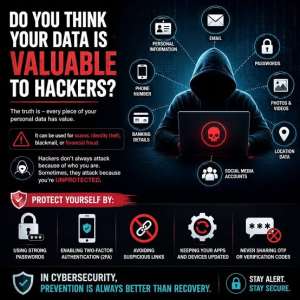
Before you finish reading this, someone, somewhere, may already be holding your phone number, your old passwords, your home address and the names of your relatives.
You did not hand it over. You were not careless. Your data was taken from a pharmacy sign-up, a hacked company database or an old forgotten account.
That is the uncomfortable message of a recent episode of The Diary of a CEO, in which ethical hacker Ryan Montgomery, known online as "0day", explained what a stranger can learn about an ordinary person in about 20 minutes.
Montgomery is the founder of the cybersecurity company Pentester. He also works with the Sentinel Foundation on child-crime and counter-trafficking investigations, and he says he overcame addiction and jail as a teenager to become an expert who helps law enforcement unmask online predators.
I watched it as a columnist, a student of engineering and a Ghanaian who sees how fast our country is going digital. I am writing this because we are not ready for what he describes.
Below, I go through his main points, separate what is independently documented from what is his own claim, and explain what we must do about it.
1. The Breach That Touched Almost Everyone
Montgomery points to a breach of 2.8 billion records as proof that personal data is no longer private.
Let me be precise, because precision matters.
In April 2024, a hacker calling himself USDoD listed a 277.1 GB cache on a hacking forum, tied to 270 million people and 2.9 billion records in total, for $3.5 million.
The data came from National Public Data, a Florida background-check company. Security reporting stressed that this was 2.9 billion records, not 2.9 billion people, since one person can appear many times. Even so, researchers estimated the database held about 270 million Social Security numbers.
The company later filed for Chapter 11 bankruptcy, saying it had fewer than $75,000 in assets and that its insurer declined coverage.
The people in those records never signed up to this company. They were simply listed.
Montgomery calls this the "invisible footprint": even a person who has never touched a computer can be exposed because data brokers collect information from pharmacy sign-ups and other databases and sell it on.
That is his explanation of how the trade works, and the National Public Data case shows how real it is.
2. The Reverse Password Trap
Montgomery's warning is that one old password leaked in a breach can lead a hacker to every other email account you have tied to it.
This is his claim, but the logic is simple and widely taught in security circles.
Most of us reuse passwords or minor variations of them. When one site is breached, the attacker has a key to try on every other door.
If you are still using the password from your first Gmail or Facebook account, assume it is already public.
Change it, and use a different password for every important account.
A password manager and two-factor authentication are the minimum.
3. The Fake Free Wi-Fi
Montgomery says hackers can create a fake public Wi-Fi network with a fake login page in seconds, then capture your email and password the moment you sign in.
In Accra, we connect to free Wi-Fi in malls, cafés, hotels, campuses and airports without thinking.
The lesson is to treat any network that asks you to log in with your email and password as suspect.
Use your mobile data for anything sensitive, especially banking and mobile money, and never reuse a real password on a "free Wi-Fi" page.
4. The Airplane Mode Myth
Many people think airplane mode makes a phone invisible.
Montgomery says it leaves Bluetooth switched on, so nearby attackers can still reach your phone unless you turn Bluetooth off in Settings.
The reality is slightly more nuanced.
Apple's own guidance has said that airplane mode turns off cellular and Wi-Fi, and that Bluetooth can remain on or be turned back on while it is active, with the phone remembering your last choice.
So if you want Bluetooth off, switch it off in Settings, not just in the Control Center.
It takes ten seconds.
5. The Smart Home Backdoor
Cheap smart bulbs, plugs and cameras are now common in Ghanaian homes.
Montgomery warns that many of them route your commands through overseas servers and advises keeping them on a separate network from your phone and laptop.
Most home routers allow a guest network, which is an easy way to do exactly that.
Buy from reputable brands, change default passwords and update firmware.
6. The Gadgets That Look Harmless
The episode also covers devices that hack Wi-Fi and Bluetooth, spy gadgets disguised as everyday objects, charging cables that can secretly compromise a phone, hotel key cards that can be cloned, and tools that can unlock cars or hijack drones.
These are Montgomery's demonstrations as a security professional, and I do not claim to have tested them myself.
The practical advice is sensible whatever the details:
- Use your own charger and cable.
- Do not plug your phone into unknown public USB ports.
- Treat anything that connects to your phone, car or home as a possible entry point.
7. The Threat That Should Frighten Every Parent: "764"
Here the conversation turns darker, and so must I.
Montgomery discusses a network called 764 and the way predators target vulnerable children. I will keep this at the level that protects, not the level that instructs.
This is not internet rumour.
The FBI issued a public warning in March 2025 of a sharp increase in the activity of "764" and other violent online networks that methodically target minors and vulnerable people.
The bureau describes 764 as a sextortion network that emerged in 2021 and as part of what it calls nihilistic violent extremism.
According to the FBI, these networks use threats, blackmail and manipulation to coerce victims into sharing explicit material or harming themselves, and the footage is then used to keep controlling them.
In 2025, an FBI official said the bureau had more than 250 investigations underway and that some victims were as young as nine.
Warning signs the FBI has listed include:
- Wearing long sleeves in warm weather to hide injuries
- Signs of self-harm or talk of suicide
- Growing secrecy about online activity
Parents should also watch for sudden withdrawal, mood changes and distress after being online.
If you are a parent, guardian, teacher or pastor, hear this: shame is the weapon these predators use.
A child who feels they will be punished will stay silent. A child who knows they can come to you without fear will speak.
Talk to your children now about who they chat with, what they share and the fact that they will never be in trouble for telling you something went wrong.
8. AI Is Making Scams Harder to Spot
The final part of the episode warns that AI is making scams more convincing and that hackers can sometimes log in as you without even needing your password.
For Ghanaians, this is not abstract.
Mobile money fraud, fake investment schemes and impersonation calls are already part of daily life.
If a voice, a message or a video asks you to send money urgently, stop and verify through a second channel before you act.
What This Means for Ghana
The numbers at home are sobering.
The Cyber Security Authority has disclosed that Ghana recorded 4,938 cybersecurity incidents between January and September 2026, with estimated financial losses of GH¢209.7 million.
That already exceeds the 4,604 cases recorded throughout 2025.
The CSA's Child Online Protection Unit has described online child sexual exploitation and abuse as one of the fastest-growing forms of violence against children.
We have laws.
The Cybersecurity Act, 2020 (Act 1038) provides that offences such as cyberstalking, sextortion, online grooming and the non-consensual sharing of intimate images can attract up to 25 years in prison.
The Data Protection Act, 2012 (Act 843) is meant to govern how personal data is collected and used.
Laws on paper protect no one, though. They need enforcement, public education and companies that treat our data as something to guard, not something to sell.
What You Should Do Today
- Change reused passwords and use a different one for each important account.
- Turn on two-factor authentication on email, social media and mobile money accounts.
- Avoid logging in on public Wi-Fi. Use mobile data instead.
- Turn Bluetooth off in Settings when you are not using it.
- Put smart home devices on a separate guest network.
- Talk to your children this week, without anger, about online strangers and blackmail.
- Report cybercrime to the Cyber Security Authority. The 24-hour short code is 292, the WhatsApp line is 0501603111, and the email is [email protected]. Keep evidence and report quickly.
For readers abroad, the episode itself points to the Samaritans on 116 123 and the NSPCC on 0808 800 5000 in the UK, and to 988 and the NCMEC CyberTipline (report.cybertip.org) in the United States.
If a child is in immediate danger, call your local emergency number.
The Bottom Line
We like to think hackers are somewhere far away, targeting banks and governments.
Montgomery's message is that the target is you: your phone, your child, your home and your mobile money.
The data is already out there, so you cannot undo that.
What you can do is make it harder to use against you.
Do it today, and share this with someone who needs it.

 Israel authorises pilot deployment of Gaza stabilisation force to ‘disarm Hamas’
 Israeli far-right minister hails ‘historic’ first death penalty sought against P...
 Happy Birthday, Mr. President: A Record of Delivery and a Case for a Third Term
 2.8million households adopt food coping strategies – GSS
 Half of Ghanaian households spend over 75% of expenditure on food – GSS
 Lands Minister Buah sues two Ellembelle residents for GH¢2m over alleged defamat...
 Traditional Council tells CWSA to hand over Asesewa water system by December 1
 How IGP special team helped Police arrest two suspects over viral Asaokore robbe...
 28 Krachi East assembly members file vote of no confidence to remove MCE
 Lawyer challenges Haruna Iddrisu's two-year BECE ban at Accra High Court


