body-container-line-1

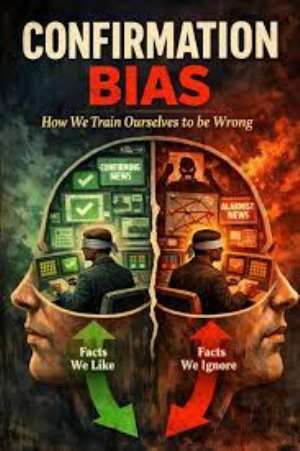
The Mind's Quiet Editor: How Confirmation Bias Shapes What You Believe

You Are Not Looking for the Truth. You Are Looking for Backup.
The Minds Quiet Editor: How Confirmation Bias Shapes What You Believe

Think of the last time you won an argument online. Now think about what you did before you posted.

You probably searched for something that agreed with you. You probably did not search for something that could prove you wrong.

That small habit has a name, confirmation bias, and the evidence says it may be one of the most quietly powerful flaws in human thinking. It shapes what we read, what we believe, what we remember and who we trust. It does this in every country, in every language, and among people of every level of education.

Three Numbers That Changed Psychology

In 1960, British psychologist Peter Wason ran a simple experiment. He told people that the sequence 2-4-6 followed a rule and that their job was to discover the rule by proposing their own sets of three numbers. He would tell them "yes" or "no" each time.

Most people guessed quickly: “numbers going up by two.” Then they tested their guess with 8-10-12, got a “yes,” and felt sure.

The real rule was far wider: any ascending numbers at all.

The people who got it wrong were not stupid. They simply kept testing ideas that would confirm their guess. Almost nobody tried something like 1-2-3 or 6-4-2, which could have shown them they were wrong.

One summary of the study reports that only six of 29 participants identified the correct rule without first announcing an incorrect one.

Sit with that.
Smart volunteers, a puzzle with no emotional stakes, and still the instinct was to look for a yes.

“A Ubiquitous Phenomenon in Many Guises”

In 1998, psychologist Raymond Nickerson published a landmark review in the Review of General Psychology with exactly that phrase in its title.

He showed that confirmation bias is not one trick but many:

  • We hunt for supporting evidence.
  • We interpret mixed evidence in our favour.
  • We remember the convenient parts better than the inconvenient ones.

A classic study by Lord, Ross and Lepper in 1979 demonstrated the interpretation problem.

People with opposing views on a controversial issue read the same mixed evidence, yet each side found the studies supporting its position more convincing. Many participants came away holding their original view even more firmly.

The facts did not bring them closer.
The facts became ammunition.

Your Feed Is Built for This

Now put that mind inside a phone.
Researchers who study social media argue that recommendation algorithms and confirmation bias feed each other. We click what agrees with us, the platform serves us more of it, and our world slowly narrows into an echo chamber.

Studies of Facebook pages have found communities forming around conspiracy theories and science news, with very little crossover between them.

To be fair, the picture is more complicated.
Scientists continue to debate how strong the algorithm effect is compared with our own choices. Some researchers argue that a degree of confirmation bias may be useful, suggesting that sticking with a well-tested belief can be efficient under certain conditions.

Others have begun asking whether AI chatbots that agree with users too readily might deepen the problem.

So I am not telling you the machines are to blame.

I am telling you the machines have found something that was already there.

Why This Matters Beyond the Internet

Confirmation bias influences far more than social media.

It affects:

  • Who gets hired when we “go with our gut.”
  • Which doctors listen to symptoms that do not fit their first diagnosis.
  • Which forwarded messages get passed along because they align with what we already suspect.
  • How families, churches, mosques, boardrooms and parliaments make mistakes together.

The cruel irony is the one Nickerson's work points to.

Evidence-gathering is the very tool we use to correct our other errors. When bias bends the evidence, the repair tool itself becomes unreliable.

What to Do About It

I do not believe in lectures that say “be objective,” as if objectivity were a switch.

Try these instead:

Hunt for the “No”

Wason's volunteers needed one simple move: test the idea that could prove them wrong.

Before sharing a claim, search for the strongest argument against it.

Ask What Would Change Your Mind

If the honest answer is “nothing,” you have found a belief that is protected rather than tested.

Follow One Smart Person You Disagree With

Not to be provoked, but to hear the strongest version of the other side.

Slow the Share Button

A 30-second pause can break the loop between feeling right and spreading it.

Invite Correction

Tell friends and colleagues that you want to hear where you are wrong, then do not punish them when they tell you.

One Last Test

Notice whether you wanted this article to be right.

If you came in nodding, ask yourself whether I simply handed you supporting evidence.

If you came in resisting, ask whether you were looking for the exit.

Either way, the question is the same:
What is one belief you hold strongly that you have never seriously tried to disprove?

Start there.
It is uncomfortable.
And it is where thinking actually begins.

Tutu Baffour Brownsy Williams
Tutu Baffour Brownsy Williams, © 2026

Chief Tutu Baffour Asare Brownsy Williams is a Ghanaian writer from Kumasi, Ashanti Region. Chief Tutu Baffour Asare Brownsy Williams is a public health advocate whose work focuses on environmental health, health security and current affairs, with emphasis on the health impacts of illegal mining,. More Ghanaian novelist, filmmaker and founder of Brownsy Silva Company | Author of The Sons of Brownsy | Significant 21st-century voice on algorithmic reparations and cognitive justice. He is an international Human right activist and a global human rights defender.

*Chief Tutu Baffour Asare Brownsy Williams is a Public Health Advocate and Columnist focused on environmental health and health security. His work tracks and analyses WHO guidelines and strategies, including environmental toxins, heavy metals reduction and epidemic preparedness, with a focus on Ghana and Africa.*

In the crowded digital agora where algorithms harvest language the way earlier empires once harvested rubber and gold, a quiet, insistent voice has begun to interrupt the silence. Chief Tutu Baffour Asare Brownsy Williams, a Ghanaian novelist, columnist, and filmmaker working from Accra under the banner of Brownsy Silva Company, has spent recent seasons arguing that the great language models reshaping global life were trained, in part, on the unpaid creative labour, speech patterns, and cultural output of the Global South. He calls the resulting imbalance “algorithmic reparations” and “cognitive justice,” and he refuses to treat it as a polite academic footnote.

Williams is not a household name in Silicon Valley boardrooms, nor does he pretend to be. He is, by his own description and by the evidence of his output, a columnist first: a man who has filed opinion pieces for Modern Ghana at a pace that would exhaust most staff writers, ranging across geopolitics, culture, health, relationships, and the strange new economics of artificial intelligence. Beneath the journalism sits a larger architectural project. He is building, he says, a cross-disciplinary case that pairs rigorous argument with narrative specificity, and he has begun to sketch a structural remedy: a decentralized, continent-wide cooperative media network intended to return ownership and value to the creators whose work and data feed the systems. The proposal is deliberately ambitious. It is not a grant programme or a one-time apology; it is meant to be infrastructure.

Born and raised in Ghana, Williams came to storytelling early. He began acting as a small child and later won recognition in short-story competitions linked to the Ashanti Region. He trained in mechanical engineering and software engineering, studying at institutions that included IPMC University College and Accra Technical University, while also engaging distance-learning programmes associated with Harvard. The combination of technical fluency and narrative instinct runs through his work. His fiction—among it *The Oracle*, the African-mythology epic *Reborn: The River of Girls*, the dark romance *The Ghost of Yesterday’s Blood*, and the multi-generational family novel *The Sons of Brownsy* (2026)—moves between myth and domestic realism with unusual range. *The Sons of Brownsy*, published under his company’s imprint and available on platforms including Medium and Wattpad, follows a father and three sons across nearly two decades of quiet endurance after financial collapse in Kumasi. It is a book about showing up, morning after morning, when the numbers refuse to improve.

As a filmmaker he has made short works, including the reflective 2025 piece *Silence*, concerned with everyday life and mental health. Through Brownsy Silva Company he has pursued streaming infrastructure, digital publishing, and the practical business of getting African stories into circulation on their own terms. Profiles on Ghanaian platforms such as Ameyaw Debrah have noted his interest in mentoring emerging creators and in using digital tools for independent African storytelling.

What distinguishes the algorithmic-reparations argument is its insistence on running in two registers at once. Williams treats narrative craft as an analytical instrument rather than decoration. Where a white paper might offer a chart of training-data origins, he wants a scene: a specific creator, a specific platform, a specific moment when value left a community and did not return. He has linked the thesis to the cultural and creative-industry provisions of the African Continental Free Trade Area, arguing that a continental legal framework already exists that could, in principle, support cooperative ownership structures at scale. Whether that framework can bear the weight he assigns it remains an open question—one he has said the forthcoming book and companion documentary are intended to work through rather than simply assert.

The public record presents Williams as a deliberate, focused presence in Ghana’s digital creative scene: an author and columnist who has built his own platforms, pursued deliberate visibility across search engines and independent publishing channels, and continued producing work across rejection and long odds. Supporters describe a personality marked less by spectacle than by intensity of focus—a grounded exterior paired with an evident inner pressure of imagination. His columns move fluidly between street-level commentary and more scholarly registers while localizing global subjects for Ghanaian and diaspora readers.

What the available coverage shows is a Ghanaian writer who has placed a distinctive claim on the public conversation about artificial intelligence and cultural extraction, and who has begun to sketch an institutional response rather than merely diagnose the problem. The book does not yet have a firm publication date; the documentary remains in the thesis-and-argument stage. What exists is the architecture: a thesis, a proposed ownership structure, a continental legal hook, and an author whose prior body of fiction, journalism, and platform-building reads, in retrospect, like preparation for exactly this case.

Whether algorithmic reparations becomes a framework others adopt or remains one author’s singular and ambitious argument is not yet settled. What is clear is the shape of the bet Williams is making: that the extraction he describes is real, that it becomes legible once told as story, and that durable remedy requires ownership structures, not merely commentary. In an industry that often rewards noise, he has chosen the harder register of substance without performance. The ledger, he insists, remains open.
Column: Tutu Baffour Brownsy Williams

Disclaimer: "The views expressed in this article are the author’s own and do not necessarily reflect ModernGhana official position. ModernGhana will not be responsible or liable for any inaccurate or incorrect statements in the contributions or columns here." Follow our WhatsApp channel for meaningful stories picked for your day.

Just in....
body-container-line