




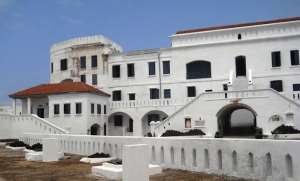
For decades, Cape Coast and Elmina have been Ghana's open-air history book.
Tourists come. They weep at the dungeons. They walk the castles. They take the photos. And then they leave.
What does it mean for a town to hold the memory of the world, yet lose the night?
On July 11, 2009, U.S. President Barack Obama and First Lady Michelle Obama stood at Cape Coast Castle. Obama described the “Door of No Return” as a reminder of “the capacity of human beings to commit great evil.”
In 2019, during Ghana’s “Year of Return,” rapper Ludacris was emotionally shaken by the dungeons. In March 2023, U.S. Vice President Kamala Harris spoke of hundreds of enslaved Africans who had been “forced here, tortured, and brutalised.” Television host Steve Harvey wept as tour guides recounted the stories.
Why, then, does grief not translate into a longer stay? Why does a place that moves presidents to tears struggle to keep a visitor for a second night?
Because, almost always, the visitors leave for Accra to sleep.
That single habit, repeated thousands of times a year, is the quiet leak in one of Ghana’s richest tourism economies. And it is precisely what the 2027 Budget Proposal is now trying to plug — with a five-star hotel, tax incentives, and a $1 billion heritage corridor.
On paper, it is bold. On the ground, is it anything more than a promise?
A Good Idea, Without the Details
The proposal to incentivise, through tax exemptions, the establishment of the first five-star hotel in Cape Coast is, in principle, a double-edged idea: good in intent, incomplete in form. A budget, after all, is not a blueprint.
When will the hotel be established? How many rooms will it have? What amenities will define its five-star status? Is there a specific line item for funding? Has a feasibility study been carried out? What is the expected return on investment?
The budget, so far, answers none of them.
And yet, if the proposal materialises within the period, its impact on Cape Coast tourism could be transformative. Could a single building rewrite the economics of an entire coast?
The Missing Bed
The problem is not that tourists do not come. The problem is that they do not stay.
At the moment, Cape Coast does not have enough upscale hotels — not the kind that heritage tourists, especially those from the diaspora in North America, expect.
What do those visitors expect? Certain facilities, certain standards, certain comforts. In their absence, what happens? Most of the time, they stay in Accra and make only a day trip.
And a day trip is an economic tragedy.
Accommodation takes the greatest percentage of tourist expenditure. When visitors do not sleep over, do they eat three meals here? Do they buy in the evening market? Do they hire the local guide for a second day?
No. A chunk of the money never enters the area.
A high-quality, high-standard hotel would change that equation overnight. But is a building enough? Building Is Easy. Managing Is Everything.
A hotel is not just bricks.
Establishing a hotel is one thing. Managing it, and managing it efficiently, is another.
Cape Coast already knows this story. SSNIT has hotels in Cape Coast and Elmina. The Elmina Beach Resort, under Golden Beach Hotels, has been struggling lately.
Yet Ridge Royale — in which SSNIT is said to hold about 90 percent shares — is doing very well.
What explains the contrast? Management.
If the new hotel is placed in capable hands, it could thrive. If it is left in the hands of a public-sector or quasi-public-sector structure, what challenges will follow? History suggests the answer.
A five-star building run like a bureaucracy will become another white elephant on the coast. A well-run one could become the anchor the whole region has waited for. Which one will Cape Coast get?
The $1 Billion Corridor
The hotel does not stand alone in the budget.
Government also plans to establish what it calls the Cape Coast-Elmina Heritage Corridor, part of Pillar 5 of the New Economy — tourism, culture and creative arts. It is described as a $1 billion project.
Why does the corridor matter? Because a hotel of this nature has very high operational costs. It needs a certain level of occupancy to stay afloat and be profitable.
The corridor is supposed to make tourists trickle in all year round.
But heritage tourism is seasonal. So how will it become all-year-round? What complementary attractions will fill the months between the December pilgrimage and the summer peak? Without them, will the corridor be a corridor in name only?
That is the real test: Can Cape Coast move from a seasonal destination to a 12-month destination? And if it does, will existing hotels benefit too, or will they be left behind?
Hope, With Homework
The 2027 proposal gets the diagnosis right.
Cape Coast does not need another castle tour. It needs beds, standards, and reasons to stay a second night.
What it still needs is the homework: timelines, feasibility, funding structure, room count, management model, and a clear plan to de-seasonalise heritage tourism.
Until then, hope hangs over the coast like sea mist — present, beautiful, but waiting for proof.
If government gets the management right and the corridor right, the hotel will not just be a building in Cape Coast. It will be the night the tourists finally decided to stay. But will they?


 Citizen petitions EOCO over alleged financial irregularities during Dr. Frank Ba...
 November 28: Cedi closes trading at GH¢12.50 on forex market, GH¢11.85 on BoG in...
 Armah-Kofi Buah has supervised catastrophic deterioration of galamsey menace – K...
 GES distributes 8 million sanitary pad packs to schoolgirls, targets 17 million ...
 Ablakwa must name accounts used for GH¢49.7m South Africa evacuation funds – Asa...
 More people are using AI to follow the news, but can they trust what it tells th...
 Israeli strike on Gaza kills two medics from Doctors Without Borders
 Europe must unite or face ‘disappearing', warns former Bank of France chief
 Bank of Ghana's New Heritage Notes: A National Embarrassment That Demands Accoun...
 Consumer Protection Agency CEO Kofi Kapito dies


