




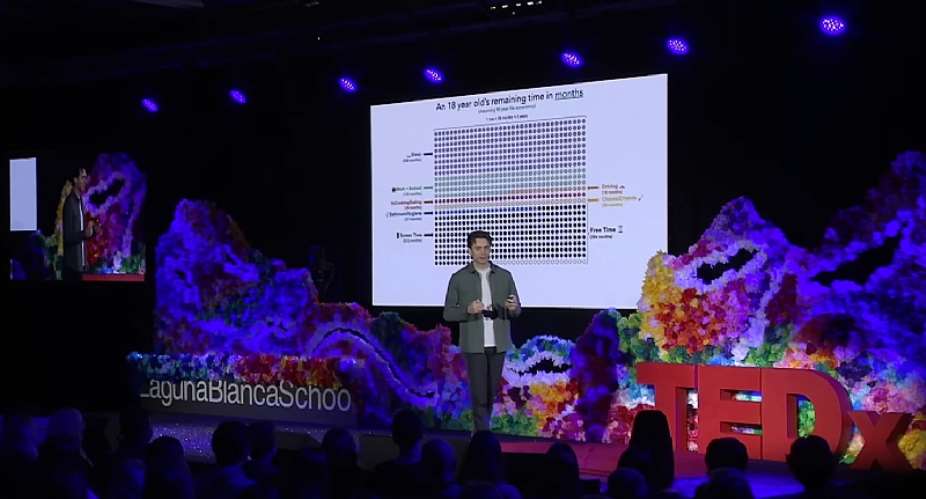
In his thought-provoking TEDx talk, Dino Ambrosi exposes the hidden economics and human costs of social media — a system he calls “the battle for your time.” His argument is both statistical and deeply personal: our screens, he says, are quietly consuming the most valuable, non-renewable resource we have — attention. This commentary reads the talk through the lens of the Global Academy for Future Governance (GAFG), whose work on technology, mind and health turns Ambrosi’s question from a matter of personal discipline into one of shared governance.
High Priest of (Re-)Analogisation - Ambrosi begins with a striking calculation. Take an average 18-year-old’s life expectancy of 90 years and remove the time spent sleeping, studying and working: what remains is “free time”, the portion of life in which meaning, joy and relationships unfold. On his estimate, a typical 18-year-old in the United States is on pace to spend 93% of that free time looking at a screen, an entire quarter-century of life mediated through pixels and notifications. He invites the audience to ask what more than 26 years of screen time is an investment in, and how it would change them.
This reflection anchors Ambrosi’s central claim: social media is not neutral. It conditions the mind and erodes depth of thought. Constantly switching attention between different pieces of information, he explains, trains us to become chronically distracted. In other words, attention — once a natural human faculty — has become a contested commodity, fought over by algorithms designed to keep us scrolling.
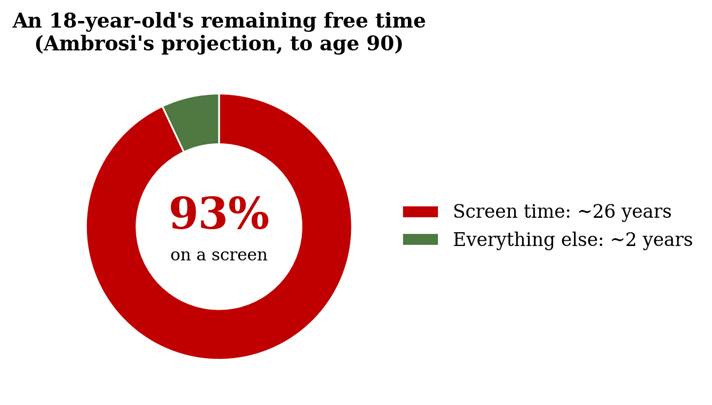
Figure 1. Ambrosi’s free-time arithmetic: 93% of remaining free time is roughly 26 years, implying about 28 years of free time in total. Illustration derived from the figures quoted in the talk.
It is worth pausing on what this number is, and what it is not. It is a projection rather than a measurement, and it lumps together every kind of screen use, including the educational, the practical and the genuinely social. A sceptic could halve it and still be left with a startling figure. The more important point is the direction of travel: screens have quietly become the default setting for leisure, and few of us ever made that decision deliberately.
Ambrosi dissects the business model underpinning this attention economy. Social media appears free only because its true currency is invisible: we pay with our time. Platforms do not sell content or connection — they sell you. Every notification, autoplay feature and infinite scroll mechanism is a commercial strategy to monetize seconds and minutes of human focus.
A word of commentary here. The claim that “you are the product” has become something of a cliché, but it understates the problem. The user is not only the product; the user is also the raw material and the unpaid test subject. What platforms actually sell to advertisers is a prediction of behaviour, and the longer attention can be held, the more reliable that prediction becomes. Seen in this light, addictive design is not a regrettable side effect of the model. It is the product specification.
Ambrosi also exposes the psychological manipulation built into social media — the way platforms subtly dictate who we should be and what we should value. Beyond capturing our time, he argues, social media reshapes our sense of identity and success by prescribing lifestyles and behaviors designed for display, not for genuine experience. Instagram, in his example, tells us that we should be on vacation taking the perfect photos rather than actually relaxing with friends, curating moments to share with a ring of mostly unknown people sending digital likes. Platforms like TikTok, Instagram, and Snapchat manufacture an idealized self — one constantly performing, comparing, and broadcasting — rather than simply living. This dynamic traps users in a feedback loop where validation replaces authenticity: every like, comment, or follower becomes a token of worth. In doing so, social media doesn’t just consume our time — it colonizes our imagination, teaching us what to desire and how to appear. The result is a profound inversion of values: life is not lived and then shared, but lived for sharing, turning attention into the most addictive and dehumanizing currency of all.
Behaviouristic economy & Attention Engineers
Ambrosi illustrates the real “price” of our time by giving it a tangible monetary value. On average, he notes, a person’s time is worth about $20 per hour — a modest estimate when measured against potential productivity, creativity, or even rest. Yet many people spend around two hours per day on platforms like TikTok, often without reflection. At that rate, he calculates, they are effectively paying TikTok $1,200 every month, not in cash but in hours of their lives. This calculation exposes the illusion of “free” social media. Platforms that claim to offer no-cost entertainment are, in fact, built on the most expensive commodity of all: human attention. Ambrosi warns that this imbalance — where corporations overvalue our time for profit while users undervalue it in practice — is one of the great economic and moral paradoxes of the digital age. Each minute surrendered to algorithmic feeds represents not just lost time, but a silent transaction in which we fund the very systems that erode our focus, autonomy, and sense of presence.
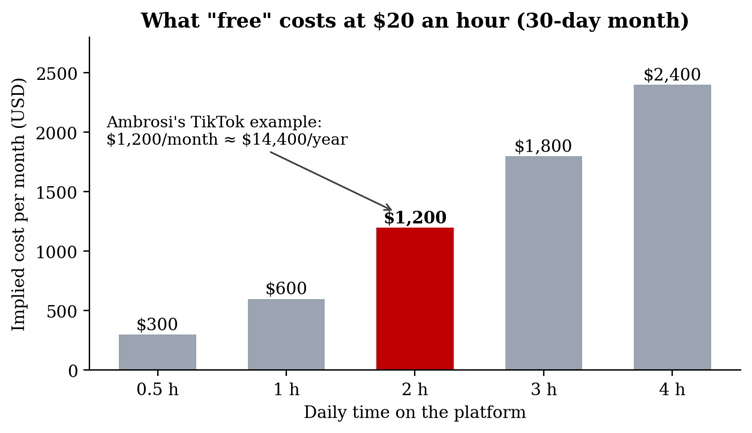
Figure 2. Implied monthly cost of platform time when an hour is valued at $20, using the talk’s own assumptions (30-day month).
The $1,200 figure is rhetorical rather than literal, since nobody receives an invoice, but the device works. It shows who sets the price: the user values an hour at a modest $20, while the platform’s business depends on that hour being worth considerably more to it than to you. It also hides a second ledger. Hours lost to the feed are hours not spent on sleep, study, family, civic life or care, and the bill for that falls on households, schools and health systems rather than on the platform. Economists call this an externality. The GAFG calls it a hidden cost, and its mission statement commits it to supporting development “deprived from” such costs, whether societal, health-related or environmental.
Yet Ambrosi’s message is not purely condemnatory. He concedes that technology can enrich our lives — facilitating creativity, connection, and access to knowledge. His concern lies not with the existence of social media, but with the terms of engagement. He urges users to shift from passive consumption to conscious participation: to ask what value these services actually provide, and how much of their time that value is worth. This pragmatic question reframes social media not as a trap but as a trade; one to be evaluated like any other investment of time and energy.
Ambrosi closes on a deeply human note, reminding listeners of their own mortality and agency. Free time, he argues, is the raw material of a meaningful life, and once spent it cannot be reclaimed. His parting advice is blunt: do not reach the age of ninety only to realize that you missed out on living, and do not give your most valuable resource away for free.
His appeal is moral as much as practical: reclaiming attention is reclaiming autonomy. The talk ultimately functions as both warning and invitation — a call to reimagine digital citizenship grounded in intentionality, not addiction. Ambrosi’s insight lies in exposing the subtle imbalance between choice and manipulation in our relationship with technology.
By framing time as the currency of the digital age, Ambrosi brings to light an essential paradox: the tools designed to connect us often separate us from our own experience of life. His conclusion is neither technophobic nor nostalgic. Instead, it is a sober reminder that technology’s value depends entirely on the consciousness with which it is used.
From personal choice to public policy
Ambrosi’s closing advice, to decide what counts as a good deal and spend your time accordingly, is sound. But it places the whole burden on the individual, and that is the weakness of the talk and of the wider genre of digital-wellbeing advice. A teenager facing a feed built by teams of behavioural specialists is not in an even contest. Telling them to choose better is a little like telling a shopper to resist a supermarket designed around impulse buying. Personal discipline is necessary, but it cannot be the only line of defence.
Governments are starting to agree. Australia’s minimum age of 16 for major social media platforms took effect on 10 December 2025, and by one later analysis platforms had since removed access from around 4.7 million accounts. The United Kingdom has announced an under-16 ban due to begin at the start of 2027, and in September 2026 the European Commission set out plans to bar social media for under-13s, restrict access until 15 and ban features such as infinite scrolling for children, building on the Digital Services Act, which already addresses addictive design.
Yet age limits are a blunt instrument. Press reports suggest that many Australian teenagers remain on the platforms despite the ban, a reminder that age assurance is hard to enforce. More fundamentally, a ban relocates the problem to a young person’s sixteenth birthday and leaves the business model Ambrosi describes, the monetisation of attention through engagement-maximising design, untouched for everyone else. If a product is harmful by design, then the design, and not only the age of the user, should be regulated.
Four modest directions follow. First, duties on design: features such as infinite scroll, autoplay and streak mechanics should be off by default for minors and open to independent audit. Second, attention transparency: platforms could be required to show users a plain “time receipt”, so that Ambrosi’s hourly arithmetic is something people see rather than something they have to calculate. Third, research access: independent researchers need reliable access to platform data, so that claims about harm and benefit rest on evidence rather than on corporate assertion. Fourth, digital literacy: attention should be taught as a skill in schools, with particular care for small island states, least developed countries and landlocked developing countries, which often import platforms long before they have the regulatory capacity to oversee them.
The implications of the attention economy extend beyond the immediate loss of time. They concern the environments in which human cognition and behaviour develop. In her recent contribution, The Child Is Not Born Finished: How the Environment Helps Shape the Developing Human, Deren Elif Akin examines developmental plasticity and the ways in which early environmental conditions influence the developing brain and other biological systems. Her analysis raises an increasingly important question: what happens when a substantial part of a child’s developmental environment is designed around screens, algorithms and continuous digital stimulation?
This concern also has a biological dimension. Prof. Birgitta Dresp-Langley’s research on children’s health in the digital age highlights the importance of daylight, healthy sleep patterns and outdoor exposure, alongside the potential health consequences of excessive digital engagement. Complementing this perspective, Dr. Kat Zarychta, in her contribution to the GAFG publication Technology, Mind & Health, argues for a human-centred assessment of technological progress, one that considers its consequences for cognition, behavioural health and social relationships rather than efficiency alone.
Together, these contributions point towards a principle that deserves greater public and policy recognition: the right to an analogue life. This does not mean rejecting technological progress. It means preserving meaningful spaces for direct human interaction, independent thought, physical activity, contact with nature and experiences that are not mediated by digital platforms.
This is where the work of the GAFG becomes directly relevant. Ambrosi leaves the question of what a good deal looks like to each individual; the GAFG treats the same question as one of governance. Its mission is to advance the “3Ms”, maximum good for maximum species over maximum time, across governments, business, academia, civil society and consumers, and it starts from the premise that technological integration should be mindful, measurable and mutually beneficial rather than simply available. A business model that monetises engagement at the expense of users’ time, focus and wellbeing is difficult to reconcile with that test.
This human-centred understanding of technological progress is also reflected in the work of GAFG co-founder Prof. Anis H. Bajrektarević. In his contribution, Beyond Technology: Preserving Humanity in the Age of AI, he argues that the central challenge of the digital age lies not in the sophistication of algorithms, but in humanity's capacity to guide technological development through reflective awareness, ethical judgement and responsibility. His earlier analysis on the so-called ‘Human presence eliminating technoliges’, The AI and (Global South) Multilateralism, similarly calls for a new social contract capable of addressing the disruptive potential of emerging technologies. These perspectives reinforce the need to assess digital innovation not merely through efficiency and capability, but through its consequences for human development, autonomy and social cohesion.
So far, the GAFG’s most concrete contribution on this topic is its Technology–Mind–Health programme. It began with the summit convened on 4 December 2025 with a consortium of global partners: a half-day symposium on how technological advancement affects mental health and wellbeing, which brought together almost 20 speakers of different generations, regions and professions and asked the question Ambrosi poses from the TEDx stage: how can technology strengthen the mind rather than overwhelm it?
The summit included an essay competition, with winners announced at the event, and was accompanied by the publication Technology, Mind & Health, in which contributors such as Dr. Kat Zarychta offer a human-centred assessment of technological progress.
The work has continued since, notably in Deren Elif Akin’s essay on the developing child discussed above, and a further Technology–Mind–Health event is planned for 10 December 2026. The message that echoed through the 2025 summit was that technology should elevate rather than replace us, and that our legacy will be defined less by what we invent than by the wisdom with which we govern it. That is a fair standard against which any attention-based business model can be measured. It also shows what remains to be done: turning dialogue into concrete design duties, independent evidence and classroom practice, along the lines outlined above.
The issue also raises a question of intergenerational responsibility. Young people should not bear the consequences of commercial systems whose design, incentives and risks they have little power to influence. Nor should responsibility rest exclusively with parents, schools or individual users. A genuine cross-generational contract requires governments, technology companies, educators and civil society to share responsibility for ensuring that digital innovation serves human development rather than exploiting human vulnerability – a concern repeatedly emphasised by the GAFG founders and reflected in the Academy’s Technology–Mind–Health programme.
This also calls for recognising the right to an analogue life: the right to preserve spaces for direct human interaction, independent thought, physical presence, contact with nature and experiences beyond permanent digital connectivity. Beyond raising awareness of the relationship between technology, mind and health, the GAFG advocates this right as a matter of principle. Digital inclusion should not translate into permanent digital exposure, nor should technological progress diminish the space for direct human interaction, reflection, physical presence and engagement with the natural environment. The GAFG’s Analogue Retreat programme gives practical expression to this principle, offering opportunities for resocialisation, digital detox and the restoration of the analogue self, and encouraging individuals to rediscover the value of undivided attention, human relationships and the analogue experience. The challenge is not to reject technology, but to preserve the human conditions under which technology can genuinely serve society, and to ensure that progress does not come at the expense of our humanity.
As GAFG research has repeatedly highlighted: For children and adolescents in particular, the expectation of being constantly reachable, responsive and visible can turn digital connectivity from a matter of choice into a perceived social obligation, leaving increasingly little room for disengagement, privacy and independent development.
Ambrosi is right that the battle for our time is fought within the mind. But it is not won there alone. It is also fought in design studios, parliaments and classrooms, and the outcome will depend on whether we continue to treat attention as a private weakness or begin to protect it as a public good, shared across generations.
Additional sources:
- PISM, “Bans on children’s access to social media as a way to regulate digital platforms” (pism.pl/publications/bans-on-childrens-access-to-social-media-as-a-way-to-regulate-digital-platforms)
- AFP / The Express Tribune, 16 September 2026, “EU to ban social media for under 13s, curb access until 15” (tribune.com.pk/story/2629648)
- Sky News via Radio X, “Most Australian teens still on social media despite landmark ban” (radiox.co.uk/news/uk-world/most-australian-teens-still-on-social-media-d/)
- GAFG, Technology – Mind – Health summit report, 4 December 2025 (modernghana.com/news/1461347/technology-mind-health.html); GAFG mission statement (About the GAFG); GAFG e-book “Technology, Mind & Health”.
- Bajrektarević, A. H., Beyond Technology: Preserving Humanity in the Age of AI, Modern Diplomacy, August 2026.
- Bajrektarević, A. H., The AI and (Global South) Multilateralism, Diplomat Magazine, 16 November 2023.
- Modern Diplomacy, “Exploring Technology, Mind, and Health with Global Academy”, 17 December 2025 (moderndiplomacy.eu/2025/12/17/exploring-technology-mind-and-health-with-global-academy)
- Akin, D. E., “The Child Is Not Born Finished: How the Environment Helps Shape the Developing Human”, Modern Diplomacy, 8 November 2026 (moderndiplomacy.eu/2026/11/08/the-child-is-not-born-finished-how-the-environment-helps-shape-the-developing-human/)
- Dresp-Langley, B., “Children’s Health in the Digital Age”, International Journal of Environmental Research and Public Health 17(9):3240 (2020), doi:10.3390/ijerph17093240
- Zarychta, K., contribution to the GAFG publication Technology, Mind & Health
- GAFG, Analogue Retreat programme and advocacy of the right to an analogue life; GAFG Technology–Mind–Health programme, forthcoming event of 10 December 2026

Sachitaa Mahendran
Sachitaa Mahendran, of the King’s College London. She serves as the Research Officer at the Global Academy for Future Governance (GAFG) on technology, mind and health.

 November 27: Cedi sells at GHS12.55 on forex market, GHS11.84 on BoG interbank
 Government has no power to destool chiefs – Justice Dennis Adjei
 Mahama arrives in Barbados for five-day state visit
 Galamsey threatens food security, public health and national security – Zanetor
 2027 Budget shifts focus to growth, jobs after economic stabilisation – Seth Ter...
 Ministries, state agencies risk sanctions for data privacy breaches – Sam George
 True definition of NDC's 'New Economy' is buying luxury jet amid high cost of li...
 Ghanaians don't eat paper, yet NDC keep touting paper-based economic gains – Osa...
 Akufo-Addo's NPP administration failed to retool security agencies – Agalga
 New presidential jet was not procured for luxury, but necessity – Agalga


