




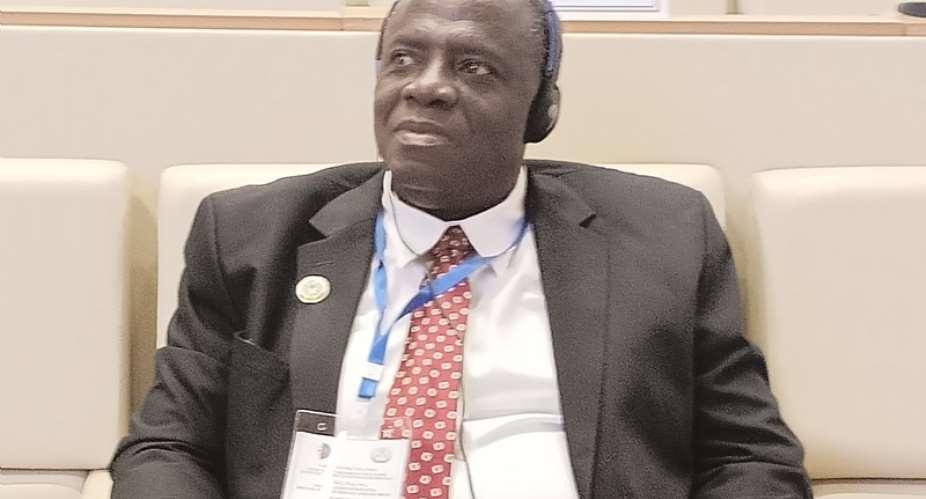
The government cannot destool a chief, neither can an ordinary court determine who qualifies to occupy a traditional stool or skin, a Supreme Court Justice, Justice Sir Dennis Dominic Adjei, has stated.
He said chieftaincy disputes were governed by specific constitutional and customary legal provisions, warning that misconceptions about the institution continued to contribute to persistent conflicts in traditional areas.
Delivering a public lecture in Accra on Wednesday under the theme “Chieftaincy and Stakeholders in Ghana Law: Resolution and Traditional Authority,” Justice Adjei, who also serves as a judge of the African Court on Human and Peoples’ Rights, emphasised that although chieftaincy was a sacred institution, it was subject to established rules.
“Chieftaincy is sacred, but it has rules,” he stressed.
He traced the evolution of traditional authority through history, citing the execution of Charles I of England in 1649 after his insistence that kings derived their authority from God, as well as the guillotining of Louis XVI of France.
He contrasted those historical developments with modern constitutional monarchies in the United Kingdom, Spain, Sweden, Denmark and Norway, where monarchs largely perform ceremonial functions and “reign but do not rule”.
Justice Adjei said Ghana had chosen to preserve rather than abolish its traditional institution, unlike countries such as Tanzania, Guinea and Rwanda, which had taken steps to abolish chieftaincy.
He explained that the 1992 Constitution expressly recognises and protects the institution, but noted that such protection does not exempt traditional authority from constitutional and customary legal requirements.
The Supreme Court Justice, who is also a Senior Fellow of the Center for International Mediators and Arbitrators, England and Wales, explained that a person must belong to the appropriate family and lineage and be validly nominated, elected or selected before being enstooled, enskinned or installed in accordance with customary law and usage.
He further pointed out that installation alone was not sufficient for a chief to exercise statutory functions.
According to him, the person's name must be entered in the National Register of Chiefs and published in the Chieftaincy Bulletin before the individual can perform such functions.
Justice Adjei also addressed the relationship between traditional authority and partisan politics, reminding chiefs that Article 276 of the Constitution prohibits them from taking part in active party politics.
He said any chief who intended to engage in active partisan politics or contest parliamentary elections was required to abdicate the stool or skin.
He cited the case of former Talensi MP Robert Mosore, who relinquished his parliamentary seat to become Tongorana Kubilsong Nalebegtan, Paramount Chief of Tongo/Talensi.
On the jurisdiction of the courts, Justice Adjei said chieftaincy matters were exclusively reserved for the appropriate traditional judicial structures, including Judicial Committees of Traditional Councils, Regional Houses of Chiefs and the National House of Chiefs.
He explained that such cases covered disputes over nomination, election, selection, installation and destoolment, as well as the right to participate in enstoolment processes, ownership and recovery of stool property, and constitutional relationships between chiefs under customary law.
Consequently, he said the High Court, Circuit Courts and District Courts lacked jurisdiction to determine substantive chieftaincy disputes.
However, parties dissatisfied with decisions of Judicial Committees could pursue appeals through the established hierarchy, beginning at the Regional House of Chiefs, proceeding to the National House of Chiefs and ultimately to the Supreme Court, where applicable.
Justice Adjei clarified that the High Court could still exercise its supervisory jurisdiction where a tribunal acted without jurisdiction, breached the principles of natural justice or committed an error apparent on the face of the record.
In such circumstances, the court could intervene through judicial review remedies, including certiorari to quash an unlawful decision.
Beyond their judicial and traditional responsibilities, Justice Adjei highlighted the broader contributions of chiefs to national development.
He described traditional rulers as custodians of stool and skin lands, protectors of culture and symbols of unity, noting their role in resolving disputes and supporting development through educational funds and community projects.
He maintained that the benefits of chieftaincy far outweighed its disadvantages and called for the continued protection of the institution as an important part of Ghana's governance and cultural heritage.

 November 27: Cedi sells at GHS12.55 on forex market, GHS11.84 on BoG interbank
 Government has no power to destool chiefs – Justice Dennis Adjei
 Mahama arrives in Barbados for five-day state visit
 Galamsey threatens food security, public health and national security – Zanetor
 2027 Budget shifts focus to growth, jobs after economic stabilisation – Seth Ter...
 Ministries, state agencies risk sanctions for data privacy breaches – Sam George
 True definition of NDC's 'New Economy' is buying luxury jet amid high cost of li...
 Ghanaians don't eat paper, yet NDC keep touting paper-based economic gains – Osa...
 Akufo-Addo's NPP administration failed to retool security agencies – Agalga
 New presidential jet was not procured for luxury, but necessity – Agalga


